

While the children played interactive games with the robot, a group of researchers led by UNBC Computer Science Assistant Professor Dr. Shruti Chandra monitored the interactions in the background. The central question Dr. Chandra and her team were seeking to answer was how children interact with robots when they are placed in real, everyday learning environments.
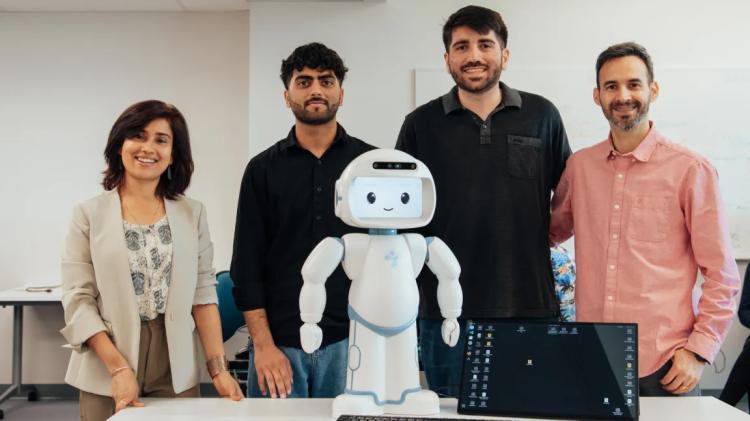
From left, Computer Science Assistant Professor Dr. Shruti Chandra, undergraduate student Piyush Daryanani, master's student Ramin Kupaei and Human-Centered Design Instructor Gerardo Chavez Castaneada pose with the QTrobot in a classroom.
Most prior research in child-robot interaction relied on controlled or laboratory studies. These studies are useful for early validation, but they do not reflect natural classroom environments where children move, talk, lose interest, get excited and influence one another.
"Children behave differently outside the lab, and technologies that perform well under controlled conditions may not translate effectively into everyday use," she explains.
Dr. Chandra published the results of her research at the 21st Association for Computing Machinery/Institute of Electrical and Electronics Engineers International Conference on Human-Robot Interaction in a paper titled Social robots on the loose: Supporting children's independent learning in the wild along with five student co-authors.
To conduct the experiment, Dr. Chandra worked with the UNBC Active Minds summer camp team to integrate the social robots into camp programming. For many children in the camp, this would be their first experience interacting with a social robot.
"Summer camps provide a wonderful opportunity to test and validate these systems because children from diverse backgrounds attend, they use the system for several days and provide feedback to improve it," Dr. Chandra says. "We designed the robot system in a way that can be deployed in summer camp classrooms in the wild without any technical or adult supervision, so it was a perfect venue for us to technically evaluate these systems and study children's perspectives."
The study ran over two months across seven summer camps, each lasting three to five days. In total, about 150 children aged six to 12 interacted with a humanoid robot through ten game-based learning activities tailored to their developmental stages.
The research showed that autonomous social robots can be integrated into classroom settings and are generally well accepted by children, while also revealing age-specific differences in engagement and perception, as well as practical challenges related to attention, timing and technical robustness in real-world use.
A key strength of the project was its student research team.
Graduate student Ramin Kupaei led the development and coordination of the system, supported by undergraduate students Piyush Daryanani, Mohammad Olaniyan and Anupriya Shaju. Together, they helped design, deploy and evaluate a system that moved beyond simulation and into children's learning environments.
They also co-authored the paper with Dr. Chandra, giving them first-hand experience in how academic papers are produced. Kupaei says the research opened his eyes to the potential of social robots and how they can help children and educators.
"It taught me to work effectively as a team member and showed me that hard work always pays off," Kupaei says "Through this research, I was able to connect with researchers from all over the world and exchange thoughts and experiences, a very great and rare opportunity."
Building on the success of last summer's field study, Dr. Chandra and her team are returning this summer to investigate how tangible, embodied interactions with social robots can create richer and more engaging learning experiences for children. Inspired by her recent publication, Beyond Screens: A Tangible and Embodied Educational Framework for Child-Robot Interaction, the new research explores how moving beyond traditional screen-based activities can better support children's learning through physical interaction with robots.
For more information

3333 University Way
Prince George British Columbia
Canada V2N 4Z9
www.unbc.ca