

Many people know lacrosse as Canada's official summer sport, but what they may not realize is that the game has been played for centuries by Indigenous Peoples across Turtle Island (North America) and has roots on this land that reach far beyond Canada's establishment as a country.
More than a sport, lacrosse, traditionally known as baggataway or tewaarathon, carries deep cultural and spiritual significance, and is often referred to as the Creator's Game because of its connections to community, healing, ceremony, and identity.
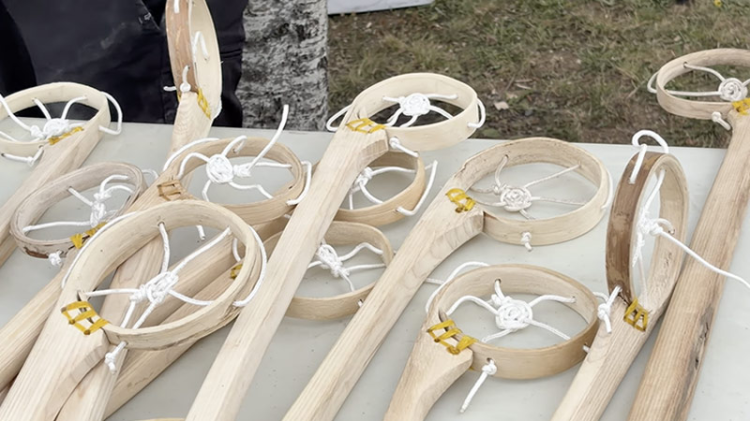
From carving traditional lacrosse sticks to learning sport fundamentals, Indigenous youth strengthened connections to culture, community, and traditional knowledge at Wolastoq Waves Skills Camp.
In the past, the game was used to honour Elders, teach life skills, and, at times, resolve disputes. It also became one of the earliest cultural bridges between Indigenous and settler communities, helping shape the sport recognized across the country today.
Honouring this tradition, the University of New Brunswick's Office of the Piluwitahasuwin (Associate Vice President Indigenous Engagement), in partnership with the Menahqesk Wellness Circle, supported the second annual Wolastoq Waves Skills Camp for Indigenous youth.
"As Saint John hosted the 2026 Lacrosse Founders Cup this summer, we were pleased to offer an opportunity for Indigenous youth to receive teachings on lacrosse through Anishinaabe and Wabanaki Elders and Knowledge Keepers," said Todd Ross, Piluwitahasuwin (Associate Vice President Indigenous Engagement) at UNB. "With teams from across the country gathered in Menahqesk, youth were able to learn from players, connect with culture and community, and gain a deeper appreciation for the traditions and teachings."
Learning the game
The two-part camp introduced youth ages five to 18 to both the sport and its cultural roots.
Participants first learned the fundamentals of lacrosse through skills sessions led by members of the Woodstock Warriors at the Lord Beaverbrook Rink in Menahqesk (Saint John). Throughout the camp, they worked on core skills such as winning ground-ball battles, proper passing and catching, cradling while running, shooting, field spacing and resilience, while learning the importance of composure and teamwork in a fast-paced contact sport.
The camp's focus extended beyond athletic development. Each session began with an opening circle and ceremony, including a smudge and teachings from Indigenous community members, Knowledge Keepers, and Elders.
The teachings helped ground the sport in its deeper cultural significance as the Creator's Game, connecting participants to the history, traditions, and values that have accompanied lacrosse for generations.
"This year, six players from the Seneca WarChiefs joined us on the first day of the skills camp," said Nick Jeddore, of the Menahqesk Wellness Circle and a camp volunteer. "On the second day, Mark Brant, commissioner of the First Nations Junior B Lacrosse League, where the Seneca WarChiefs compete, also came to support the camp."
"It meant a lot to have them show up and spend time with the kids, even if just for a few hours. It also gave the kids a chance to see what they could achieve in just a few years if they stick with the game."
Reconnecting to tradition
Prior to the skills camp, participants explored the game's cultural roots through traditional stick making, guided by Elder Frank Belleau, a traditional knowledge sharer, baaga'adowewin (lacrosse) stick maker, carver, and beader.
Over three days, youth, parents, volunteers, and members of the university community worked together to transform locally harvested ash wood into traditional lacrosse sticks. The process provided an opportunity to connect with the land and learn firsthand about the materials, craftsmanship, and traditional knowledge that have long been part of the game.
"We have a wonderful opportunity here," said Suzanne Paros, of UNB's Office of Piluwitahasuwin.
"The kids are getting a chance to learn about working with ash, which we were able to harvest right here on the property, and they're getting the opportunity to become deeply involved in the medicine of the ash tree while learning from someone who has a wealth of traditional knowledge."
Paros said the workshop represented an opportunity to bring different ways of knowing together through hands-on learning.
"It's a really nice opportunity to bring two cultures together," she said. It's bringing Indigenous culture to people, to community, to potential students, and it's showing that it is respected and appreciated."
Reconnecting to ancestral knowledge
Belleau, a member of the Anishinaabe community of Ketegaunseebee (Garden River First Nation) in Ontario, credits his grandparents with passing down the teachings and cultural knowledge that continue to shape and guide his work today.
Widely recognized throughout the Indigenous lacrosse community for his handcrafted traditional sticks, Belleau carries forward teachings deeply rooted in family, land, and community, and sees each piece he creates as a connection to the generations who came before him.
Using white and black ash harvested by hand, Belleau crafts each stick through a meticulous process of splitting, carving, boiling, steaming, and bending the wood before weaving the final pocket. For him, the work is both an art form and a deeply personal expression of identity and tradition.
"As soon as you make something, it becomes a living thing and an extension of you," Belleau explained during the workshop.
His journey into stick-making began more than two decades ago, after overcoming addiction and reconnecting with traditional teachings.
"I put down the bottle and picked up a stick to carve, and I've never looked back," he said.
Today, Belleau travels throughout Ontario and beyond, sharing both his craft and his story. His traditional baaga'adowewin sticks have found homes across Turtle Island and around the world, including in England, Scotland, Ireland, Australia, Uganda, and throughout Europe.
For Belleau, teaching extends far beyond the craft itself. It's about sharing knowledge, strengthening cultural connections, and inspiring pride in the next generation.
"What stood out most was the pride," he said in reference to the workshop. "The kids were proud of what they made. Their parents were helping, their grandparents were helping. Everybody showed up."
The workshop took place on UNB's Saint John campus, beside the sweat lodge. Throughout the three-day event, participants and volunteers worked under the guidance of Belleau, while Elder Noel Milliea smudged the completed sticks as part of the closing activities.
"It's just so special for them," said Ruthie Fullerton, a parent of two young Indigenous boys who attended the camp. "They got to meet Elder Milliea, who is from their original community, and they get to see people celebrating their culture with them."
"For them, it is so meaningful," she added. "And they realize that meaning. When they get in the car, they are very grateful."
The workshop concluded with a ceremonial planting of an ash tree in front of the Hans W. Klohn Commons, followed by a medicine walk through the Blueberry Hill Nature Preserve led by Belleau and Kaitlyn Pelletier, an Indigenous UNB student and volunteer organizer.
Building on the spirit of the Founders Cup
The camp coincided with the 54th Annual Founders Cup Junior B Box Lacrosse Championship, which brought teams from across the country to Menahqesk.
The Menahqesk Wellness Circle is a non-profit organization dedicated to creating opportunities for urban Indigenous people to connect with culture, community, and traditional teachings. Through initiatives such as the Wolastoq Waves Skills Camp, the organization aims to ensure Indigenous youth have access to cultural experiences that strengthen identity, pride, and belonging.
As participants left with handcrafted sticks in hand and new skills under their belts, they carried something less tangible but equally important: a deeper connection to culture, community, and the Creator's Game.
"You might take the stick away someday," said Belleau, "but you can't take away the experience."