

In their earliest iterations, sundials were sticks and stones stuck in the ground. Human observers would read shadows cast by the sun to tell time. Some of the most accurate early sundials were from Africa, Australia, China, the Arabic world, Greece and Rome. Societies created sundials that were beautiful, large scale, and acted as gathering spaces for communities. Since solar clocks are tied directly to locations on Earth, different latitudes required different designs from human ingenuity.
It is in this spirit of sculptural appeal, scientific discovery, human connection and time and place that York University has brought a sundial back to campus, with the help of a 101-year-old donor.
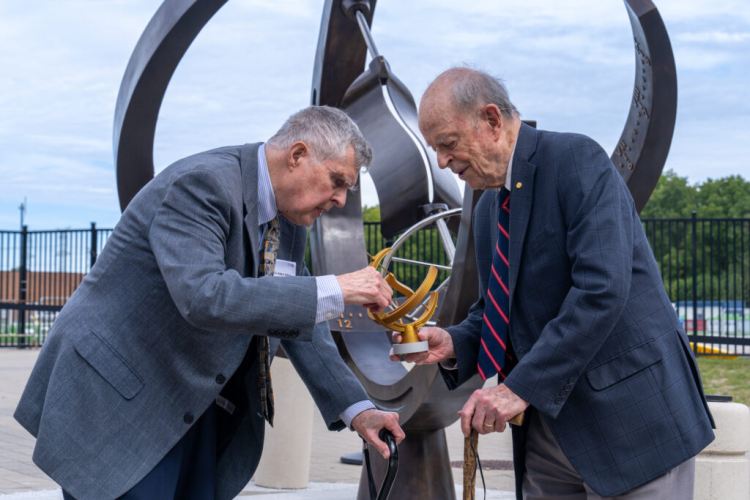
R.L Kellogg and Robert Stairs meet for the first time in person outside the STAIRS, the sundial Kellogg designed and Stairs fully funded
Robert Stairs first happened upon York's sundial in 1970, standing on a platform between the Steacie Science Library and the Farquharson building. The sundial appeared to be made of bronze, but it was actually made of wood and painted to resemble metal. Liking it so much, he bought a miniature version at a hobby shop on Yonge Street. Back on campus years later, Stairs discovered the sundial was gone.
"Unfortunately, by 1980, the wood had warped and rotted, to the point that it was beyond repair," explains Stairs, a Trent University professor emeritus who was also the school's first chemistry professor.
Decades passed, but time did not erase the memory of the sundial. Several years ago, Stairs embarked on a project to bring the sundial back to campus, with the help of many collaborators along the way, including Allan I. Carswell Observatory Director Elaina Hyde and R.L Kellogg, Vice President of the North American Sundial Society (NASS), who designed the new sundial, dubbed the STAIRS (Schmoyer-Type Adapted Interactive Reliable Sundial).
"York used to have a publicly accessible sundial, which meant that everyone could come out and experience astronomy firsthand, interactively, on campus. It was a great meeting place," says Hyde, also an Associate Professor in the Department of Physics and Astronomy, Faculty of Science at York.
Hyde says the STAIRS will serve similarly, being incorporated into observatory tours and class curriculum. "It's basically another telescope, but for the sun," she says.
"It's got huge educational overlap with classes in natural science, space sciences, physics and astronomy and remote sensing. We have used our precise location in Toronto, Ontario, on the traditional territory of the Huron-Wendat and Haudenosaunee, to place a particularly accurate solar clock of a unique design."
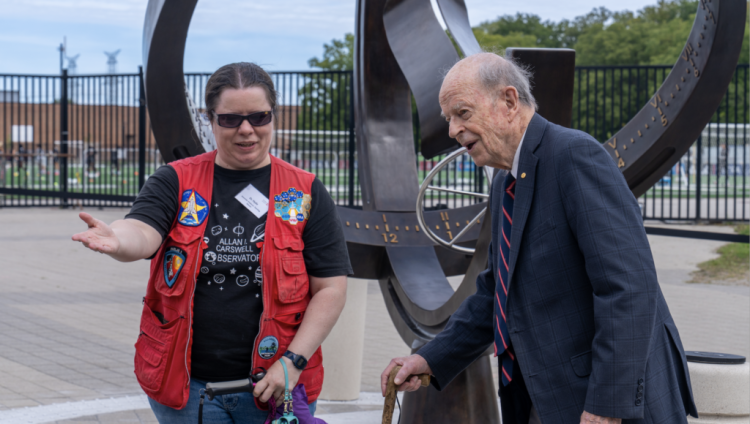
York Prof. and Observatory Director Elaina Hyde and Trent Prof. Emeritus Stairs
Kellogg used the iconic 1950s Richard Schmoyer sundial, which York acquired in the 1960s, and still lives atop the Arboretum Parking Garage in the Observatory atrium, as the basis for the update. However, Stairs requested that the York sundial not have a "cheat" on the gnomon, the part of sundials that cast the shadow used to read time.
"They've both got a funny curve, to change sun time into civil time, accounting for the seasonal correction of the sun's variable motion," explains Kellogg. "Shmoyer stretched this curved shape for readings during solstices."
With the gnomon weighing in at over 200 pounds and interactive, designed to be rotated depending on the time of year, they were ok to lose this feature. "We figured in June, most of the students aren't here, and same with Dec. 21."
Situated south of York Lions Stadium and directly in line with the Observatory, the STAIRS also adjusts for longitude from the time meridian, and it was the remote sensing group at York that helped map true north for the instrument. The STAIRS tells time in both daylight saving, printed in Roman numerals above, and standard time, written in Arabic numerals below.
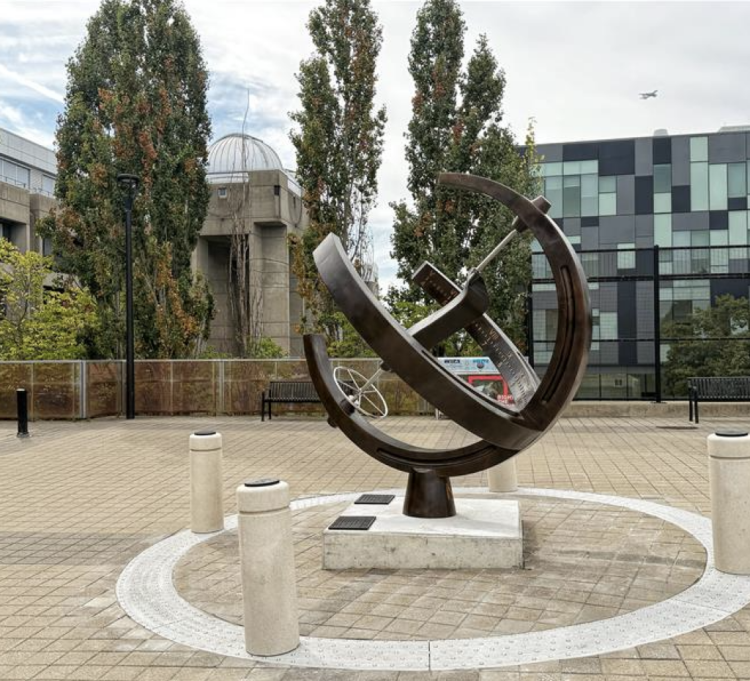
Powerful instruments: The newly-unveiled STAIRS (Schmoyer-Type Adapted Interactive Reliable Sundial) is seen with the Allan I. Carswell Observatory in the background.
"I hope the sundial will be appreciated as sculpture. It is also a hands-on astronomical instrument," said Stairs in his closing remarks during the unveiling of the STAIRS. "My personal motto, appropriate for a sundial, is Horas non numero nisi serenas' or as Brian from Monty Python might say, Always look on the bright side of life."
A popular engraving on sundials, the motto translates to "I only count the serene (or sunny) hours. The message also has a literal meeting, as sundials can only tell time on sunny days.
While the mid-September morning chosen for the unveiling of the STAIRS was overcast, the sun did make its presence known during parts of the morning, with the STAIRS reading time within minutes of what the smartphones of guests were reporting.
When I see it live, I am most impressed by it," said Stairs, smiling, the light shining in his eyes.