


UBC researchers found genetic mutations weakened the virus's ability to bind to human cells, highlighting the need to test how emerging viruses behave
When a B.C. teenager became critically ill with H5N1 avian influenza in November 2024, Canada's first human case, scientists around the world took notice.
The virus carried two unusual genetic mutations on the surface protein it uses to attach to cells. A similar mutation was later detected in samples from a Louisiana patient who died from the disease.
It led many experts to speculate: Was this a signal that H5N1 was becoming better at infecting people?
New research from the University of British Columbia suggests that was likely not the case.
In a study published today in Nature Communications, UBC researchers analyzed the two mutations from the B.C. case and found they actually weakened the virus's ability to bind to human cells, a critical first step in infection.
"We pay very close attention to mutations in this part of the virus because changes here can potentially help H5N1 adapt to humans," said senior author Dr. Sriram Subramaniam, professor of biochemistry and molecular biology at the UBC faculty of medicine and investigator at Canada's Immuno-Engineering and Biomanufacturing Hub. "To our surprise, the mutations did the opposite of what many expected. Cases like this show just how much we still have to learn about what allows an animal virus to infect people."
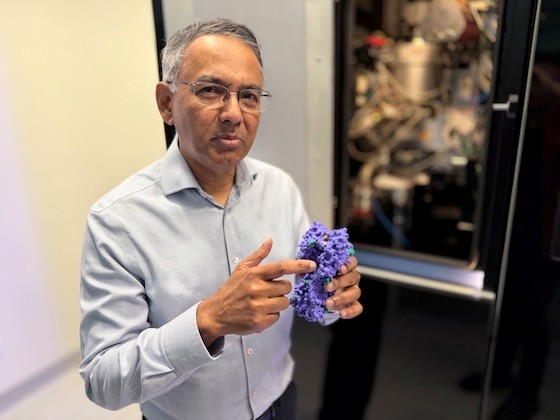
Dr. Sriram Subramaniam holds a model of the H5N1 surface protein, whose atomic structure UBC researchers have mapped to study the two mutations (yellow). Image credit: Subramaniam lab.
From genetic warning signs to real-world behaviour
Understanding how genetic mutations influence virus behaviour is increasingly important as scientists around the world track H5N1 and other viruses with pandemic potential.
Genetic sequencing can quickly flag new mutations as they emerge. But a virus's genetic code alone can't always tell researchers how those changes will affect its behaviour, including whether it is becoming better equipped to infect people.
To find out, the UBC team put the mutations through a series of tests. Using powerful cryo-electron microscopes, they mapped the structure of the mutated surface protein at near-atomic detail. They then tested how the mutations affected the protein's ability to latch onto both human and bird cell receptors.
"Genetic surveillance is an incredibly powerful early warning system, but it's only part of the picture," said Dr. Subramaniam. "If we want to be better prepared for the next pandemic, we need to understand what mutations allow a virus to do. In this case, the mutations weakened receptor binding, but other changes in this same region could have very different effects."
A puzzle from the B.C. case
The findings left researchers with another question: If the mutations made the virus worse at attaching to human cells, how was it still able to infect a person?
Further testing offered a clue. After attaching to a cell, the virus must fuse with the cell membrane, allowing its genetic material to enter the cell, where it can replicate.
When the researchers tested this second step in human lung cells, they found the mutated protein could still trigger fusion despite its weak receptor binding although far less efficiently than other H5N1 strains tested.
"It's possible that numerous weak interactions between viral proteins and cell receptors may collectively provide enough attachment for the virus to function," said John Ni, first author of the study and a graduate student in the Subramaniam laboratory.
Building a clearer picture of emerging threats
The study demonstrates how different parts of Canada's infectious disease surveillance and research system can work together to better assess emerging threats.
In the B.C. case, scientists at the B.C. Centre for Disease Control sequenced virus samples from the patient and shared the genetic data with the research community. That allowed the UBC team to investigate the unusual mutations and test what they actually did.
Dr. Subramaniam says this combination of rapidly detecting genetic changes and having the scientific capacity to investigate them can help scientists and public health officials better distinguish meaningful warning signs from those that look concerning on paper.
"Surveillance tells us where to look, and laboratory studies help us understand what we're seeing," said Dr. Subramaniam. "Together, they allowed us to better understand Canada's first human H5N1 infection, from which the patient thankfully recovered. The stronger our understanding of how these viruses work, the better equipped we are to assess emerging risks and respond when a new threat appears."
This research was supported by a Canada Biomedical Research Fund grant for the PROGENITER platform through Canada's Immuno-Engineering and Biomanufacturing Hub.