More than a century after the First World War ended, students can sit at a computer, open a digital military personnel file, and begin piecing together a life.
A name leads to a service file, which leads to a census record, which points to a community, a family, and a story beyond the battlefield.
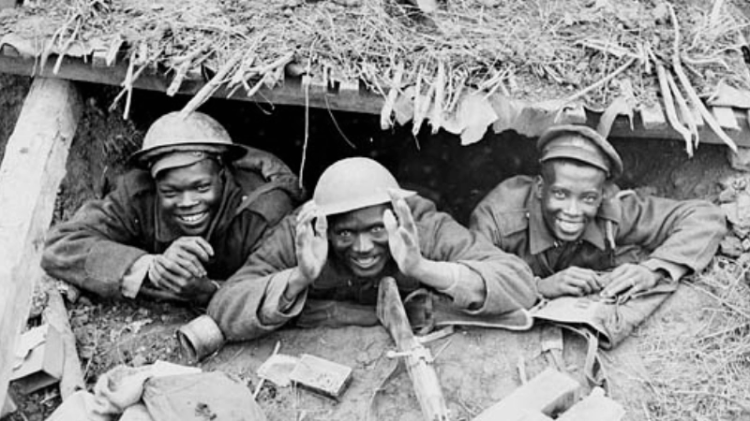
Three Black Canadian soldiers of the First World War in a German dugout captured during the Canadian advance east of Arras, October 1918. (William Rider-Rider / Canada. Dept. of National Defence / Library and Archives Canada / PA-003201)
That sits at the heart of the Minorities at War project at the University of New Brunswick's Gregg Centre for the Study of War and Society. Rooted in reconciliation, anti-racism, and equity, the initiative provides a means to explore the military service of Indigenous, Black, and other racialized Canadians during the First World War while creating resources to bring those stories into classrooms.
The project also includes nursing sisters, whose contributions have often been overlooked. Working in hospitals, some in the field near front lines, the nursing sisters saw much of the grim horror of the war as wounded and maimed soldiers were brought in for treatment. Most were white women and generally came from more socially privileged backgrounds than many of the racialized soldiers whose experiences are examined through the project.
The project grew from Canada's digitization and online availability of more than 600,000 Canadian Expeditionary Force personnel files.
Dr. Cindy Brown (BA'02, MA'04), executive director of the Gregg Centre, said this isn't the first time these stories have been told.
"We don't want to express the idea that this work hasn't been done before, because community members have done it," she said.
Brown points to people such as Kathy Grant, whose research has highlighted the experiences of Black soldiers, and Indigenous communities that have documented the military service of their members.
"It's not that these stories were missing," Brown said. "It's that these stories were not more broadly known in white spaces."
Following the evidence
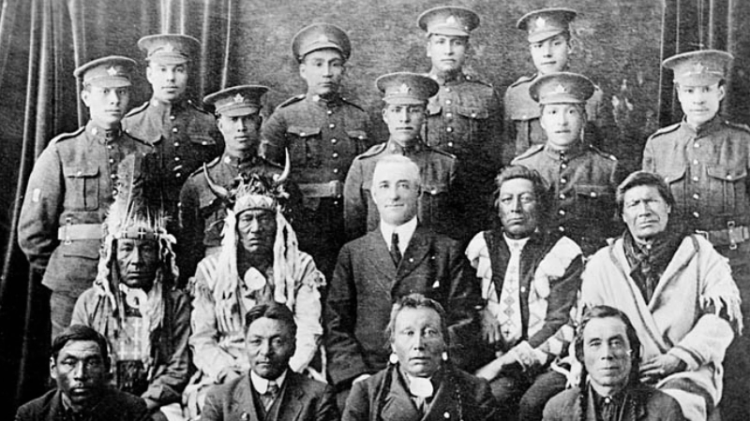
Elders with Indigenous soldiers in the uniform of the First World War Canadian Expeditionary Force, ca. 1916-17. (Library and Archives Canada / PA-041366)
Dr. Katelyn Stieva (BA'16, MA'19, PhD'25), now a Postdoctoral Fellow in the Department of History at Western University, worked on the project as a student researcher.
Their research focused primarily on Black soldiers in the First World War, although they also worked extensively with Indigenous service members' records.
"When I started my graduate research, I did not intend to write about Black soldiers," they said. "I arrived at my topic through chance and found these incredible narratives of Black men who served. Almost everybody I talked to had no idea that Black men served in the war, and I wanted to change that."
Stieva helped develop educational resources for teachers and students and worked with undergraduate researchers to compile lists of verified Indigenous and Black soldiers.
The project has also supported new graduate research.
Darian Calhoun (BA'21), a graduate student at the Gregg Centre, is studying 45 Wolastoqiyik and Mi'kmaq soldiers who served during the First World War, most of them from New Brunswick.
Part Indigenous himself and the son of a Canadian Armed Forces veteran, Calhoun said the research offered an opportunity to examine stories that have often received little attention.
"I wanted to continue my studies with a focus on Indigenous-Canadian military history," he said.
"It was a topic that fit what I wanted to pursue and had also been largely overlooked and deserving of more attention."
Identifying those soldiers is not always straightforward.
Military files rarely recorded race consistently. Researchers often had to compare service record information with other available historical sources and find at least one additional record confirming a person as Black or Indigenous.
"It's not a perfect system, and it certainly has its faults," Stieva said. "But given the records, it is one of the only ways to go about it."
More than one story
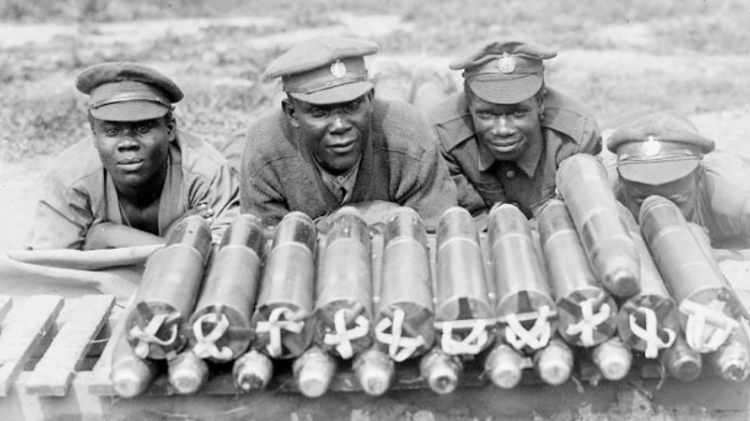
First World War Black Canadian soldiers resting with 18-pounder artillery shells which they were loading on the Canadian Corps tramways in July, 1918. (Credit: Canada. Dept. of National Defence / Library and Archives Canada / PA-3396814)
One lesson emerged repeatedly during the project: There was no single experience of the war. No one story could represent every nursing sister, soldier, or family.
Calhoun's research illustrates that point.
One of the soldiers he has studied is Arthur Paul, a Wolastoqiyik soldier who enlisted as a teenager, served during the Hundred Days Offensive, and was wounded overseas.
Calhoun said the broader lesson is not one man's story but the extent of Indigenous participation.
According to records from the period, he noted, about 62 of 116 known status adult Mi'kmaq and Wolastoqiyik men in New Brunswick were known to have enlisted during the war.
"The Indigenous population was vastly outnumbered by the Anglophone and Francophone communities in Canada," Calhoun said, "but they contributed and sacrificed in all the same ways that others did."
Brown said it was important the project made sure that the complexity of experiences is forefront.
That complexity also shaped how the researchers approached the records themselves.
For Brown, the files raise important ethical questions. Created by military officials and preserved by government institutions, they contain intensely personal information about people who never consented to sharing their records publicly more than a century later.
The files can reveal medical conditions, disciplinary actions, family circumstances, and other details that descendants may find difficult today.
"There is an ethical tension space for me because we're sort of being voyeurs into the lives of these people," Brown said.
At the same time, she believes the records create valuable opportunities for learning and historical understanding.
Calhoun's research also found that many Indigenous veterans returned to the same barriers they had faced before enlistment.
"Canadian society had largely remained the same with regard to how the public and the government viewed the Indigenous populations of Canada," he said.
Many Indigenous veterans continued to encounter discrimination after returning home and often faced additional barriers in accessing veterans' benefits and government programs.
Those questions became real for Stieva.
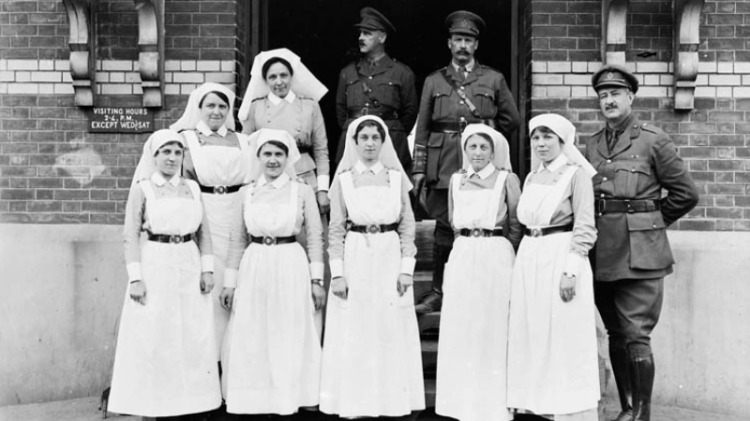
Canadian nursing sisters outside No. 1 Casualty Clearing Station, location unknown. (Henry Edward Knobel / Canada. Dept. of National Defence / Library and Archives Canada / PA-000368)
While studying one Indigenous soldier's file, they discovered evidence that the soldier's children had been placed in a residential school.
"I still sit with that soldier, and I still don't know if I have a way to describe the weight of realization that this type of narrative has," they said.
Experiences like that reinforced another principle that guided their work.
"One of the principles that I maintain in my own research is that I do not own these stories," Stieva said. "There are skill sets I have, and when I have the opportunity to offer those skill sets to the community, I believe I have an obligation to do so."
Bringing history into the classroom
While research is a major part of the project, education matters just as much.
That is where Blake Seward (MEd'16) comes in.
A longtime collaborator with the Gregg Centre and an award-winning educator, Seward has spent decades helping teachers use military history resources.
For him, the project is not just about building a database but helping students become historians.
"There are these significant groups of individuals that were participating in Canadian society, many of them marginalized," Seward said. "What is their story?"
Just as important, he said, is another question.
"How can we work so that it's not just the adults in the room that can learn about the story, but how do we get students involved in this too?"
Seward believes personnel files offer an ideal entry point.
Students encounter original documents, handwritten records, military terminology, and unanswered questions. They learn to interpret evidence, test assumptions, and build arguments from primary sources.
In many cases, they also discover connections between past and present.
A service file might lead students to questions about racism, citizenship, voting rights, Truth and Reconciliation, social movements, mental health, or community history.
"The beautiful thing about these service files," Seward said, "is that they make so many connections to so many other things that are out there."
Teachers across Canada have begun using the project's resources in increasingly specialized ways. Some focus on nursing sisters. Others investigate specific communities, military units, or Indigenous Nations. The result is a richer understanding of history through individual lives.
Seward said students often develop a strong connection to the people they research.
" My guy was killed at Hill 70,' a student might say. Another might talk about a soldier at Vimy Ridge or Passchendaele," he noted.
That moves history beyond memorized dates and famous battles as students explore real people whose lives intersected with larger historical events. Many served honourably, only to be caught up in institutional racism when they returned home.
Building access through technology
Mason Black (MEd'18) worked on the project's technical side.
"The real opportunity is helping people navigate those records, ask meaningful questions and discover stories that might otherwise remain hidden," said Black.
"The goal was to make the technology serve the historical inquiry, rather than have the technology dictate it."
Seward credits Black with transforming years of research into tools that work in modern classrooms and on modern devices.
The result is a public resource that combines historical scholarship, digital technology, and experiential learning.
It also reflects the Gregg Centre's broader mission of understanding how war affects people and societies.
For Brown, that means helping Canadians connect with the human stories behind military history. For Stieva, it means making research accessible to communities. For Seward, it means ensuring the next generation can participate.
"If you don't engage them, if you don't meaningfully invite them into the tent, you can't expect them to be interested," Seward said.
"You can't expect them to be interested in somebody else's work when the opportunity exists for them to actually assist in doing the work themselves."