The University of British Columbia ranks fourth in the entire world in the 2027 QS Sustainability Rankings, up one place from the 2026 edition. This is particularly impressive as the rankings have grown from more than 700 institutions in the inaugural edition in 2022 to more than 2,000 this year, the largest field to date.
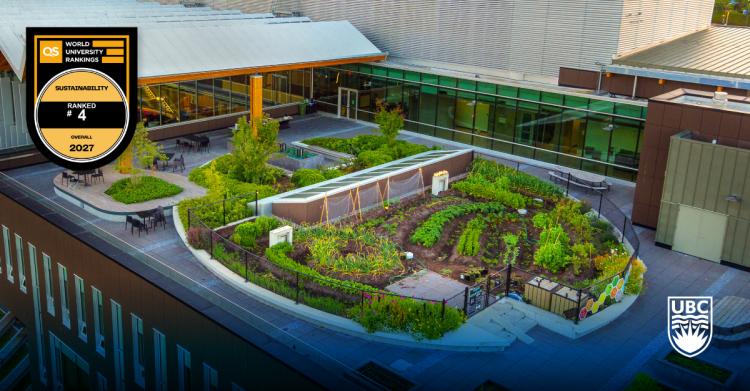
Sustainability initiatives such as the rooftop garden at the AMS Student Nest have earned UBC fourth place globally in the 2027 QS Sustainability Rankings.
UBC ranked second overall among 399 institutions in the Americas and second among 39 in Canada. The rankings also placed UBC first in the Americas for environmental research, social impact and equality.
"We welcome this recognition of decades of dedication from UBC faculty, staff, students and partners," said UBC President and Vice-Chancellor Dr. Benoit-Antoine Bacon. "Working together, UBC is helping communities prepare for a changing climate, protecting biodiversity, educating the next generation of sustainability leaders, supporting businesses as they bring cleaner technologies to market, and improving wellbeing and reducing emissions on our own campuses."
Leading in environmental research, with benefits for communities and businesses
UBC ranked first for environmental research in Canada, North America and the Americas.
Across the university, interdisciplinary teams are working with communities, governments, and businesses to find evidence-based solutions to the world's most urgent sustainability challenges, ranging from plastic pollution to sustainable agriculture and wildfire preparedness. These efforts are also creating economic opportunities.
For example, a partnership between the Wet'suwet'en First Nation and UBC has brought a made-in-B.C. solution to the global plastic crisis, turning local forestry waste into biodegradable foam packaging. At the Bioproducts Institute, researchers are exploring how plant-based materials can help remove microplastics from water. A UBC-led partnership with government and industry is also developing tools to help Canadian cattle and dairy farmers cut methane emissions while saving costs and improving profits.
UBC's Centre for Wildfire Coexistence brings together researchers, Indigenous Knowledge Holders, communities and fire agencies to reduce the risk of wildfire disasters and restore fire to support ecosystem resilience. At UBC Okanagan, research teams are developing tools to help communities prepare for wildfires and get information to the crews responding to fires. The Fire Ecology and Remote Sensing Lab is using a network of sensors to track temperature, wind and humidity, and using the readings to feed into forecasts that help communities anticipate wildfire risk.
That research and expertise is also being put to practical use through the Canadian Prescribed Fire Training Program, a first-of-its-kind national initiative housed at UBC Okanagan and designed to address a critical gap in Canada's ability to use and scale prescribed fire as a land management and ecological restoration tool.
Sustainability in teaching and campus life
UBC Vancouver and UBC Okanagan each have a Climate Action Plan 2030 to cut greenhouse gas emissions from campus operations and activities such as commuting, food, waste and business air travel. UBC Vancouver aims to reach net-zero operational emissions from buildings and energy supply by 2035, while UBC Okanagan aims to cut operational emissions by 65 per cent by 2030.
The UBC Sustainability Hub catalyzes, supports and advances innovative and impactful sustainability teaching, learning and research opportunities at UBC. Programs include working with faculty to bring sustainability and climate action into courses and develop educational resources, coordinating paid internships for graduate students to advance sustainability in the community, and providing opportunities for undergraduate students to work in teams on sustainability impact projects.
The Sustainability Hub also runs Campus as a Living Lab, which engages researchers, students, operations staff and external partners to leverage the campus to explore, develop and test new ideas to address global sustainability challenges, and to share the knowledge gained from these experiences beyond campus.
Learn more about UBC's results in the 2027 QS Sustainability Rankings: https://www.topuniversities.com/sustainability-rankings