




When Dr. Roger Jackson, PhD, first came to the University of Calgary in the summer of 1978, recruited as dean of the Faculty of Physical Education, which is today the Faculty of Kinesiology, he took his office in a building far different from the one we presently see.
Then, the entire faculty was housed in what is today Kinesiology A including the three gymnasiums still in use (Red, Gold and Auxiliary), as well as the dressing rooms, squash courts and swimming pool, along with a single classroom. The current coffee shop served as the "academic headquarters," Jackson recalls. "My office, along with those of our academics, coaches and support staff were all crammed into that little area."
As for the adjoining Kinesiology B structure we see today, which includes the Dean's office, atrium and fitness centre, leading to the Jack Simpson Gymnasium (where generations of convocation ceremonies have been held) that didn't yet exist. "On that spot was a dilapidated outdoor hockey rink with boards that were leaning inwards," Jackson reminisces. "It was a mess."
The Sport Medicine Centre (SMC), which Jackson helped establish in 1988 as its founding director, was an empty space. As for the iconic Olympic Oval, he says, the parcel of land on which that historical structure now stands was then "a sunken bowl used as a football field."
Impact on kinesiology went beyond buildings
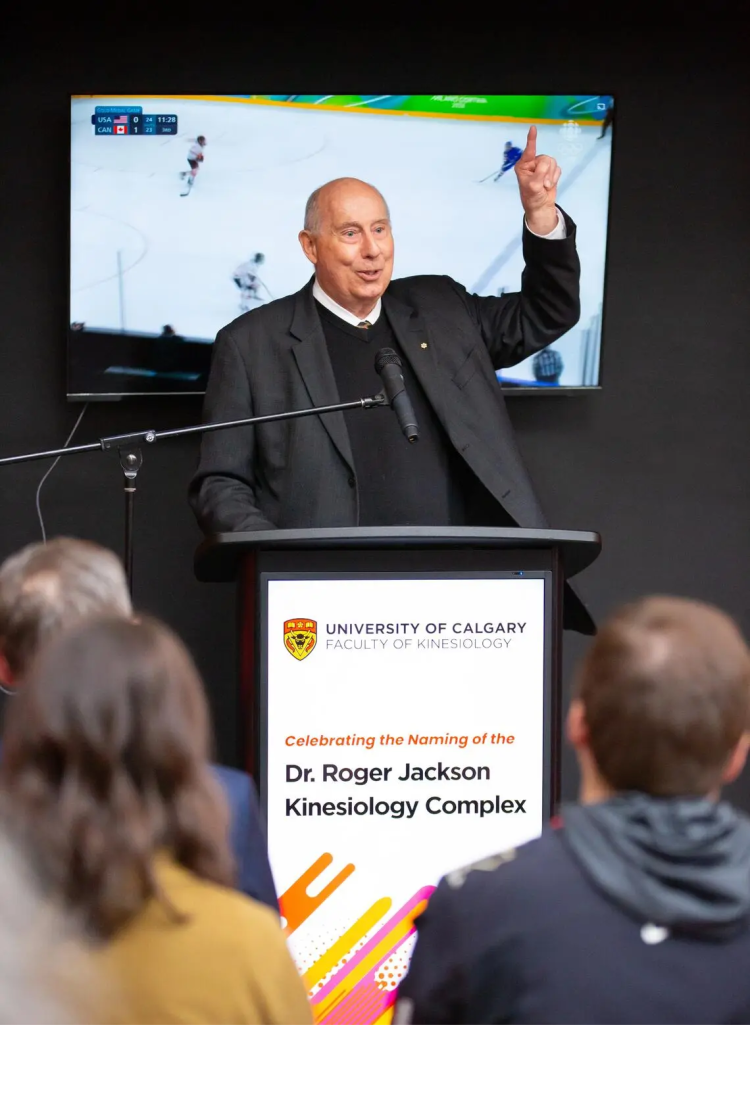
Roger Jackson. Photo Credit: Riley Brandt, University of Calgary
Jackson's impact on the Faculty of Kinesiology was seismic, and it was about more than just structural additions. He was instrumental in transforming the institution from its basic physical education roots, geared more towards the training of school gym teachers, to the world-class centre for sport-science and health and fitness research that it is today.
That's why it's fitting that the buildings known as Kinesiology A and B should now be renamed as the Dr. Roger Jackson Kinesiology Complex. An official ceremony to mark that rebranding was held on Feb. 19 at the Faculty of Kinesiology's atrium.
An Olympic rower who won gold in coxless pairs at the 1964 Tokyo Games, Jackson was serving the federal government as the director of Sport Canada when he was offered the role of dean at UCalgary's Faculty of Physical Education.
Road to hosting '88 Olympics begins
Dr. Peter Krueger, PhD, then the university's vice-president (academic) and provost, had a grand vision for the faculty that included the building of new facilities and the implementation of a robust research program. Meanwhile, there were serious talks underway that Calgary would put together a bid to host the 1988 Winter Olympic Games. UCalgary's then-president, Dr. Norman Wagner, PhD, was, as Jackson recalls, "very keen on having the university be a major part of the Games." Notably, as the director of Sport Canada, Jackson had been heavily involved with the Montreal Olympic Games in 1976.
With his Olympic past, governmental experience, and serious academic credentials, holding a PhD in biodynamics, it's easy to see why UCalgary's leadership was eager to bring Jackson on board.
He didn't disappoint.
"I realized that Calgary hosting the '88 Winter Olympic Games would provide a great opportunity for building brand new facilities for the university," says Jackson.
UCalgary central to Olympics bid
As one of the leaders of Calgary's Olympics bid, Jackson made UCalgary a key part of the city's pitch to the International Olympic Committee. "We proposed that the university would be the athletes' village," Jackson says. "That meant they had to build new dormitories to house 1,800 or so visiting athletes. Facilities were needed for a dining centre, a medical centre, a transportation hub. We created an environment where the University of Calgary was central to the whole project."
Nothing hit that centrality home as profoundly as the creation of the Olympic Oval for the speedskating events. Initially, Olympic organizers planned to erect the Oval alongside the newly built Canada Olympic Park (now WinSport) on the western edge of the city. Jackson and Wagner, however, pushed back, insisting it should be built on university grounds, where it could be put to better use after the games.
Establishing the SMC in 1988 was a project near and dear to Jackson's heart. It, too, finds its roots in the Olympics as in its formation it served as the medical centre for the games.
"We knew it was important to integrate medicine with the teaching of health and wellness and physical activity," says Jackson. "We set about building this incredible new laboratory complex for biomechanics and physiology and such, and this put us on the research radar."
He credits the early recruitment of renowned biomechanics researcher Dr. Benno Nigg, PhD, Dr. sc. nat., as being instrumental in the centre's growth. Jackson jokes: "I led the building of the spaceship, but he was the one who populated it by attracting first class researchers."
Dr. Nick Holt, PhD, dean of the Faculty of Kinesiology, says naming the Dr. Roger Jackson Kinesiology Complex is a richly deserved tribute to Jackson's enduring legacy.
"Roger provided the leadership and vision that helped transform a young faculty into an internationally respected centre for teaching, scholarship and research," Holt says, noting that, in Jackson's tenure as dean, he established the faculty's first master's and doctoral programs.
"Founding the Sport Medicine Centre, he helped create a model that brought together athlete care, high-performance sport, and world class research," Holt adds. "This has had a lasting impact not only on our faculty, but on sport-science and health research nationally and internationally.
"Dr. Roger Jackson is a builder in the truest sense of the word."


