




When conversations turn to youth mental health, they often focus on illness and crisis. For Dr. Zahra Clayborne, BSc'15, PhD, the more pressing question is what helps young people actually do well.
Clayborne, a psychiatric epidemiologist, leads the University of Calgary's Flourishing and Inclusive Health Research (FAIR) Lab, which studies youth mental health through a strengths-based lens that centres well-being, resilience and lived experience throughout their lives.
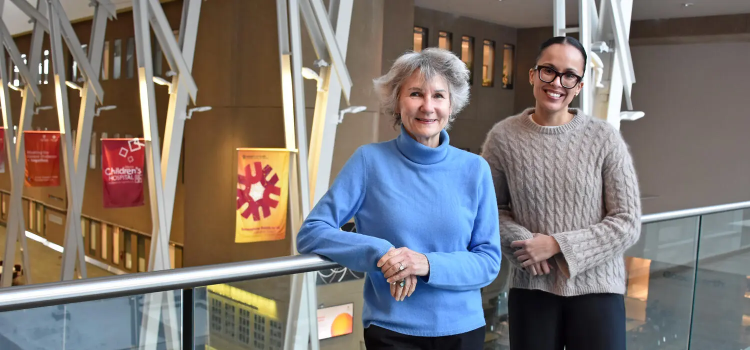
Suzanne Tough, left, and Zahra Clayborne. Photo Credit: Brittany DeAngelis
"Flourishing isn't just the absence of mental illness," says Clayborne, a member of the O'Brien Institute for Public Health at the Cumming School of Medicine (CSM).
"It's about whether young people feel connected, valued, hopeful. Whether they see meaning in their lives and can imagine a future for themselves."
Looking beyond illness
Traditionally, mental health research has focused on identifying symptoms and diagnoses. Clayborne's research takes a broader view. Her research centres youth voices through qualitative and quantitative mixed-methods approaches that ask young people to define what well-being and flourishing mean to them.
"If we only look at the absence of disorder, we end up with a very narrow picture of how young people are actually doing," says Clayborne, who is also a member of the Owerko Centre at the Alberta Children's Hospital Research Institute, and the Mathison Centre for Mental Health Research and Education at the Hotchkiss Brain Institute at the CSM.
"Many youth don't meet criteria for anxiety or depression, but still feel disconnected or uncertain. Those experiences matter, and they shape long-term outcomes."
Today's youth are navigating rapid social, technological and environmental change, including social media, AI, climate anxiety and post-pandemic recovery. However, says Clayborne, much of the evidence guiding mental health policy and practice continues to focus on illness, rather than prevention.
Studying flourishing as a measurable outcome, Clayborne says, helps researchers and decision-makers understand how to strengthen well-being before problems escalate.
"Flourishing gives us tools to think about how families, schools and communities can create environments where young people can thrive in the first place, not just respond when things go wrong."
A powerful longitudinal lens
Much of the FAIR Lab's work is anchored in All Our Families, a long-running research cohort that began in Calgary in 2008 and has followed more than 3,000 families from pregnancy through childhood and adolescence.
"The youth in our cohort are now 15 to 17 years old," Clayborne says.
"Because we've been following families since before their children were born, we can see how early home, neighbourhood and family experiences influence well-being in adolescence."
That long view has allowed Clayborne's team to examine how youth well-being shifts during major disruptions, including the COVID-19 pandemic. They found that young people who felt emotionally supported by trusted adults and were able to maintain routines and interests were more likely to flourish after the pandemic.
Connection mattered most, says Clayborne.
"Supportive relationships were the strongest protective factor we saw."
Social media and a changing world
Clayborne's research also looks at contemporary influences shaping youth well-being such as social media use.
During the pandemic, the team found that social media use was not linked to poorer flourishing, likely because it was one of the few ways youth could stay connected. Post-pandemic, the picture changed.
"The issue isn't social media itself," Clayborne says. "It's when use becomes addictive or displaces other important activities such as being active, reading for fun or spending time with friends."
This year, the All Our Families cohort is collecting new data on AI use and climate-related stress. These are areas where Clayborne says there is little existing longitudinal evidence.
"Understanding how they shape well-being is key if we want to respond effectively."
From research to real-world impact
Clayborne is also working with UCalgary professor Dr. Suzanne Tough, principal investigator of All Our Families, to adapt a resilience and flourishing workbook for children and youth. The original workbook, focused on adults, has seen strong uptake in the community and is freely available through public libraries and online.
"We have been energized by the response of the community to learning about evidence based, low cost, practical ways to enhance resilience and enable flourishing," says Tough, BSc'83, MSc'87, PhD, a member of the O'Brien Institute and Owerko Centre.
"We know life brings challenges. When we have a few strategies we can manage our stress and make better decisions when something unexpected or disruptive happens."
The youth-focused version aims to translate research evidence into practical tools that families, schools and community organizations can use.
"Research tells us a lot about what supports well-being, but it doesn't always turn that knowledge into something people can use," Clayborne says. "This kind of applied work helps bridge that gap."
Whose voices are reflected
A core principle of the FAIR Lab is ensuring that youth from diverse backgrounds are represented in research.
"Flourishing doesn't look the same for everyone," Clayborne says. "If we only listen to a narrow group of voices, we risk designing policies and programs that don't reflect young people's real lives."
Clayborne says her own experiences growing up in Calgary as a first-generation Canadian and a visible minority have shaped how she approaches her work, particularly her attention to belonging, opportunity and access to support. During Black History Month, she says, it's important to recognize how lived experience can inform public health research, without becoming a tokenized focus.
"My background has influenced the questions I ask and whose experiences I prioritize," she says. "Public health research is strongest when it reflects the full diversity of the communities it aims to serve."
A broader shift in thinking
If readers take one message from her work, Clayborne hopes it's this: youth are more than a collection of risks or outcomes.
"Flourishing asks us to look at whether young people feel seen, supported and hopeful," she says.
"Supporting well-being means strengthening the environments they grow up in, not just reacting when something goes wrong."
Dr. Zahra Clayborne is an assistant professor in the departments of Community Health Sciences and Pediatrics at the Cumming School of Medicine. She is a member of the O'Brien Institute for Public Health, the Owerko Centre at the Alberta Children's Hospital Research Institute, and the Mathison Centre for Mental Health Research and Education at the Hotchkiss Brain Institute.
Dr. Suzanne Tough is also a professor in the departments of Pediatrics and Community Health Sciences and a member of the O'Brien Institute and Owerko Centre.


