Several University of Calgary researchers received a funding boost on March 18, by way of a Government of Canada announcement of $20 million through Genome Canada and regional Genome Centres. The funding will launch 33 new research and development projects across the country, three of which will take place at UCalgary.
Karim Bardeesy, Parliamentary Secretary to the Minister of Industry, made the announcement today at UCalgary, on behalf of the Hon. Mélanie Joly, Minister of Industry.
"We know that building Canada into the world's leading hub for science and innovation will help create the strongest economy in the G7," said Bardeesy. "The projects announced are a great example of how Canadian ingenuity is tackling some of the world's toughest problems, finding solutions, and driving real change."
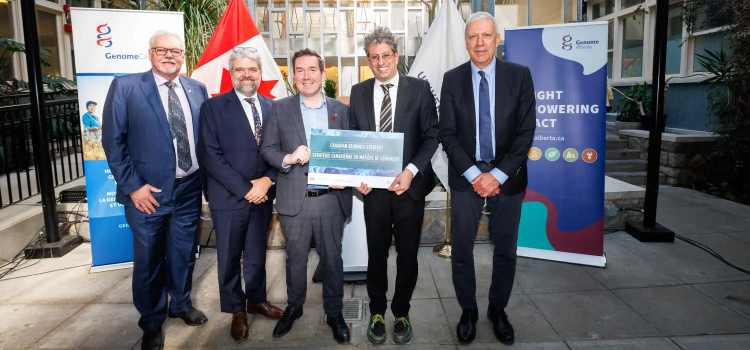
Photo Credit: Riley Brandt, University of Calgary
Funding brings together companies, researchers, end users
The funding, delivered through Genome Canada's Genomic Applications Partnership Program (GAPP), brings together companies, researchers, and end users to accelerate development and adoption of genomics-based technologies across health, agrifood, natural resources, clean technology, and advanced manufacturing. The program is designed to reduce commercialization risk, attract private investment, and shorten the path from innovation to market.
According to Dr. William Ghali, MD, UCalgary vice-president (research), this investment will lead to solutions for a wide range of challenges facing Canadians.
"Using innovative genomic tools, UCalgary researchers are working on canola crops that can stand up to drought conditions, creating more food security for a hungry world," he said. "A second initiative is focusing on commercializing a new treatment of the most common form of thyroid cancer with fewer complications or followup procedures. And a third project is de-risking underground energy storage in Atlantic Canada through deep biosphere genomics.
"Making strategic investments in research that partners with industry leads to positive economic impacts and a better quality of life for all Canadians.".
UCalgary funded projects
Clinical Utility of Thyroid GuidePx®: An Alberta-Led Genomic Innovation in Thyroid Cancer Care
- Dr. Caitlin Yeo, MD, clinical assistant professor, Department of Surgery, Cumming School of Medicine
- Dr. Oliver Bathe, MD'90, professor, Departments of Surgery and Oncology, Cumming School of Medicine; member, Arnie Charbonneau Cancer Institute
- Industry partner: Qualisure Diagnostics
This project will evaluate the clinical utility of Thyroid GuidePx®, a genomic test developed in Alberta that helps doctors better understand how aggressive a patient's thyroid cancer is likely to be. Today, many patients undergo surgery or additional treatments without clear information about how their cancer will behave. By analyzing patterns of gene activity in a tumour, the test can help guide decisions about the extent of surgery, the need for radioactive iodine therapy, and the intensity of followup care. Clinical studies at UCalgary and the University of Alberta will assess whether using this genomic information improves treatment decisions and reduces unnecessary care.
"Genomics is giving us new tools to understand the biology of cancer in ways that weren't possible before," said Bathe. "This funding allows us to test whether that information can help doctors make better treatment decisions for patients with thyroid cancer. It's exciting to see Alberta-developed innovation being evaluated in our own health-care system, with the potential to improve care while also reducing unnecessary treatments."
Identifying Genetic Traits for Abiotic Stress Resilience During Canola Reproduction
- Dr. Sam Yeaman, PhD, associate professor, Biological Sciences
- Industry partner: AgGene Inc.
Heat and drought stress are two of the most significant yield-limiting factors for Canadian canola, especially during flowering and pod development. With climate change increasing the frequency of extreme weather, Prairie producers face growing economic risks. High temperatures during flowering can reduce yields, while drought only compounds these losses.
Despite the scale of the problem, no commercial hybrids provide targets genetic resilience to heat or drought stress at flowering. This project will deliver non-GMO heat- and drought-resilient canola traits by integrating mutagenesis (the process of inducing changes in the genetic material of an organism), phenotyping (the process of measuring, analyzing, and characterizing the observable physical, physiological, and biochemical traits of an organism, resulting from its genetic makeup and environment), and genomics to identify the genetic basis of stress tolerance.
"Stress-resilient canola will reduce yield volatility and improve profitability for farmers," explained Yeaman. "Working with partners at AgGene and the National Research Council, this project will generate new intellectual property, licensing revenues, and strategic positioning in climate-smart crop development while strengthening the resilience and competitiveness of Canada's $43-billion canola industry, helping maintain our leadership in sustainable oilseed production."
De-Risking Underground Energy Storage in Atlantic Canada Through Deep Biosphere Genomics
- Dr. Casey Hubert, BSc'98, PhD'04, professor, Biological Sciences; associate member, The Calvin, Phoebe and Joan Snyder Institute for Chronic Diseases
- Industry partner: Triple Point Resources
A cross-Canada research project led by UCalgary, in partnership with Triple Point Resources and Memorial University, is helping de-risk underground hydrogen storage by addressing an often-overlooked challenge: microbial activity. The collaboration was initiated by Dr. Omid Ardakani, PhD, at Natural Resources Canada, and focuses on hydrogen storage in underground salt caverns environments thought to limit microbial activity due to extreme salinity. However, some salt-loving microorganisms, known as halophiles, can survive in these extreme conditions, potentially consuming the hydrogen or contributing to corrosion. Hubert's lab will study these "extremophiles" to better understand whether they pose a risk, helping ensure hydrogen can be safely and reliably stored as Canada works toward a low-carbon energy future.
"This project and partnership are exciting because it allows us to apply energy sector knowledge about subsurface microbiology to tackle new challenges associated with the transition to clean low-emissions energy like hydrogen," explained Hubert. "It also allows expertise from Alberta to contribute to an opportunity in Atlantic Canada, and collaborate on a national scale."
This project builds on an Alberta Innovates grant Hubert received in 2023.
Through the Canadian Genomics Strategy, Canada is investing $175.1 million over seven years in genomics commercialization, data co-ordination and talent cementing genomics as a cornerstone of Canada's bioeconomy. The CGS committed a total of $96 million in investment support for commercialization and adoption through Genome Canada's Genomics Application Partnership Program (GAPP).
About Genome Canada
Genome Canada is a national not-for-profit leading large-scale research missions that translate excellent science into economic, health and environmental solutions. It aligns Canada's genomics ecosystem for impact.