

Red Deer Polytechnic (RDP) continues to expand its multi-disciplinary applied research capacity through projects that strengthen health and social outcomes across Alberta. One such initiative is Alberta Neonatal Abstinence Syndrome Mother Baby Care Improvement (NASCENT), a provincial effort improving care for mothers who are or have been substance-involved and their newborns. Since April 2025, RDP research assistant Haley Zinger has contributed to NASCENT's work across eight hospitals, helping reshape care practices province wide.
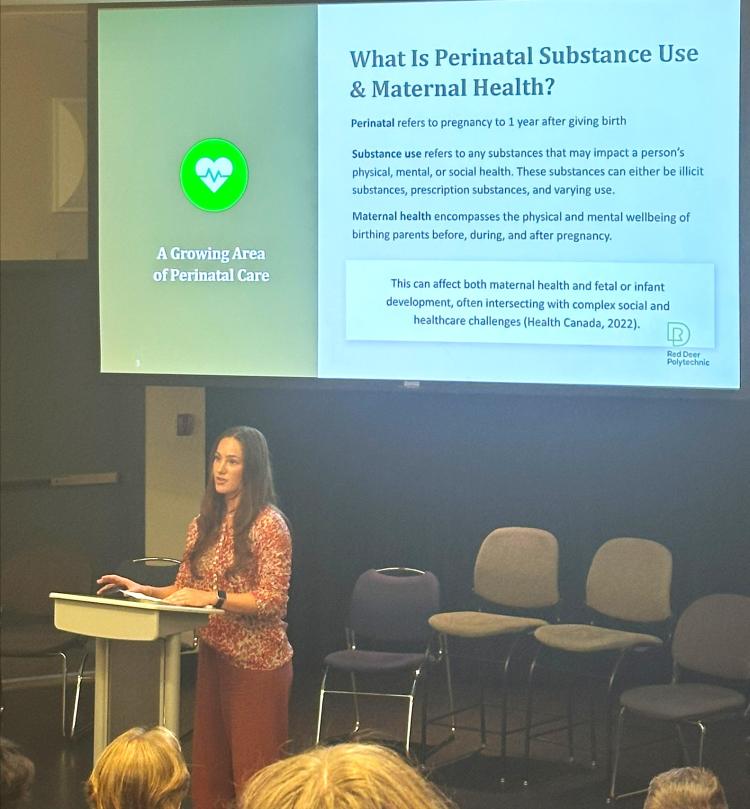
NASCENT promotes enhanced rooming-in, keeping mothers and infants together after birth rather than separating them for Neonatal Intensive Care Unit (NICU) admission. Guided by the principle that "mom is the baby's medicine," the model emphasizes wraparound care and mother-baby bonding.
"For infants exposed to substances during pregnancy, that means mother-baby togetherness does the work that a NICU admission and medication once did," says Haley.
Her role includes data entry, supporting education days for care providers and contributing to projects that centre the experiences of people with lived and living experience of substance use in pregnancy.
"These projects use a listening-first approach, which means sitting down with participants, hearing their stories and using those conversations to guide how we understand and improve care," she explains.
Haley's work was supported through an Alberta Innovates Summer Research Studentship, with additional Natural Sciences and Engineering Research Council of Canada (NSERC) Mobilize funding during the academic year. She collaborated with Recovery Alberta and Acute Care Alberta, reflecting RDP's commitment to advancing evidence-based practice with provincial partners.
Through NASCENT, the team gathered data before and after enhanced rooming-in was implemented.
"Comparing the two, we found a rise in breastfeeding rates and a decrease in NICU admissions, which in turn reduces costs for the healthcare system," Haley notes.
These findings underscore the impact of applied research on strengthening Alberta's healthcare pathways and improving outcomes for families.
"Our goal is to continue scaling enhanced rooming-in across Alberta," says Haley.
The NASCENT team is now focused on helping to scale enhanced rooming-in across Alberta, using the study findings and listening-first engagement sessions to support practical improvements in mother-baby care. The team is also preparing publications to share lessons learned more broadly.
This applied research project is one of numerous initiatives currently being advanced by RDP's students and employees to enhance Alberta's healthcare sector, exemplifying RDP's impact through education, training and applied research as the province recognizes Life Sciences Week from September 21-25, 2026.
RDP's growing applied research ecosystem, spanning healthcare and health technology, social innovation, manufacturing and advanced manufacturing, and energy innovation, creates opportunities for students, faculty and staff, including research assistants like Haley, to contribute to projects with real- world impact. This reflects the Polytechnic's commitment to advancing multi-disciplinary solutions that improve lives across the province.
For more information about research and innovation at RDP, visit: rdpolytech.ca/innovation.