In 2023, Mount Royal student Quinnten Iversen was just 16 when he came across an international design competition inviting the public to design the livery (the exterior paint scheme) for Airbus's next-generation A350F cargo aircraft.
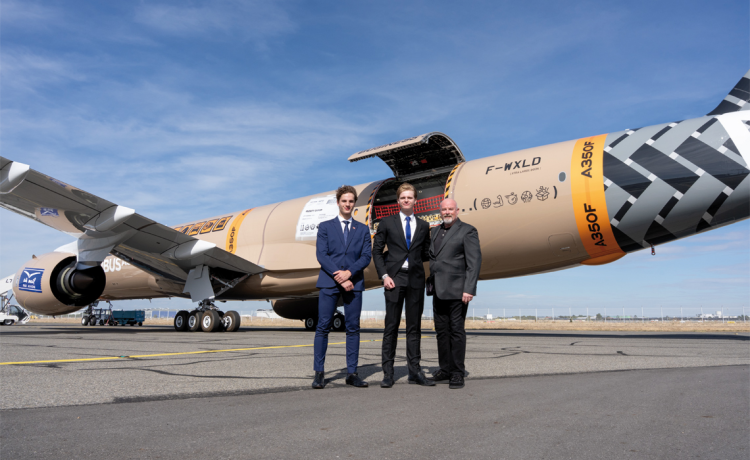
From left, livery contest winners Ellisten Iversen, Quinnten Iversen and John Feehan. (Airbus media centre)
An aviation enthusiast who had already begun flight training, Iversen immediately saw an opportunity to create something unusual. Why not make an aircraft designed to transport packages look like one itself?
His first move was to recruit his younger brother, Ellisten, then 12, who shared his fascination. "My brother Ellisten and I have always been close growing up, sharing a passion for aviation," Iversen says. "Together we were able to take that idea and develop it into a design that aimed to create something memorable."
The brothers' submission featured an eye-catching paint scheme with a cardboard-coloured fuselage, packing tape graphics and shipping symbols.
Now, three years later, their creation has become a reality. The first A350F rolled out of the Airbus paint shop in Toulouse, France, in August 2026. Iversen and Ellisten were there to watch as the plane completed its maiden flight on Sept. 29.
For Iversen, who is now pursuing a Bachelor of Aviation Management at MRU, seeing the finished aircraft was the culmination of an unforgettable journey.
"It was a truly surreal experience," he says. "The environment was one of pure excitement, and you could sense the immense pride in the room held for the aircraft sitting in front of us."
Broadening horizons
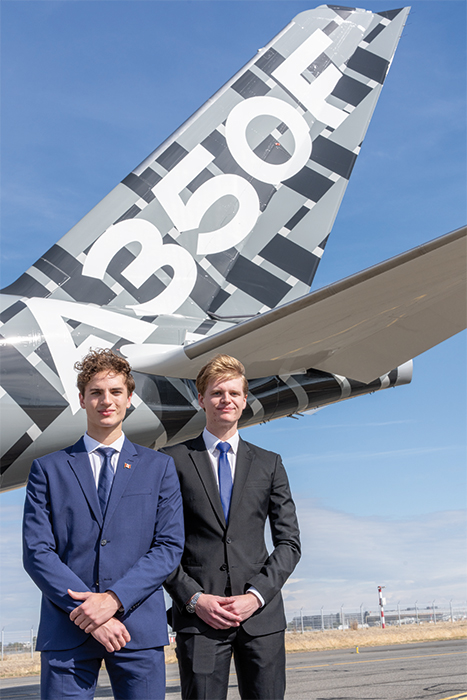
The brothers' concept was among more than 4,000 submissions from around the world. When the winners were announced at the 2023 Paris Air Show, the Iversens learned their design had been selected alongside a similar concept submitted by Irish graphic designer John Feehan. Rather than choosing one, Airbus combined elements of both winning entries into a livery of distinction, incorporating cardboard packaging, shipping labels, tape and handling instructions.
Bringing the design to life required a joint effort between Airbus's designers, engineers, manufacturing specialists and paint teams, who worked to translate the winning concepts into an aircraft livery that met technical and safety requirements.
For Iversen, the experience was about more than international recognition. "I feel incredibly proud that the bond between my brother and I was able to play a part in helping to contribute to the field that has inspired us both for many years."
Although designing the exterior of an Airbus might seem like an unusual first contribution to the aviation industry, Iversen has long known his future would be in the flightdeck.
"I have known that I have wanted to be a pilot for as long as I can remember," he says.
That ambition brought him to Mount Royal University, where he completed his Aviation Diploma and flight training before continuing into the Bachelor of Aviation Management program.
"When looking at where to start my journey, I quickly became aware of MRU's excellent reputation in the industry," he says. "Having completed my diploma and flight training, the Bachelor of Aviation Management program provides me the opportunity to continue learning more about the industry that I love."
New programming and facilities expand horizons and opportunities
Launched in fall 2024, MRU's four-year Bachelor of Aviation Management is the first degree of its kind in Alberta. The program builds on the university's longstanding reputation for flight training while expanding opportunities for students interested in the business, operational and leadership aspects of aviation. With concentrations in flight crew operations and aviation operations, the degree prepares students for careers both in the cockpit and across the industry.
For students pursuing flight training, the experience extends well past traditional classroom learning. Mark Benson, an assistant professor with MRU's aviation program and a graduate himself, explains students balance their academic course load with flight simulation and practical training in the University's aircraft fleet, which includes Cessna 172s and multi-engine Piper Senecas.
The different learning environments reinforce one another, allowing students to apply classroom concepts to real-world flying and practice situations that would be impractical or unsafe to reproduce in an aircraft.
That hands-on approach also means preparing students to think quickly and independently when technology fails. Students might learn to navigate using modern flight systems, for example, but must also know how to reach their destination using traditional navigation methods if newer systems become unavailable.
The result is an education that goes beyond operating an aircraft to understanding the complex decisions involved in safe flying. Benson says one of the most important skills students develop isn't simply how to fly an aircraft, but how to work effectively with the people around them. Known as crew resource management, or CRM, this approach focuses on communication, teamwork and collaborative decision-making. Pilots must learn to draw on the knowledge and expertise of their colleagues, including other flight crew members, air traffic controllers, maintenance personnel and ground crews.
"Working as crews instead of individuals is hugely important," he says.
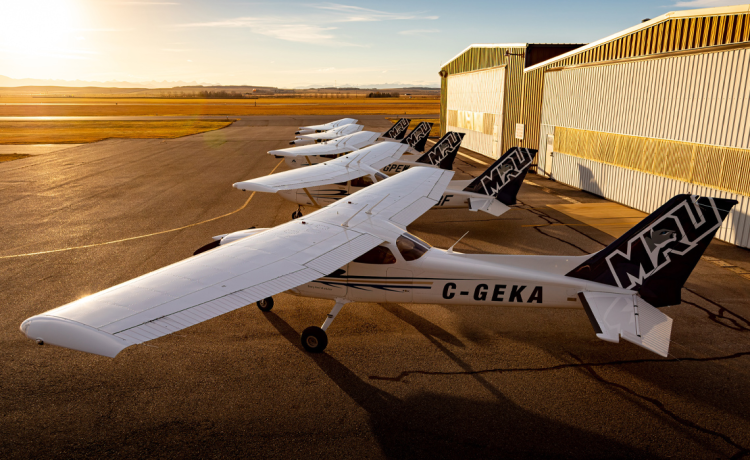
Mount Royal University aircraft line the tarmac outside the hangar at Springbank Airport.
At MRU, students practice these skills through simulations that challenge them to assess complicated situations, communicate with others and determine an appropriate course of action.
"We give them problems that don't have clear-cut answers and they have to solve them using all the tools they have available," Benson explains.
This line of thinking represents a shift in aviation professions, where effective leadership increasingly depends on collaboration and considering various perspectives. The emphasis extends into the business side of aviation management, where students learn to balance operational requirements with financial and strategic considerations.
Benson points to airline management simulations in which students develop business strategies and assess their viability, accounting for everything from maintenance expenses to ground operations and airport landing fees. These experiences help students understand the many people, systems and decisions involved in keeping an airline operating safely and successfully.
Iversen says the program has already expanded his understanding of where an aviation career might take him.
"MRU has broadened my horizons and ambitions in the aviation industry," he says. "I have been fortunate to have plenty of unique opportunities and experiences in the program ranging from technical ground schools with industry partners to deep explorations of human factors and communication skills."
"I have learned that there are limitless opportunities and ways to explore aviation that tie together to create a passion-filled, safety-first industry."
MRU playing significant role in training tomorrow's pilots
This is a time of significant growth for aviation education at Mount Royal. In October 2025, the university celebrated 55 years of aviation education with the opening of its new 3,400m² Springbank Aviation Campus. With its modern classrooms, study spaces and two hangars with room for an expanding aircraft fleet, the facility represents a major investment in the next generation of pilots and aviation professionals.
The campus was made possible through government funding and private philanthropy, including a $2.4-million gift from the late Ken Lett, a decorated Second World War pilot, aviation industry leader and longtime supporter of aviation education at MRU. In September 2026, MRU joined government and industry partners to break ground on the Alberta Training Centre of Excellence for Aviation and Aerospace near the Calgary International Airport. Scheduled to open in 2028, the centre will feature eight full-flight simulators and other advanced training technologies, with capacity to train approximately six thousand aviation professionals annually.
As the centre's post-secondary partner, MRU will collaborate with industry leaders, including WestJet and CAE, to expand opportunities for hands-on learning, applied research, mentorship and career development. Together, these investments are helping prepare graduates for an industry that offers far more opportunities than many aspiring aviators initially imagine.
Benson, whose own career has included flight instruction, charter flying, aviation operations and entrepreneurship, understands that variety firsthand. He says the most rewarding part of returning to MRU as a faculty member is helping students discover their potential.
"I love those a-ha' moments when I see students putting the pieces together," he says.
His advice to anyone considering a future in aviation is simple: find the part of the industry that inspires you and pursue it wholeheartedly.
"Is this your passion? Then chase it as hard as you absolutely can."
A career ready for takeoff
Iversen isn't waiting until graduation to take the next step toward his ambitions. Along with his degree, he completed his flight instructor rating at MRU this month, preparing to share his knowledge with the next generation of pilots.
"My goal is to get a start to my flying career while simultaneously expanding my horizons and possibilities through education," he says.
It's a fitting next leg in the journey for someone whose fascination with aviation has already taken him from Calgary to the Paris Air Show and part of the story of a new Airbus aircraft.
And although the A350F has now taken flight, Iversen is still discovering where his own flight path might lead.
"I hope and expect that aviation will continue to bring me places I never thought possible," he says. "I hope to keep contributing to a passion that has opened so many doors in my life."