Dr. Mostafa Ameli arrived at the University of Calgary this summer as the first participant in a new international initiative to strengthen research ties between Canada and France, including a focus on improving future wildfire-caused community evacuations.
Through the Visiting Scholars from France program, UCalgary welcomes leading researchers from French institutions for extended visits that foster collaboration, innovation and knowledge exchange. The initiative is a partnership between the university, the French Embassy in Canada, and the Centre National de la Recherche Scientifique (CNRS), bringing researchers to campus for immersive two- to six-month residencies. Three additional scholars are participating this fall, bringing expertise in fields including AI, health, sustainability and energy.
For Ameli, PhD, an associate professor in applied mathematics and computer science at Université Gustave Eiffel, the visit provided an opportunity to deepen an existing collaboration with Dr. Saeid Saidi, MSc'11, PhD'16, an associate professor in the Schulich School of Engineering's Department of Civil Engineering. They first connected through international transportation research networks and quickly identified complementary interests in resilient and sustainable transportation systems.
One area of focus was wildfire-evacuation planning for communities such as Jasper and Banff using real-world data, traffic simulation, behavioural modelling and mathematical optimization, studying how evacuation plans can remain effective during emergencies involving uncertain demand, road closures and infrastructure constraints.
Ameli has worked with UCalgary researchers on projects focused on transportation resilience, emergency planning and public transit systems.
"My research focuses on intelligent, resilient and sustainable transportation systems," explains Ameli. "I use mathematical optimization, artificial intelligence, game theory and data-driven models to understand how people and vehicles interact in complex mobility systems, and how these systems can be better designed and managed."
Adds Saidi: "We invited Dr. Ameli because of the strong alignment between his expertise and the strengths of our transportation research team. His experience in mobility data, optimization and sustainable transportation has created valuable opportunities for collaboration.
"Our collaboration centres on emergency evacuation planning and network resilience, which are directly relevant to Canadian communities. The goal is not only to produce research publications, but to develop tools and insights that can support transportation agencies and public authorities facing real resilience and evacuation challenges."
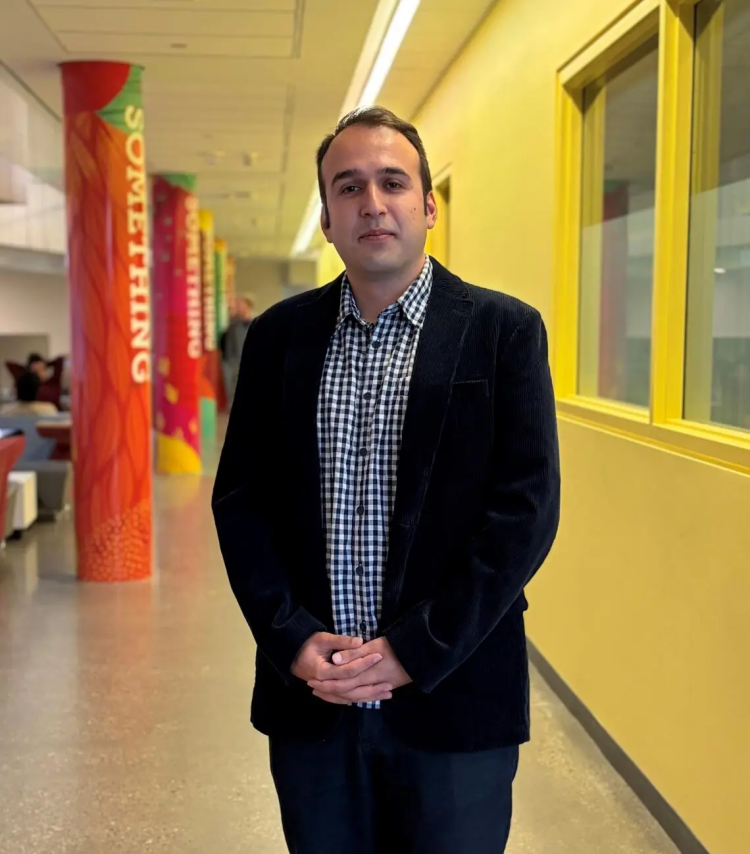
Mostafa Ameli, associate professor in applied mathematics and computer science at Université Gustave Eiffel, France. Photo Courtesy Melanie Yar Khan
Ameli also co-supervised a summer student researching the 2024 Jasper wildfire evacuation, helping lay the groundwork for future student exchanges and collaborative research projects.
The researchers are also examining ways to strengthen the resilience of public transit systems through improved demand forecasting, network design and real-time operational decision making. The work aims to support more efficient, reliable and sustainable transit services.
"The Visiting Scholars from France program reflects the kind of global partnerships that help a university turn expertise into impact," says Dr. William Ghali, MD'90, vice-president (research) at UCalgary. "By bringing together researchers with complementary strengths, we create opportunities for new discoveries, student learning and collaborations that embody UCalgary's commitment to our communities, here at home and around the world."
The Visiting Scholars from France initiative is already opening new doors for the development of high-level scientific collaborations between a major Canadian university and French scientists, says Dr. Andrea Dessen, PhD, director of the CNRS office in Canada. "It aligns perfectly with the key objectives of the international scientific policy of the CNRS, which includes research excellence as one of its top priorities," she says. "The research questions that are being tackled are challenging and innovative; I look forward to seeing the results and reading the publications!"
Beyond the research itself, both scholars see significant value in the international exchange of students, researchers and ideas.
"For students, international collaboration provides exposure to different research cultures, methods and educational systems," says Ameli. "For researchers, a physical visit creates dedicated time to develop ideas together and establish trust in ways that are difficult to achieve through occasional online meetings."
Saidi says the benefits were immediately apparent within his research group.
"Students received constructive feedback from an international expert outside of their regular supervision meetings, and we explored opportunities for student exchanges in both directions," he says. "These experiences help create a genuinely sustained relationship rather than a short-term collaboration."
The collaboration also opens new opportunities for international research funding and consortium-building. Ameli's networks within Horizon Europe and his experience navigating European research ecosystems provide valuable connections for UCalgary researchers, particularly as Canada expands its participation in European research initiatives. Together, the researchers hope to pursue future collaborative funding opportunities that strengthen research partnerships between Canada and Europe.
The visit has also opened doors to broader international partnerships. During his time at UCalgary, Ameli participated in the 4 Universities Joint International Conference (4UniC), which brings together researchers from universities across Canada and Asia. Discussions are now underway about potential future involvement by Université Gustave Eiffel, which would introduce a European partner to the long-standing network.
Looking ahead, both researchers view the visit as the beginning of a much larger collaboration between UCalgary and Université Gustave Eiffel.
Plans include joint research projects, co-supervision of students, researcher exchanges, collaborative funding applications and expanded international partnerships.
"My long-term ambition goes well beyond the two of us," says Saidi. "I want this visit to become the foundation for a sustained institutional partnership between UCalgary and Université Gustave Eiffel involving multiple faculty members, structured student exchanges and collaborative research initiatives."
Ameli agrees.
"Our objective is to use this visit as a starting point for a long-term research and educational partnership," he says. "We are already building a pipeline of joint research topics involving researchers and students from both institutions. The long-term goal is to combine our complementary expertise and create meaningful impact for transportation systems and society."
As the Visiting Scholars from France program welcomes additional researchers to campus in the months ahead, partnerships like this one demonstrate how international collaboration can strengthen research excellence, expand opportunities for students and help address complex problems.
The Visiting Scholars from France program is part of the UCalgary Visiting Scholars Program, which sponsors distinguished scholars based in Canada and international candidates who will make a significant contribution to the academic life of the university enriching our research community, raising our institutional profile, and promoting knowledge exchange across countries and continents.