


Cranberry sauce is a staple on Canadian tables during the holiday season, enjoyed by millions of people.
But what if this delicious seasonal favourite became a rarity? Cranberry crops will be impacted by climate change in the years to come, according to new research by the University of the Fraser Valley (UFV), funded by the B.C. Cranberry Growers Association.
Working in the university's cutting-edge BERRI Lab, and in a local field, student Yowana Kanyumwa confirmed that warmer temperatures lead to fewer berries. The third-year Agriculture Science student tested six varieties and found substantially lower yield for all of them when they were grown in a controlled environment a growing dome that simulated a 2 degree Celsius increase in temperature.
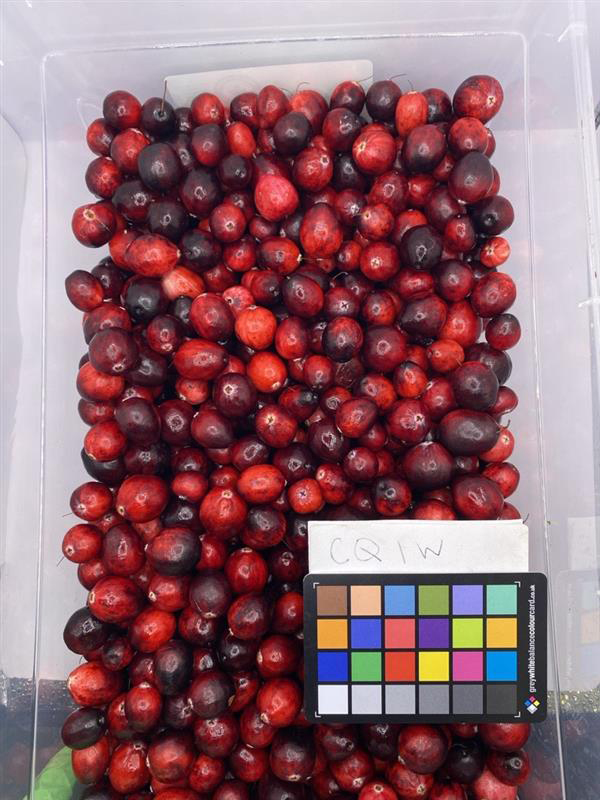
Cranberries are evaluated in UFV's BERRI Lab.
The results back up computer modelling that BERRI Lab director and Canada Research Chair Dr. Lauren Erland, published in 2022.
"My research also showed that higher temperatures impacted the size of the cranberry plants," Yowana says. "The good news is that the weight and firmness of the berries didn't see much impact at all."
Also, not all the varieties evaluated in the trial suffer equally, and that may help growers in choosing which plants they use in future planting.
Yowana moved to Canada from Zimbabwe three years ago and knew nothing about cranberries when she started the experiment.
"They're famous in North America, but they're not found in Zimbabwe, so it was fun learning about them," she says. "And one of the side benefits of this experiment is that I was able to harvest some cranberries and make cranberry sauce for my Thanksgiving dinner."
According to a report from Agriculture Canada, Canada is the world's second-largest producer of cranberries, trailing only the United States. About 95 per cent of that is grown in B.C. and Quebec, with B.C. producing 45,988 metric tonnes in 2024.
The stakes are high protecting an industry that, according to Ocean Spray Cooperative, contributes over $400 million in economic activities and supports nearly 3,000 jobs in mostly rural areas.
The good news is that by identifying what happens to cranberry crops as temperatures rise, researchers like Yowana can now move on to why it happens.
"This means from a physiological perspective, and also from a chemical and hormonal perspective," Lauren says. "Is there less fruit because the plants are making fewer flowers? Or are there the same number of flowers but they're not turning into fruit? And what are the internal signals in a plant that are controlling this?
"If we can answer these questions then we hope we can give growers solutions."
Solutions may come in the form of recommendations of climate-resilient varieties, field-management recommendations to mitigate stress, or the development of climate-resilient cranberry plants. The BERRI Lab is involving a whole team of undergraduates in the research, bringing in students from agriculture, biology, biochemistry and environmental science programs.
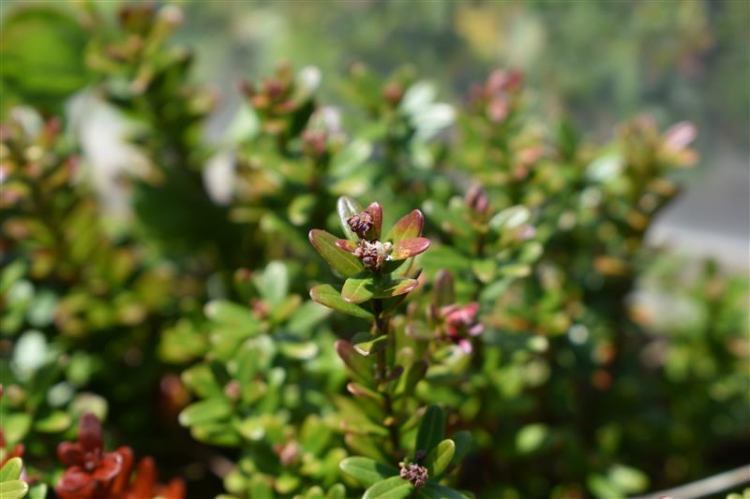
Research at UFV's BERRI Lab has confirmed that cranberry plants will produce lower yields in hotter temperatures.
Yowana says the project has been an amazing opportunity, getting her into a laboratory for the first time.
"I've always liked being in the field, which is why I picked agriculture, but one of my main goals was to learn how to work in the lab," she says. "I've never had insight into the scientific side of research, and I wanted to advance my knowledge in that area.
"This project provided the whole research experience, and I discovered that I like the laboratory. I looked forward to getting in there to do the work, and it's something I would now consider doing as part of a future career."
For more information

33844 King Road
Abbotsford British Columbia
Canada V2S 7M8
www.ufv.ca/