


When Stefania Pizzirani looks at students like Mwenda Dyck and Jason Lighton, she knows the University of the Fraser Valley (UFV) has equipped them with the knowledge and skills to excel in their chosen field.
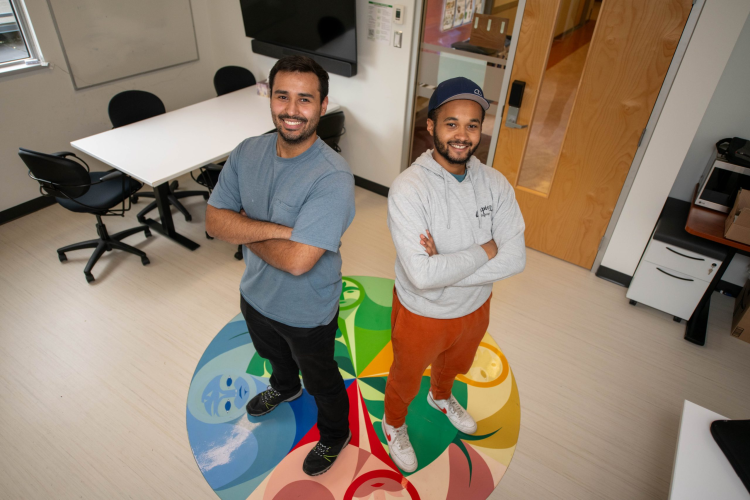
Jason Lighton (left) and Mwenda Dyck (right) participated in a two day agriculture-focused hackathon in October.
But do they believe it? Confidence is hugely important, and that's why Stefania presented them with an amazing opportunity in early October. As part of the Sustainable Food Systems for Canada (SF4C) platform, a national food security project co-led by UFV, Mwenda and Jason travelled to Winnipeg to participate in a two-day hackathon.
They joined some of the brightest young minds in western Canada, tasked with brainstorming sustainable agriculture solutions. They were the only undergrads participating in the hackathon event, and Stefania wanted them to realize that they belong in the same room with the best of the best.
"Everybody has talents, and there's only a year or so between Mwenda and Jason and the master's students," she notes. "They don't need another 10 years of experience to be on par with graduate students. Titles matter a lot less in the real world, and it's more about who you are, what skills you bring to the table, and what you have to say."
The "Solutions in Scaling Sustainable Agriculture" hackathon took place over two days at the University of Manitoba campus.
Mwenda and Jason were placed in teams and given a big problem to solve in a short amount of time.
"We were introduced to a challenge statement, the organization behind it, and some resources we could use to figure it out," Mwenda recalls. "At that point, it was off to the races."
Nature United supplied the problem for Mwenda's group, asking them how a farmer knows that regenerative agriculture is working. Regenerative farming focuses on using holistic practices - such as no-till farming, increased plant/animal biodiversity, rotational grazing - to improve farmland without using chemicals, and fertilizers. It's a step beyond sustainable farming, which aims to maintain, not enhance.
Mwenda, who's studying agriculture science at UFV, joined forces with a computer scientist, an engineer, and a soil scientist. As they worked through their challenge, they had timely help from Nature United mentors.
"They were critical," he says. "They mostly watched from a distance, but when they heard something, they were great at focusing us and keeping us on the right track. When our group started talking about an idea, we called the "farm resilience score", one of the mentors said, Ah ha! That's what you guys need to dial in on.'
"We benefited a lot from their guidance, and they helped us stay calm."
Since May, Mwenda has been working on a farm that is trying to apply regenerative techniques.
"I was able to share some of the real-world problems that come with that, and I was happy to bring that to the discussion," he says. "The two days were very intense with the whiteboard and the sticky notes and the ticking clock. We needed a lot of caffeine, but it was a great exercise on how to manage under stress."
Jason's group focused on a different problem while facing the same challenges.
Jason, a UFV environmental studies student, says the experience pushed him well outside his comfort zone. He says he was initially intimidated working with people who have PhDs and master's degrees, but he settled in and greatly enjoyed the experience.
"Even though I felt less qualified, my voice mattered," he says. "All of the ideas I shared were useful, and I'm confident I contributed to my group's success."
Jason agreed with Mwenda that the mentors were crucial.
"Our mentor pretended she was on a panel and asked us a lot of questions," Jason says. "That helped us relax, because when we answered her questions, we knew we were in good shape. The last thing you want is to be in front of judges, stumbling over your words and not knowing the answers, so she really prepared us well."
Partners providing mentorship at the hackathon included Nature United, McCain, TELUS, and the South East Research Farm.
Officially, the teams spent eight hours at the hackathon, though many worked well into the night (and early morning) after they regrouped in their hotel. That effort culminated in a two-minute sell-your-solution pitch.
"One team made a website in under a day," Mwenda marvelled. "That was super impressive."
Stefania says that the feedback she received from the event organizer was that all of the participants were amazing, and the mentors and judges couldn't tell who the undergrad students were.
"Opportunities such as hackathons really work because they are so immersive, and help students get outside of their comfort zones to see options they didn't know they had access to," Stefania says. "Gathering data, creating presentations, working under pressure - those are technical skill sets that will serve Jason and Mwenda well. But the realization that they are emerging as experts in their respective fields; that's something I hope they will value and hold onto."
For more information

33844 King Road
Abbotsford British Columbia
Canada V2S 7M8
www.ufv.ca/