Two University of Victoria (UVic) geologists have integrated field geology with statistical modelling to give scientists a new view of the chemical reactions happening on ocean floors billions of years ago. The revised picture shows that big changes in the carbon cycle were happening earlier than expected, and at the same time as ballooning atmospheric oxygen and global glaciation.
During what scientists call the Lomagundi-Jatuli Excursion, there was a huge (and puzzling) bump in the number of carbon-13 molecules relative to the more common carbon-12 in the oceans.
"There was previously a lot of uncertainty and debate over what the Lomagundi excursion actually looked like, when it happened and how large it was, because it's very difficult to reconstruct global changes in geochemistry (like carbon-13) from the rock record," says Stacey Edmonsond, UVic PhD candidate in Earth and Ocean Sciences and lead author of a recent article in the Proceedings of the National Academy of Sciences.
Creating a new model
The study found the increase in carbonate rocks rich in carbon-13 was smaller than expected and that it happened around 2.45 billion years ago, earlier than scientists previously thought. That's about the same time as the amount of oxygen in the Earth's atmosphere rocketed from almost nothing to enough to support complex life also known as the Great Oxidation Event.
Edmonsond found answers by creating a statistical model that made almost no assumptions and analyzed carbon ratios in ancient seabeds around the globe.
"It's that lack of reliance on assumptions, the explicit choices she made when designing the model and her using data from many sources around the world that give the model the rigour to work for rocks two billion years old," says Blake Dyer, assistant professor, Earth and Ocean Sciences and Edmonsond's co-author.
By considering all the available observations in concert, this statistical approach places better constraints on what the global change in carbon-13 looked like and how it relates in time to the Great Oxidation Event and worldwide ice ages.
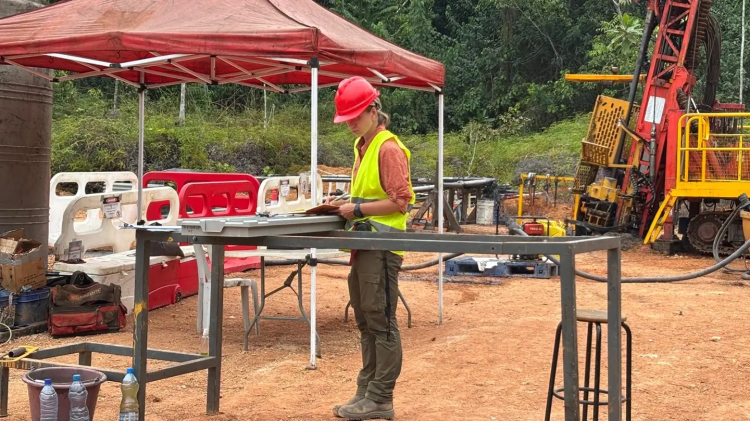
Stacey Edmonsond, UVic PhD candidate, on a site in Gabon with rocks that preserve evidence of the Great Oxidation Event and the Lomagundi-Jatuli Excursion. Photo credit: Tony Prave
The picture of Earth before and after
Before these events, Earth was home to single-celled organisms that used photosynthesis to create organic matter and oxygen. At the same time, other chemical processes like volcanoes and rock formation captured oxygen and kept it from building up in the atmosphere.
Edmonsond wanted to know what tipped the balance to allow oxygen to accumulate and more complex life to evolve. Knowing that as the number of living creatures increased billions of years ago so too would the oxygen they released she developed the new statistical model to better understand the relative timing of these changes.
Using Edmonsond's model, scientists will be able to update calculations as new data becomes available. And that can only help to unearth answers to the biogeochemical mysteries of our evolving planet.
The main impact of this research is an improved understanding of carbon cycling across the interval when Earth's atmosphere first gained oxygen. That set the stage for the evolution of complex animal life. Understanding these transitions provides a critical perspective on the development of our planet, and the rarity of life in the universe."
Stacey Edmonsond, PhD candidate and lead author