The applied research arm of Camosun College, Camosun Innovates, is partnering with FireBozz to further develop a compact wildfire-protection system designed for rapid deployment and reliable structural protection in communities at risk from wildfire.
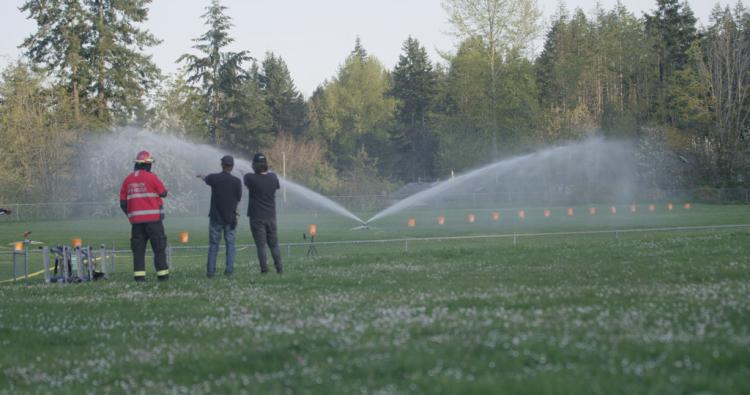
FireBozz - Active testing by Camosun Innovates staff and a local fire department official.
Conventional sprinkler approaches can be limited by small water volume, extended setup times, limited area protection, and reduced effectiveness under variable pressure and flow conditions, particularly in remote or infrastructure-limited environments. Traditional sprinkler systems rely upon agricultural irrigation sprinklers, which are not designed for wildland fire.
The Camosun Innovates project focuses on improving portability, performance under variable water pressure and flow conditions, and overall water efficiency -- key considerations for remote and wildland-urban interface environments.
"This project continues a strong partnership with FireBozz to expand and improve wildfire-protection technology for use in B.C., across Canada, and around the world," says Dr. Richard Gale, Director of Camosun Innovates. "By combining applied research with industry expertise, we're helping accelerate solutions that can make communities safer and improve how water is used during wildfire prevention and mitigation."
Key design aspects of the collaboration include:
- Performance under variable water conditions
- Rapid deployment and portability
- Water efficiency and targeted application
- Durability in field conditions
- Scalability across deployment scenarios
This work builds on an established collaboration between the Nanaimo-based company FireBozz and Camosun Innovates, combining applied research methodologies with field-driven design. Previous phases included iterative prototyping, development of new nozzle designs, and validation of system performance under field conditions.
Working with Camosun Innovates enables the integration of applied engineering methodologies into system development, including iterative prototyping, controlled testing, and field validation. This supports the development of engineered solutions for structural protection that are both measurable and aligned with operational wildfire conditions.
"This next phase of work builds on what we have already seen in the field," says Rod Szasz, Managing Director of FireBozz. "Working with Camosun Innovates allows us to take proven concepts and refine them into more consistent, practical engineered solutions for structural protection."
FireBozz's current work with Camosun Innovates is supported by a $40,000 grant from the National Research Council of Canada Industrial Research Assistance Program (NRC-IRAP), delivered through a pilot initiative administered by Tech-Access Canada focused on advancing clean technology solutions to some of Canada's most pressing challenges.
Camosun Innovates connects applied learning and applied research, design thinking and interdisciplinary inquiry, productivity improvement and tech-savvy intention. Recent projects include design and manufacturing of competitive equipment for Olympic para-athletes, the development of novel methods to carve totem poles using second growth trees, and advanced manufacturing processes informed by real-time digital feedback.
FireBozz systems have been deployed in a range of wildfire environments across North America to support structural protection efforts, including use in community and infrastructure defense scenarios under active wildfire conditions. FireBozz sprinklers have been actively challenged by wildfire ember storms and radiant heat and have protected what they were designed to protect. Real-world deployments have informed system design and operational approach and continual refinement. FireBozz systems are used by all Provincial Wildfire Agencies from Ontario west, they have defended the town of Yellowknife with perhaps the longest wildfire wet line, Jasper Stone Mtn. Village, Adam's Lake sawmill and they are utilized to protect remote structures the Oil & Gas industry, and critical infrastructure such a water treatment plants and electrical grid structures.