Indigenous communities across Canada have worked for generations against the corrosive effects of colonialism to preserve cultures steeped in millennia of history while also preparing for a prosperous, sustainable future.
For three B.C. First Nations, a unique partnership with university researchers and government will support that work by exploring opportunities for Nation-owned clean energy infrastructure and, critically, advancing their energy sovereignty.
Penticton Indian Band (Snpink'tn), Kwikwasut'inuxw Haxwa'mis First Nation and Quatsino First Nation are collaborating with the University of Victoria-led Accelerating Community Energy Transformation (ACET) initiative, Clean Energy BC and the provincial Ministry of Energy and Climate Solutions to identify potential ways to develop and operate their own energy utilities.
Announced in April, the First Nations Utility Study will explore what financing, technologies and policies are needed for the utilities to thrive, then provide business case scenarios tailored to each Nation.
The three First Nations involved in the study will also lead collaborative research on the role energy utilities have played in the past and define what a utility can mean for their communities now and down the road. As well, the Nations will lead the research priorities, define outcomes and maintain ownership of their data and stories.
The goal, say the Nations, is for them to generate clean electricity so they have more power over their futures.
Leading conversations for clean energy projects
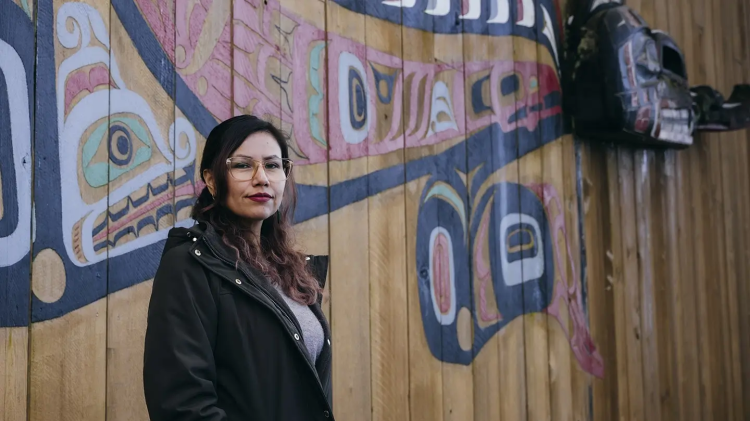
Kara Wilson, Quatsino First Nation. Photo credit: Geoff Heith.
Quatsino First Nation is no stranger to green energy generation.
Located about 50 km northwest of Port McNeill on Vancouver Island in the Quatsino Sound area, the Nation which represents the Saka's Gamakw Gugasa-akw (Five Tribes of the G̱utsa Speaking People), a subgroup of the Kwakwaka'wakw peoples is part owner of the Cape Scott wind farm, which has been operating since 2013. It also uses solar panels to reduce power costs for its administration building, daycare and K'ak'ot'lats'I School. The daycare has battery backup to maintain heating and cooling, and the school's solar system is set up for battery backup, which will be installed at a later date.
"We're very driven to be leading conversations for clean energy projects and being open to new innovations of how we perceive clean energy and how we obtain it," says Kara Wilson, a Quatsino member and energy champion.
"We really like to take care of our people, making sure that we have energy to try to reduce the cost of living for our Nation," she says.
But Quatsino's involvement in the study goes beyond cost reduction.
"We're very determined to continue economic growth while ensuring energy sovereignty," Wilson says, noting the Nation's leadership hopes its youth will find rewarding career paths in the clean energy industry.
Taking a leadership role in the study, and ownership of a prospective power utility, "gives us control of how the project will be run and how it will go through our traditional territories."
Moving away from dependency on diesel
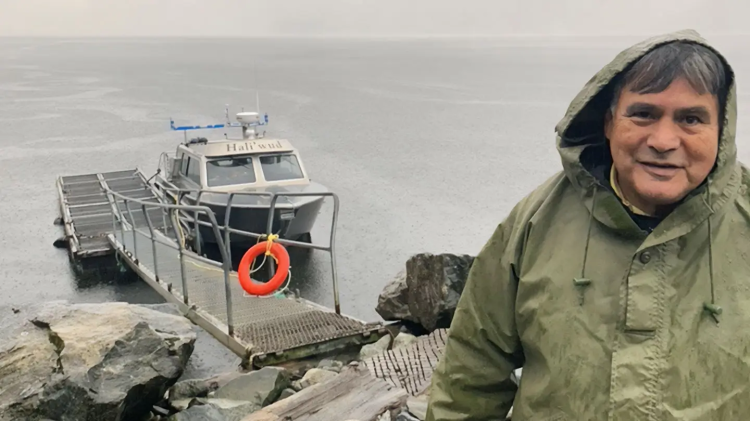
Kwikwasut'inuxw Haxwa'mis First Nation Chief Rick Johnson. Photo credit: Andrea Lyall.
Kwikwasut'inuxw Haxwa'mis First Nation (KHFN) has long used diesel generators for electricity and its partnership in the FNUS is about reducing dependency on diesel, says Karen Burk, KHFN's interim lands manager.
KHFN's culture and governance are grounded in sustainability and stewardship, and the Nation aims to balance cultural teachings with emerging opportunities in clean energy and sustainable resource management. Indeed, the main village site on Gwa'yas'dums (Gilford Island) already has a micro grid fed by solar panels, Burk explains.
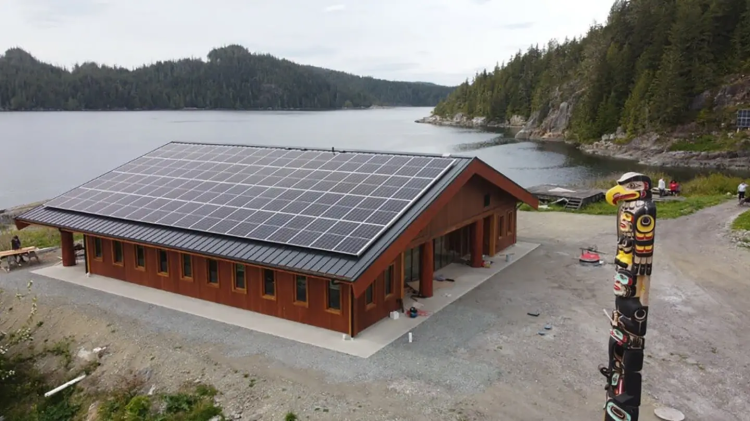
The KHFN band office and solar array. Photo credit: Andrea Lyall.
Expanding the energy sources that feed that grid is a goal for KHFN, she says, noting it is currently underutilized, "so whether it's getting more solar power there or exploring wind it's getting away from that dependency on diesel and just having more options that could be an economic driver."
With many KHFN members living outside the village, the availability of green power is seen as a way to serve more of them when they return to the community.
Energy sovereignty is also a crucial piece of any power utility initiative for Kwikwasut'inuxw Haxwa'mis First Nation, which sees the First Nations Utility Study as a way to leverage local and traditional knowledge while making the most of partners' expertise. Says Burk: "To have somebody else be able to partner and look into the feasibility of something is just so important to be able to see if it's a viable project or not, and make sense of where they want to go and what fits that the best."
From generating energy to economic development

Snpink'tn Councillor Tim Lezard. Image: Douglas Drouin.
"We believe in protecting the land, protecting the water," says Tim Lezard, a Penticton Indian Band (Snpink'tn) councillor whose portfolio includes public works and infrastructure.
Part of the Syilx Okanagan Nation, whose people have lived within their 69,000-square-kilometre territory in the Okanagan Valley since time immemorial, Snpink'tn is guided by the traditional teachings to build a thriving, resilient and self-determining community rooted in language, culture and stewardship.
Lezard says Snpink'tn council is also guided by Snpink'tn's Comprehensive Community Plan, containing the feedback from its 1,100 members. "We got our marching orders. It had a lot of input from our community and green energy was one of them," he says.
"Our people have very high energy bills," he notes, "so a part of being energy-sovereign is to be able to establish an electric utility . We would like to produce our own energy, whether it's a solar farm or wind turbines or geothermal."
Snpink'tn also aims to build a model for other First Nations around B.C. and across Canada to follow, Lezard says. "From generating energy, there's economic development. When you do have your own energy, there's a lot of things you can do with that energy to provide jobs and opportunities."
The First Nations Utility Study is crucial for that, he says. "The data we'll get from this study will help inform decisions for the future of our band."
ACET leads research with First Nations partners
The First National Utility Study was first announced in December 2025 at the First Nations Energy Summit in Vancouver, followed by an announcement of the First Nations participants in April. Next steps for the study include research and model development in 2026, which includes applied research, policy analysis and case study development led by ACET in partnership with the participating First Nations. Presentation of findings, including model frameworks and recommendations, is slated for this year and next.
ACET is a multi-partner initiative based at UVic that is accelerating the global push for resilient and equitable clean-energy solutions through local, community-based collaborations.
FNUS builds on work advanced through the BC Utilities Commission's Indigenous Utilities Inquiry (2019/2020) and the Indigenous Clean Energy Opportunities process since 2021. It reflects a shared commitment to reconciliation, First Nations leadership and the development of economically viable Nation-owned and -operated utilities in B.C.