A shoebox-sized satellite built by students and researchers at the University of Victoria (UVic) is about to take on two very different jobs at once: probing the ionosphere for clues about climate change, and flying a radio communications system that will be released as fully open-source, giving others a working starting point to build satellites of their own.
MARMOTSat, the second CubeSat from UVic's Centre for Aerospace Research (CfAR) and the UVic Satellite Design Team (UVSD) is set to launch in July aboard a SpaceX Falcon 9 from the Vandenberg Space Force Base in California. The satellite has already been integrated into its deployment canister at the Canadian Space Agency, and the team expects it to reach orbit and deploy within hours of liftoff.
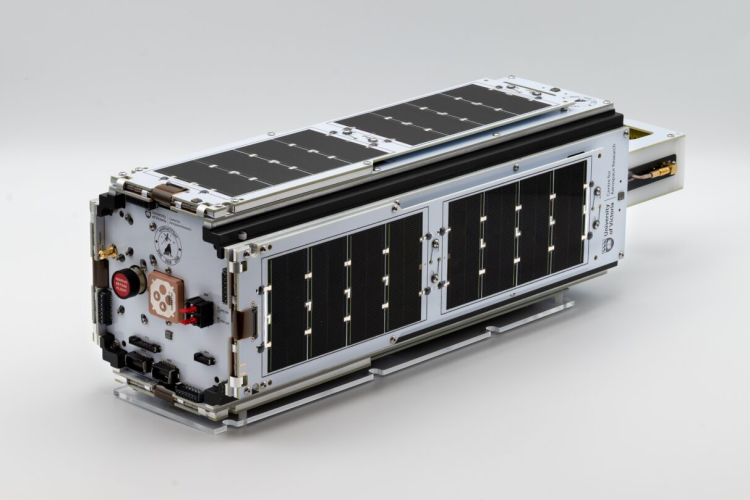
The flight model of the MARMOTSat CubeSat. Photo: Alexander Doknjas.
Once in orbit, MARMOTSat will collect data on the structure and composition of the ionosphere, the charged layer of the Earth's atmosphere that plays a role in everything from radio propagation to satellite navigation. Researchers are particularly interested in how the ionosphere is shifting in response to human-caused climate change, which is a connection that is still not well understood.
Its second job is an open-source radio project. A roughly half-million-dollar undertaking, this system is designed to give amateur radio operators anywhere in the world the tools to build their own satellite communications capability. Most amateur radio operators already have the ground station equipment they need to communicate with satellites, so what MarmotSat is releasing publicly is the spacecraft hardware itself, along with the software that runs it.
"What we're open-sourcing is the spacecraft radio itself," says Blake Baldwin, an electrical designer with CfAR's Space Division and former president of the UVic Satellite Design Team. "This means that other university teams, research groups, or hobbyists can take what we've built and use it as a starting point, instead of designing a satellite radio system completely from scratch."
What we're constructing is a sustainable and comprehensive space engineering program where one mission informs the design and ambition of the next."
Afzal Suleman, CfAR director and professor of mechanical engineering at UVic
UVic's growing satellite program: from ORCASat to PolarLink
The satellite's dual purpose reflects the steady climb in scale of UVic's satellite program. ORCASat, the university's first CubeSat, showed that a small team at a Canadian university could design, build and fly a satellite. MARMOTSat is significantly more ambitious, and it's meant to prove that UVic can keep doing this, and do it better each time. A third mission, PolarLink, is already planned for 2027. That satellite will focus on Arctic communications, testing high-data-rate, low-latency technology including space-to-space optical links aimed at closing a long-standing gap in connectivity across Canada's North.
"A single satellite teaches you a great deal, but it doesn't build a sector," says Afzal Suleman, CfAR director and mechanical engineering professor at UVic. "What we're constructing is a sustainable and comprehensive space engineering program where one mission informs the design and ambition of the next, so that the expertise, infrastructure and people we develop and train stay here and keep compounding, rather than dispersing once a single project concludes."
That ambition has institutional backing. In March, UVic researchers received $5.4 million in federal funding from Pacific Economic Development Canada (PacifiCan), including $4 million earmarked to help establish a Western Canada cluster focused on space-enabled industries. The investment is intended to give CfAR the infrastructure to build that cluster, including specialized facilities, access to satellite data and a pipeline of skilled graduates that missions like MARMOTSat are already training.
Training Canada's next generation of space engineers
That talent pipeline is a quieter but key story behind MARMOTSat. Building and flying a satellite gives students hands-on experience that is difficult to replicate in a classroom. By designing hardware that has to survive launch and operate in orbit, troubleshooting under real constraints and working alongside researchers on a live space mission, students gain the kind of highly qualified personnel training that Canada's growing aerospace sector will need. CfAR's track record in this area extends well beyond one satellite, as many of the students who worked on ORCASat or MARMOTSat are now heading into the space industry themselves, carrying that experience with them.
"Working on MARMOTSat was the most useful learning experience of any co-op I've had," says Sydney Macdonald, a UVic Satellite Design Team computer lead and former CfAR co-op student. "I got to contribute to multiple subsystems and work with different types of technologies and hardware, which gave me a breadth of skills I couldn't have gotten otherwise. That experience is the reason I was offered a position building satellites after graduation."
Watching MARMOTSat launch live
When MARMOTSat reaches orbit, a few members of the UVic team will be watching live from California, alongside the Director General of the CSA, while others follow along from a campus viewing event with the rest of the world via SpaceX's public launch livestream. Whether or not deployment will be visible on camera will depend on the angle of the spacecraft, but the team expects to know within hours whether the satellite has been deployed successfully.
For a team already looking past July toward PolarLink and the next rung on the ladder, that quick confirmation will mark the start of the next phase: turning a successful mission into real data, real results and a real case study in what a sustained university space program can do.