UBC researchers and municipal partners have developed a modelling tool to help cities adapt to rising temperatures by mapping where new trees offer the greatest cooling impact.
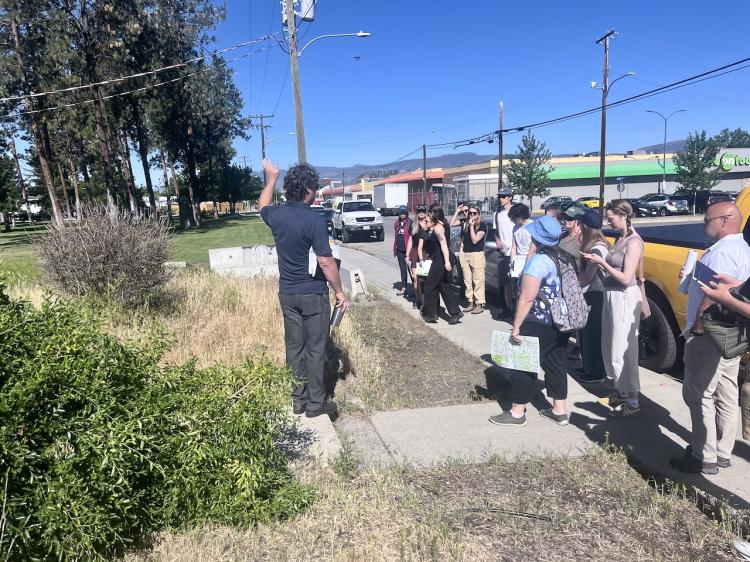
Todd Cashin and Jennifer Miles of the City of Kelowna and UBC's Dr. Melissa McHale lead a walking tour of Rutland with researchers and city staff, assessing tree-planting challenges in the neighbourhood. (Photo credit: Melissa McHale)
First piloted in Kelowna and now expanding to Vancouver, CanopyFit accounts for urban constraints like underground utilities, overhead wires and infrastructure that often hinder planting.
"Creating and sustaining extensive canopy cover, by protecting mature trees and planting trees that can grow to large sizes, is one of the most effective investments cities can make to reduce exposure to extreme heat," said Dr. Melissa McHale, a professor in UBC's faculty of forestry and environmental stewardship and lead of the Urban Ecology and Sustainability Lab. "The challenge is making space for those trees and helping them thrive where they're needed most."
Turning heat maps into action
"A site can look empty on a map and still be impossible to plant," said Dr. McHale. "CanopyFit accounts for the hidden barriers that determine where trees can realistically go and how large they can grow."
By combining CanopyFit data with heat maps, shade models and demographic data, researchers can pinpoint priority zones. In Kelowna, the team identified neighbourhoods like Rutland as high priorities for heat relief and equity, while others, like Midtown, faced significant constraints despite high cooling needs.
"Trees are no less important there -- overcoming barriers, choosing suitable species and investing in long-term care may just require more resources," said Dr. McHale.
The analysis found that about half of Kelowna's new-canopy potential was concentrated in roughly 20 per cent of its highest-opportunity planting sites, suggesting cities can maximize limited budgets by targeting areas where cooling benefits and planting opportunities align.
The team also used satellite imagery and machine learning to improve the city's heat map resolution from 30 metres to 10 metres, helping planners pinpoint exact locations for cooling interventions.
Researchers found that every 10 per cent increase in tree canopy can reduce mean radiant temperature -- the heat people feel from their surroundings -- by roughly 1 C.
Science developed with cities
The UBC-Kelowna partnership began in 2022, developing tools for municipal planning needs.
"Our goal is to support the planting and long-term success of more trees across Kelowna, growing a stronger urban canopy for future generations," said Todd Cashin, urban forestry supervisor with Kelowna. "These partnerships are incredibly valuable because they allow us to accomplish so much more together than we could on our own."
Cashin noted that recent wildfires and extreme heat have heightened public awareness of the role of urban forests in climate adaptation.
"We've known about heat effects in desert-style communities like ours, but sharing that message is easier now," he said. "After experiencing wildfires and extreme heat events in recent years, more people recognize the important role trees play in creating cooler, healthier and more resilient communities."
"Cities move faster than academic publishing," said Dr. McHale. "We develop tools on municipal timelines, test them against real planning decisions and publish once we prove that they are genuinely useful."
From Kelowna to Vancouver and beyond
While researchers refine the tool through further study, its core methodology is reproducible. Diamond Head Consulting has integrated CanopyFit into its spatial forecasting tools to evaluate Vancouver's future canopy growth and guide urban planning.
"We saw real alignment between the research methods and the questions cities are trying to answer," said Amelia Needoba, principal and senior urban forester at Diamond Head Consulting. "It's been a powerful example of research and practice informing each other."
For Reg Eddy, arborist and urban forest planner with the Vancouver Park Board, the project supports more strategic canopy planning.
"While results are early, this project aims to improve tree canopy decision-making," said Eddy. "It will help us identify strategic actions to boost canopy cover in the highest-priority areas."
The Kelowna research was supported by grants from Canada's Natural Sciences and Engineering Research Council. Dr. McHale's broader research partnership with the City of Kelowna was supported by a UBC Wall Fellowship.