

Using machine learning to predict how climate change will affect monarch butterflies in southern Ontario might sound like an unexpected project for a business student.
For Royal Roads Master of Global Management student Guillermo Granillo Sanchez, it was a natural fusion of his two-decade career in enterprise IT and a desire to venture into new territory.
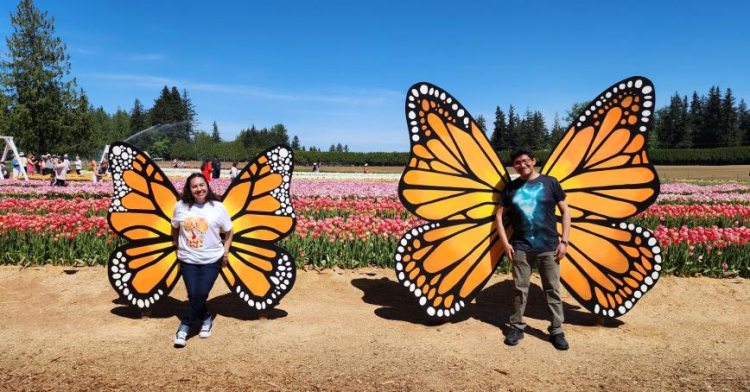
Granillo Sanchez completed a research internship with the Ontario-based International Center for Applied Systems Science for Sustainable Development, applying machine learning models to analyze potential monarch butterfly habitat loss around Lake Ontario and Lake Erie.
"I never expected to research something in biology because of my background and because of the [business] master's, but it was interesting," says Granillo Sanchez, who is originally from Mexico City.
Model predicts migrant butterfly's future
The orange-and-black-winged monarch butterfly is found across Canada, migrating up to 4,000 kilometres south to Mexico each autumn before returning north in May. Around the Great Lakes, monarchs feed on nectar from milkweed a vital food source increasingly threatened by shifting weather patterns driven by climate change.
To analyze these shifts, Granillo Sanchez built a machine learning model that aggregated data from biodiversity platforms such as the Global Biodiversity Information Facility and iNaturalist, alongside weather projections from the open-source weather API Open-Meteo. His goal was to forecast habitat changes as far ahead as 2050.
The model projected that both the Lake Erie and Lake Ontario basins will lose suitable monarch habitat over the next 25 years, with the Lake Ontario region experiencing significantly greater loss.
"In the next 25 years, the areas around the lakes will be warmer than they are currently," Granillo Sanchez explains. "Because eventually these new temperatures will be moving to the north of the lakes, so the insects and the plants will be moving, too."
If monarch butterflies are forced north to follow milkweed, their migration routes and breeding territories could be permanently altered.
Accounting for Possibility
While Granillo Sanchez did not anticipate conducting environmental research, his technical background and the data-processing capacity of machine learning proved essential.
"The amount of information that the machine can manage is huge in comparison with what humans can do," he says. "Once we train the model, we can process new information much faster and more efficiently than starting from scratch."
Though he plans to remain in the technology sector, Granillo Sanchez credits his internship and MGM coursework with broadening his professional perspective.
"I discovered I can open my mind to explore more things," he says, noting he chose the Master of Global Management program to expand his career options. "After one year in the MGM, my scope is bigger because of topics such as ethics, leadership, strategy and change management. I have learned more than I expected."
Having spent most of his career in financial technology, Granillo Sanchez sees endless potential ahead.
"Now, when I look at other sectors, other opportunities and other perspectives, the possibilities are amazing."
Learn more about the Master of Global Management.