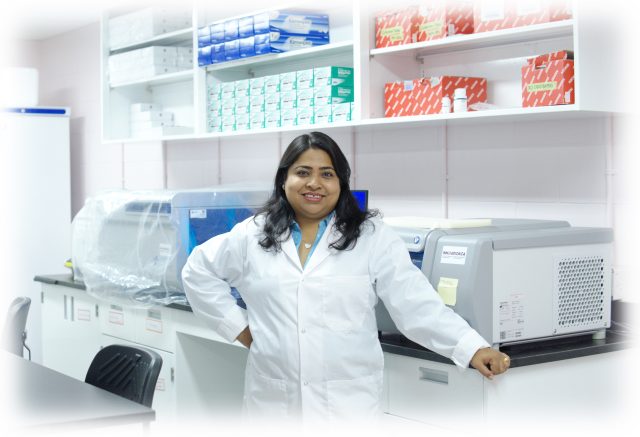
Brandon University's Dr. Mousumi Majumder has been renewed as Tier 2 Canada Research Chair in Genotoxicology. The five-year, $500,000 award from the Canadian Institutes of Health Research (CIHR) runs from June 1, 2026 to May 31, 2031 and will support the next stage of her breast cancer research at BU.
Breast cancer is the most common cancer in women around the world, and the second leading cause of cancer deaths. Treatments like surgery, radiation, and chemotherapy work in part by damaging the DNA inside cancer cells; then DNA repair mechanisms signal whether a cell should live or die. But some cancer cells find ways to fight back. They can make their own protective molecules, ignore instructions to die, or conduct faulty DNA damage repair, and then the cancer comes back. This is a serious problem for triple-negative breast cancer, one of the hardest forms of the disease to treat and often chemotherapy is the only choice; around 30% of TNBC develop resistance to chemotherapy.
"Too many patients do well at first and then find that the cancer has returned. We want to understand how cancer cells survive treatment, if we can find biomarkers to predict treatment outcome, so we can help doctors stay one step ahead." - Dr. Mousumi Majumder
Dr. Majumder is a Professor in BU's Department of Biology and leads the Breast Cancer Cell & Molecular Research Lab (BCCMRL). In her first term as Chair, her team discovered two tiny molecules, called miR-526b and miR-655, that help breast cancer grow and spread. Think of them as small switches that tell a cell which genes to turn on or off. Her team also found that the harmful effects of these molecules can be blocked by targeting a pathway in the cell known as COX2/EP4, and that high expression of miRNAs could one day serve as warning signs in a blood sample.
In this second term, the team will look closely at how these molecules help breast cancer cells handle stress. In the lab, they will put breast cancer cells under pressure in two ways: with hydrogen peroxide, which causes the kind of damage that builds up in cells over time, and with doxorubicin, a common chemotherapy drug. They will then read the activity of thousands of genes at once to see which ones change, and test what those genes actually do. The goal is to find that molecular switch that can help treat treatment-resistant cancers, including whether pairing doxorubicin with a COX2/EP4 blocker could work better against triple-negative breast cancer. Along the way, the team will test whether these genes and molecules can be measured in a blood sample to predict treatment outcomes in patients who might not respond to chemotherapy, helping doctors choose the best treatment.
"Dr. Majumder's work shows what a research program at a university of our size can do. This renewal recognizes the importance of her research, and we are proud to support her as she pursues answers that matter to patients and families here in Manitoba and across Canada." - Dr. Bernadette Ardelli, Vice-President (Research & Graduate Studies)
Much of this work happens through the students who train in Dr. Majumder's lab, from second-year undergraduates learning to grow and study cells to graduate students leading their own projects. While their work is separate from the Chair itself, it is closely tied to her research program. The foundational work on stress responses and chemotherapy resistance was done by two previous MSc students in BCCMRL, Reid Opperman and Brady Nault.
Current graduate student Carter Williamson is studying how breast cancer cells change the way they use energy after being treated with doxorubicin, which could shed light on why the drug stops working over time. Shamima Nasrin Anonna is investigating a protein called TXNDC12, which her lab's earlier work found at unusually high levels in cells carrying the cancer-promoting molecules, and which has been linked to cancers that spread. Vaishnavi Lakshana Gopaul is looking at another protein, MYL6B, that helps cells move, and whether it could make blood tests for breast cancer more sensitive. Research assistants Evan Dreilich and Bree Pringle are, respectively, using computer analysis to search for shared patterns in cells that resist doxorubicin, and testing whether an out-of-place protein called ATP synthase is something cancer cells need to survive. Sujit Maiti analyzes large-scale omics-based data, conducts statistical analysis, and also helps manage BCCMRL.
Undergraduates also take part. Antoni Klonowski, an NSERC Undergraduate Student Research Award recipient, and Morolaoluwa Temitope, who held a CIHR undergraduate research award, have gained hands-on experience with lab techniques such as cell culture, imaging, and protein analysis. Newer trainees Aditya Virpariya and Glydel Capua are learning those same skills with the hope of completing honours theses in breast cancer research.
"Dr. Majumder's students gain hands-on experience exploring solutions to a major health challenge. This renewal ensures continued support for unique research opportunities for our students and further strengthens the training and development of these emerging scientists at Brandon University." - Dr. Chris LeMoine, Dean of Science
Dr. Majumder's work has earned wide recognition. She received the 2025 YWCA Westman Women of Distinction Award in Science, Technology, and Trade, and has been profiled by the Canada Foundation for Innovation, Research Manitoba, and Breast Cancer Canada. BCCMRL, led by Dr. Majumder, is also supported by an NSERC Discovery Grant, the Lotte and John Hecht Memorial Foundation of Vancouver, BC, and locally by the Butler Family Foundation and the Waves of Hope Dragon Boat Team, which recently launched a capital fundraising campaign, Hope in Our Backyard', to support the breast cancer research program at Brandon University. The Canada Research Chairs Program supports research excellence at universities across the country.