



Lara Campbell, a history professor who holds the endowed chair in Leadership and Civic Studies within Wilson College of Leadership and Civic Engagement, has been named the college's new academic director.
She takes over July 1, 2026, from acting director Stephen Jones, a professor emeritus in the Department of Economics.
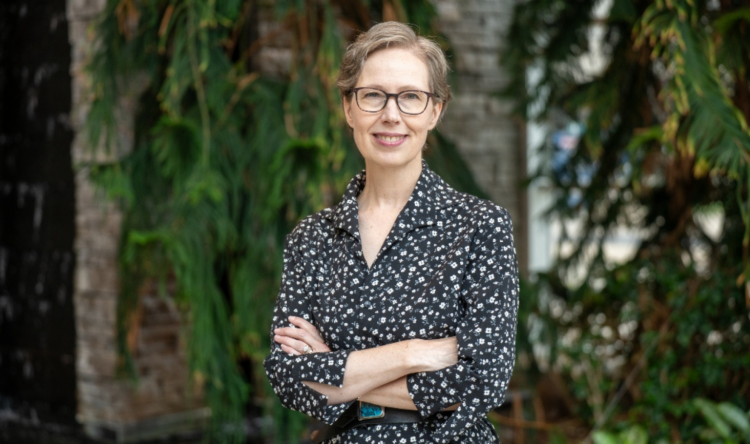
Campbell joined Wilson College and the Faculty of Humanities in September 2025, after having served as a professor of gender, sexuality and women's studies at Simon Fraser University, where she also held several administrative positions.
Campbell joined Wilson College and the Faculty of Humanities in September 2025, after having served as a professor of gender, sexuality and women's studies at Simon Fraser University, where she also held several administrative positions.
Campbell is the author of two books: Respectable Citizens: Women, Gender and the Family in Ontario's Great Depression and the award-winning A Great Revolutionary Wave: Women and the Vote in British Columbia. She has published numerous edited and co-written books, and is currently working on a co-written history of Canadian welfare state policy, a SSHRC-funded research project on transnational anti-draft and anti-war activism during the Vietnam war, and a co-authored project on the intersection of suffrage and socialist feminism in Canada.
She completed her undergraduate degrees in social work and history here at McMaster, and holds a PhD in history from Queen's University.
"We are thrilled that Lara Campbell has joined us as both the academic director and endowed chair for Wilson College," says Pamela Swett, dean of the Faculty of Humanities. "Dean of Social Sciences Jerry Hurley and I both feel that Dr. Campbell's administrative experience and commitment to working across disciplines will enable the Wilson College community of students, faculty, staff and practitioners to grow and flourish as they work together to redefine leadership."
We sat down with Campbell to learn more about her, her work, and her vision for Wilson College.
What inspired you to get into your field? And what inspires you now?
My teaching and my research field is in Canadian women's and gender history. During my undergraduate degree at McMaster, I was inspired by my professors, whose research was at the intersection of gender and the social welfare state - how women resisted political and social inequality, but also how individuals worked together collectively to make political change.
I took a great course in labour history at McMaster, and it was the first time I'd taken a labour history course that was also a women's history course - it allowed me to see what I was learning in social work and what I was learning in history really complemented each other. I ended up going on to graduate school to explore those questions more deeply.
And after teaching for two decades, I can say that I'm now inspired by my students. I really feel this generation of students are facing tough challenges in a world that is rapidly changing, and the way that they think hard about how to meet those challenges helps me to be a better teacher.
What are some influences on your work?
My work has been influenced by working in interdisciplinary environments. I've been influenced by feminist theory, particularly feminist theories of gender and the state. I've also learned from cultural studies scholars who have researched the intersection of emotions with activism and politics, and by critical race scholars whose research is about the intersection of gender and race.
I really do like working with colleagues across disciplinary divides because that reminds me that there are multiple ways to approach and understand a question, or to solve a problem.
I feel like interdisciplinarity is like a web - you end up working with people who might have interests in similar topics, but who approach a question or problem or time period from a completely different point of view. That's what exciting about interdisciplinary research and teaching.
What do you see as the impact of your work?
That's a hard question to answer! I do hope that my academic research and teaching in women's and gender history and on social movements demonstrate that what we believe about ourselves and what we believe about the world can change and always does change.
Change comes from working together collaboratively, being open to new ideas and new ways of understanding the world, as well as being invested in institutions - whether that's government or social welfare or education - that have shaped our lives in the past and will continue to shape our lives in the future.
That segues nicely into asking about civic engagement - what does it mean to you, and what is the role of the university in encouraging it?
I've been interested in civic engagement for a while through my research - how people interact with their communities, participate in ways to strengthen democracy, hold politicians to account and tackle pressing issues.
I think about civic engagement quite broadly - it may be about involvement in politics, it might be about community advocacy, and it might be about social and political protest.
What I've learned as a historian of social movements is that civic engagement and social change happen on many levels and they happen in many spaces: it might be in formal politics and policy-making, in families, in universities, in unions, or in faith-based institutions.
I think civic engagement happens when people talk with each other, listen and work collaboratively.
Universities play a crucial role in fostering civic engagement - they're places where we can explore ideas and think through pressing problems together in ways that are driven by intellectual curiosity and creativity, but also a respect for dialogue and conversation and a commitment to inclusion and equity. Universities have an opportunity to model those values in everything we do, from our research to the classroom.
What are your plans for Wilson College?
As you know, we welcomed the first cohort of undergraduate students to Wilson College this September. I've met them, and they're a very inspiring and dedicated group of young people. I'm really looking forward to being part of a team of staff, faculty, and students working together to increase the visibility of the program.
I'll be continuing the work of building partnerships with organizations and community groups in the Hamilton area, as well as supporting our incoming practitioners and scholars in residence, which is an exciting and energizing part of Wilson College.
As research chair, I'll be working to build a community of scholars at McMaster who are interested in research around democratic engagement, dialogue, community building and leadership. McMaster has a vibrant culture of research and is home to scholars across the social sciences and humanities who are approaching these questions from a range of perspectives, so I'm looking forward to learning more about the work of my new colleagues.
Now for the fun questions - what do you like to do when you're not working?
I have a very sweet standard poodle, so I like to take him for walks. I've enjoyed getting reacquainted with the trails in and around Hamilton - the Bruce Trail has been especially fun to explore. I'm looking forward to continuing that once the weather gets better and the trails are a little less icy!
Like a lot of academics, I'm a big fan of murder mysteries, so I love to read, especially the Scottish writer Ian Rankin. And I play the flute! I worked as a flute teacher during my undergrad, and was in the concert band here at Mac. I'm hoping once I'm more settled I might find a community band to join.
Campbell at the end of hiking Hadrian's Wall in Northumberland, UK.
Finally, what's one fun fact about yourself that people might find surprising?
A few years ago, after a conference in the UK, I hiked a 100-km stretch of Hadrian's Wall in Northumberland solo. It's a UNESCO World Heritage Site, and a great way to explore Roman history and take in the beauty of the Northumberland countryside up close. It was a beautiful, interesting, and inspiring walk!
Made possible by a $50-million gift from McMaster chancellor emeritus L.R. "Red" Wilson in 2022, Wilson College offers Canada's only Bachelor of Leadership and Civic Studies, which students take alongside degree studies in a discipline in either humanities or social sciences.
Along with its undergraduate program, the college, a partnership between McMaster's faculties of Humanities and Social Sciences, also offers residencies for both practitioners and academics, and encourages research and conversation around leadership and civic engagement through a variety of initiatives.
Learn more about Wilson College of Leadership and Civic Engagement on their website.


