Clarity is key to success for Megan Babiski.
By combining clear expectations with what they describe as "relational engagement," a strategy for making curriculum accessible to students in a personal way, the award-winning graduate teaching assistant aims to improve learning experiences for everyone.
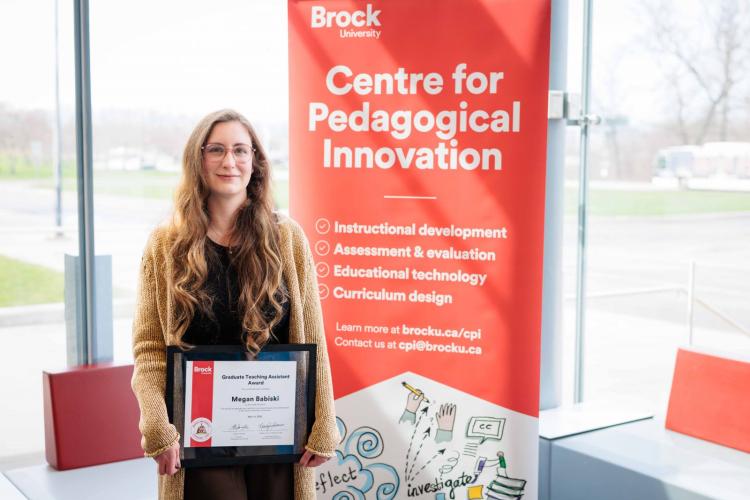
Graduate (Master's) Teaching Assistant Award recipient Megan Babiski from the Department of Applied Disability Studies was one of several teaching assistants recognized at a celebration hosted by Brock's Centre for Pedagogical Innovation on Tuesday, April 14 in the Goodman Atrium.
"People are more engaged in learning when they care about what they're learning about," she says. "I try to integrate students' interests, but I also come into the classroom as a human with my own interests. For me, that relational element can really help enrich the learning process and the application of knowledge."
Babiski was one of five teaching assistants who received special recognition during a reception hosted by Brock's Centre for Pedagogical Engagement (CPI) on Tuesday, April 14 in the Goodman Atrium. The event honoured recipients of CPI's Teaching Assistant Awards, Teaching and Learning in Higher Education certificates and Graduate Teaching Assistant Practicum certificates.
Babiski says the opportunity to start guest lecturing while completing a post-graduate college certificate in autism and behavioural science sparked a passion for pedagogy that has yet to subside.
As an autistic person, they developed their pedagogy through lived experience. Now, as a Master of Arts student in Brock's Department of Applied Disability Studies, they are also studying pedagogy, completing research on trigger warning practices in higher education systems with a focus on the perspectives of autistic students who have also experienced trauma.
Taking advantage of training offered by CPI, Babiski took part in this year's series of workshops on teaching in the age of generative artificial intelligence (AI), gathering insights she says were especially helpful in online asynchronous courses. Collaboration and mentorship from within the Sociology and Criminology department also influenced her approach.
"We had really good conversations about how we can approach expectations about generative AI in the online space in a way that's compassionate and also maintains the scholarly rigour that will allow students to thrive," Babiski says. "We are doing students a disservice if we're not preparing them for the academic environment and the environments associated with their career outcomes."
Mary-Beth Raddon, Chair of Sociology and Criminology, says Babiski shows students how to become engaged learners.
"Many first-year students arrive in Introduction to Sociology expecting rote lessons on the course material," says Raddon. "With Megan, students had a seminar leader who modelled and imparted the intellectual skills and disposition to explore the complexity of social thought."
Giulia Forsythe, Director, Teaching and Learning in the Centre for Pedagogical Innovation, says all of this year's award recipients "exemplify Brock's commitment to high quality and meaningful educational experiences."
Other recipients included fellow Graduate TA Award winner Shealin Murray, a PhD student in the Department of Psychology; Novice TA winner Erika Savage in the Department of Child and Youth Studies; International TA Award winner Tanima Ferdous from the Faculty of Education; and TA Award winner Mariam El-Morched in the Department of Chemistry.
"Every year, it is such a joy to read the nomination packages for teaching assistants across Brock University," says Forsythe. "The rich diversity of instructional strategies is matched by the care and compassion TAs show for their students in their ongoing efforts to create inclusive and meaningful learning environments. Each year we receive an increasing number of nominations, and the calibre is always so impressive."