Leaders in research, government and industry gathered to celebrate the official opening of BioLabs University of Toronto, the largest shared lab incubator in the city and the first Canadian site of BioLabs' global network.
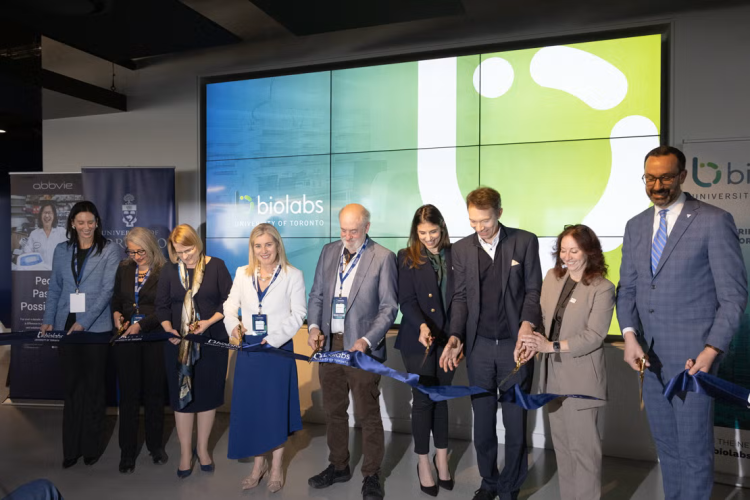
Representatives from U of T, BioLabs, government and industry cut the ribbon to officially open BioLabs University of Toronto (photo by Polina Teif)
The ribbon-cutting ceremony, held April 20, marked the launch of the 40,000-square-foot shared lab and co-working space in the MaRS Discovery District, already home to dozens of early-stage life-science startups.
U of T President Melanie Woodin welcomed BioLabs - now with 19 locations worldwide - as an important partner who will help Canadian discoveries take root at home.
"Their presence will strengthen the Toronto region as a place where breakthrough life science research can be turned into new companies and jobs, and improve the health of Ontarians and Canadians," Woodin said.
Johannes Fruehauf, founder and CEO of BioLabs, agreed. He told attendees that the new site will "position Toronto as an internationally competitive hub for early-stage biotech and health-care innovation."
Located at the heart of Toronto's life sciences ecosystem, BioLabs University of Toronto builds on the university's longstanding support for life sciences innovators and entrepreneurs, and complements its existing venture-creation programs. It works with key local stakeholders - MaRS, Toronto Innovation Acceleration Partners, U of T's hospital partners and other members of the Toronto innovation ecosystem - to support companies from formation to scale.
U of T's Leah Cowen, vice-president, research and innovation, and strategic initiatives, and Scott Mabury, vice-president, operations and real estate partnerships, both emphasized the partnership's role in building an end-to-end pathway for founders - from discovery through commercialization and scale-up.
Sylvia Jones, Ontario's deputy premier and minister of health, and Nolan Quinn, minister of colleges, universities, research excellence and security, attended on behalf of the provincial government, with Vic Fedeli, minister of economic development, job creation and trade, sending video greetings.
Among the industry partners on hand was AbbVie, which announced its founding sponsorship of BioLabs University of Toronto - a five-year commitment supporting equipment, staffing and programming, plus two annual AbbVie Biotech Innovator Awards offering free lab space to Canadian founders.
"AbbVie's founding sponsorship continues our commitment to support life science entrepreneurs and the biotech ecosystem in Ontario and Canada," said Arima Ventin, executive director of market access and government affairs, who was joined by colleagues Sridhar Mandapati, senior director of international business development, and Christina Vorvis, director of East Coast ventures.
The event also included a panel on building Toronto's biotech advantage, where speakers discussed how BioLabs' entrance will elevate the city's stature on a global scale.
Christine Allen, a professor in U of T's Leslie Dan Faculty of Pharmacy and co-founder and CEO of Intrepid Labs, said the arrival of BioLabs underscores Toronto's status as an important life sciences ecosystem "and that helps us to attract investors and prospective partners."
One of the roughly 30 startups currently operating out of BioLabs University of Toronto, Intrepid Labs was among the companies that gave attendees a glimpse of the innovative work taking place at BioLab University of Toronto during a tour of the space. The startup is harnessing AI and robotics to accelerate drug formulation development.