As the heart valve sample came into focus under the microscope lens, Kathryn Grandfield knew this was what she wanted to do for the rest of her life.
In high school, Grandfield attended a materials engineering camp, where a session was led by Diego Mantovani, an expert in biomaterials for regenerative and reparative medicine at Université Laval in Quebec City.
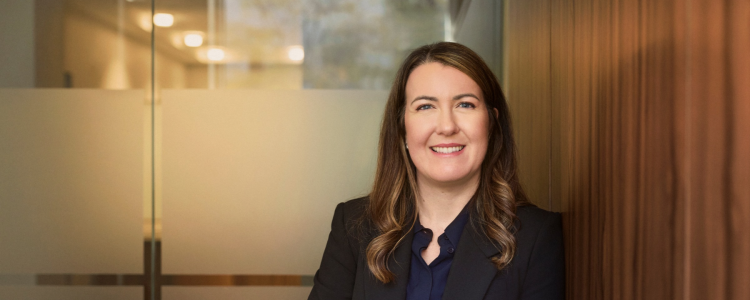
I want to be known for taking these big swings and these big risks, and for taking on challenging projects and delivering good science,' says Kathryn Grandfield, who is one of this year's Arthur B. McDonald Fellows, a prestigious honour awarded to only six outstanding researchers in Canada each year. (Photo by Sylvie Li, Shoot Studio)
"I remember he showed us this project that explored why heart valves fail," recalls Grandfield, now a leading McMaster Materials Science and Engineering expert and associate dean of graduate studies in the Faculty of Engineering.
Mantovani asked them to look at samples under a microscope to observe cholesterol build up and defects in the heart valve. That was the moment everything came into focus for Grandfield.
Before, she had considered a career in medicine. But it was seeing through a microscope that opened her eyes to biomedical engineering and showed that she could "create solutions to improve people's health as an engineer."
Today, that vision has grown into a remarkable career. Grandfield's research output has earned her a Tier-2 Canada Research Chair in Microscopy of Biomaterials and Biointerfaces, and her work in the field of microscopy has been featured on the covers of Physics Today, Nano Letters and ACS Nano.
A moment of recognition
The Arthur B. McDonald Fellowship recognizes six early-stage researchers from across Canada each year for their transformative contributions to the natural sciences and engineering.
Funded by the Natural Sciences and Engineering Research Council of Canada (NSERC), the fellowship provides recipients with $250,000 in research funding to expand their labs and grow their research programs. It also releases them from teaching and administrative duties.
When the email asking Grandfield to contact NSERC's president first hit her inbox, she almost didn't believe it. "I just remember saying out loud, Oh my gosh, does this mean what I think?'"
The first person Grandfield wanted to share the news with was Carlos Filipe, the faculty's associate dean of research. He had given her the nudge she needed to apply for the award.
Text messages were sent, a chase around John Hodgins Engineering Building ensued, and Filipe eventually found his way to Grandfield's office, where he gave her the "biggest high-five" of her life.
Amid the joy and high-fives, the importance of this recognition was not lost on Grandfield. She calls it a "humbling moment" one that recognizes the good work that her team is doing.
"As researchers, you do this work because you're curious and you have questions to answer. You work tirelessly, experiments fail all the time, and you just keep going without any expectation for recognition. You do it because you love it and because there's always more to uncover." Kathryn Grandfield
Seeing details no one has seen before
Despite a multitude of academic titles and a vast research program, Grandfield will tell you she's still a microscopist at the end of the day.
"I just want to go to work and look at interesting samples in my microscope," she says with a chuckle.
But the microscopes she uses are not the high school tabletop version she used in camp. They are large-scale microscopes sometimes filling an entire room that use X-rays, electrons and ion beams to see the internal structure of materials in high resolution.
The combined use of these different types of microscopes is called correlative microscopy, explains Grandfield. "It's the idea that one tool can't give us all the answers, but together we can look at the same region and go progressively smaller in scale."
Thanks to correlative microscopy, Grandfield's lab can see what bones are made of and how those internal structures are organized on an atomic scale. And though the atomic scale already sounds small, says Grandfield, you might be surprised by just how small of a scale it actually is.
"We study small sections of bone that are roughly 700 times smaller than a single strand of human hair," she explains. "With these microscopes, we can observe exactly where an implant touches bone and we can analyze how its structure integrates together."
The process starts with an X-ray analysis, where Grandfield observes the large structure of material on a bone-implant interface. From there, she'll dig down further into the structure with electron and ion beam microscopes.
These analyses are key to understanding how a material is structured and what it's composed of, explains Grandfield. "It also gives us hints into why it performs a certain way so we can understand how it works."
But why do we need to understand structures on such a microscopic scale? It turns out human health kind of depends on it.
There's a concept in biomedical engineering called biomimetics, explains Grandfield. It's the idea of taking inspiration from nature to solve engineering design challenges.
Grandfield's group is doing exactly that to figure out how to design better medical implants think seamless hip replacements or stronger dental implants.
"If we want to develop new devices to replace bone tissue, we need to know what that tissue actually looks like first," says Grandfield. "Since we know everything is made up of atoms, we shouldn't just be looking at the large-scale structure we need to look all the way down to the atomic scale to see how these materials form."
This small-scale analysis allows researchers to answer key questions about the device, like whether the natural tissue recognized and integrated with the device, or whether the new material is even effective at all.
Big swings pay off
Though Grandfield's work happens at the atomic scale, her ambition is nothing short of astronomical.
"Our lab has discovered features in bone that people didn't know existed because they couldn't see at the length scale we were looking at," says Grandfield.
"With this fellowship, we want to take that discovery beyond a snapshot of what's happening. We want to see this happening in real time."
That means developing an imaging approach that can observe how proteins interact with the surface of an implant, how bone forms, while it's happening.
Most of these microscopes operate in a vacuum, explains Grandfield. The absence of air or other particles allow the electron beam cuts perfectly through this vacuum to interact with the material inside the microscope.
With the help of a specially fabricated holder, though, Grandfield can put capsules inside the microscope that are filled with tiny channels of liquid and collagen fibrils. From within these capsules, she can observe the formation of bone from a liquid state at the tiniest of length scales.
But the work doesn't stop there Grandfield's thinking bigger.
Her group has developed a method to take pieces of fabricated biomaterial and put them inside this specialized holder that mimics what's inside our body.
This method allows researchers to screen biomaterials quicker, seeing which biomaterials work the quickest or which of them develop the best coating of bone on their surface.
And though this type of project may seem like a "pipe dream" to some, says Grandfield, it's precisely these kinds of risks that have defined her career.
"I want to be known for taking these big swings and these big risks, and for taking on challenging projects and delivering good science," she says. "Now, we have a chance to take those big swings and keep pushing this field forward."
Opening doors
Reflecting on this recognition and what it means to her, Grandfield recalls a moment that happened shortly after she learned that she was one of this year's fellowship recipients.
One of her students called her down to the lab because they had imaged a specific protein for the first time, she recalls, and they had the opportunity to celebrate this achievement three years in the making together.
More than anything else, Grandfield hopes this recognition will help her train the next generation of leaders in this field.
"I think I have the best job in the world. My job is to learn and to teach people. Isn't that such a privilege that I get to work each day to learn as much about something as I can to push a field forward, and I'm able to pass that knowledge on to trainees who will surpass me one day? I can't imagine a better job than this." Kathryn Grandfield
Grandfield's students have gone on to various roles over the years some work in industry and others are professors all around the world.
"It's incredible to see this network of good young scientists and engineers forming," says Grandfield. "I hope that this award enables me to continue playing a part in opening doors for them."
This is the second consecutive year a McMaster Engineer has won the Arthur B. McDonald Fellowship. Last year, Mechanical Engineering Associate Professor Tohid Didar took home the prize. In 2018, Chemical Engineer Todd Hoare earned the NSERC E.W.R. Steacie Memorial Fellowship, which was later renamed in honour of McDonald.