

Looking back on 80 years of the Edwards Bachelor of Commerce degree at the University of Saskatchewan.
Born of Prairie pride, the Edwards School of Business (Edwards) at the University of Saskatchewan (USask) has a rich history of transformation. With more than a century of impact, Edwards Dean Dr. Keith Willoughby (PhD) reflected on 80 years of the Bachelor of Commerce program and shared a look at the future.
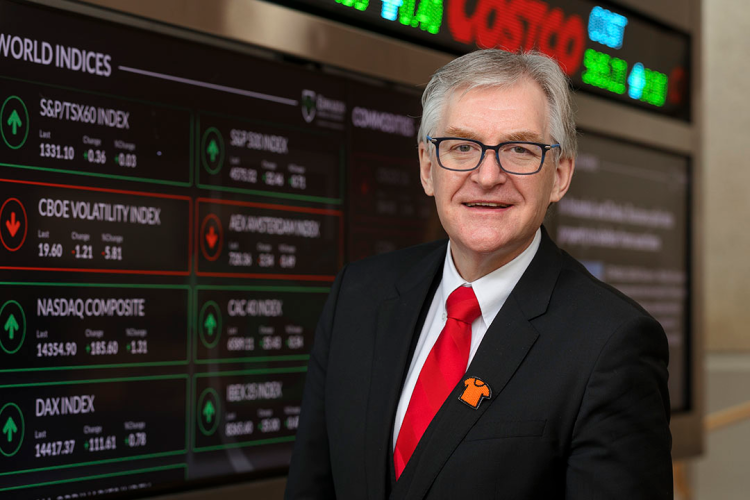
The dean of the Edwards School of Business, Dr. Keith Willoughby (PhD), in front of the N. Murray Edwards Market Watch stock ticker. (Photo: David Stobbe)
The School of Accounting launched in October 1917 with Canada's first accounting degree. It later became the College of Accounting and, in 1943, transitioned to the College of Commerce.
The year 1943 marked a turning point for business education at USask and for the province. The transition to the College of Commerce expanded the school's focus beyond accounting to include disciplines such as finance, marketing and management.
"Becoming the College of Commerce created an opportunity to expand the school's impact," said Willoughby. "It allowed us to maintain the excellence built over decades in accounting while growing into new areas, such as finance, marketing, and management. This transformation positioned the school to deliver the skills, competencies and transformative learning that shaped disciplines across the business sector."
This evolution set the stage for a major milestone when the first Bachelor of Commerce students graduated 80 years ago, in 1946. It also introduced a theme that endures today: navigating change. Reflecting on the school's history, Willoughby emphasizes that adapting to shifting circumstances connects generations of students, linking the challenges of the past to those of today.
"The first graduates in 1946 walked into a post-World War II world filled with uncertainty," Willoughby said. "They wondered what the future would look like after years of conflict and a return to some degree of normalcy. Eighty years later, today's students face a different kind of disruption. They have lived through a global pandemic and now navigate challenges such as the rise of Artificial Intelligence (AI) in learning and business, shifting global trade dynamics and tariffs that could impact supply chains. Despite the decades between them, both generations share a common experience: beginning their careers in times of significant transformation."
Today, the Edwards School of Business continues to build on its legacy of excellence as an Association to Advance Collegiate Schools of Business (AACSB)-accredited institution and United Nations' Principles for Responsible Management Education (PRME) signatory.
The Bachelor of Commerce program includes six majors, an international business minor, study abroad opportunities, a student-managed portfolio trust and a cooperative education program. They are all aligned with leading professional standards for designations including the Chartered Financial Analyst (CFA), Chartered Professional Accountant (CPA), Chartered Professional in Human Resources (CPHR), Certified Management Consultant (CMC), and Supply Chain Management Professional (SCMP).
"We are part of the University of Saskatchewan, the university the world needs," said Willoughby. "AACSB accreditation is a global endorsement of excellence in research, teaching and strategic direction. Only six per cent of business schools worldwide earn this distinction, and we are proud to be the first in our province to achieve it. PRME reflects our commitment to responsible and sustainable education. These recognitions ensure our students graduate with credentials and values that resonate globally, opening doors to careers and leadership opportunities around the world."
That same focus on excellence and global perspective was reinforced in 2007 when the College of Commerce was renamed the N. Murray Edwards School of Business, a name that Willoughby said reminds graduates that success knows no borders.
"The name change reflects the confidence and commitment of a globally influential alumnus who supports students through scholarships, bursaries and opportunities," said Willoughby. "It strengthens the school's identity and reputation, giving students confidence that they are part of something significant. The Edwards name brings access to resources and serves as inspiration, showing that graduates from Saskatchewan can achieve global success."
Alongside strengthening its identity, Edwards has continued to expand opportunities for students. The co-operative education program launched in 2007 with support from Cameco. Today the program is generously supported by Federated Co-operatives Limited, and continues to give Edwards students eight to 12 months of hands-on experience, enriching their learning and fostering employer relationships.
"The co-op program has become a cornerstone of experiential learning, creating a strong link between classroom knowledge and real-world application," said Willoughby. "It has also transformed graduate employment patterns in our school. Today, over 90 per cent of Edwards graduates work in Saskatchewan, a shift credited largely to the co-op program's influence."
As Edwards leaders look to the future, Willoughby sees three priorities that stand out for business education.
"AI will infuse how courses are taught and how students perceive the world, strengthening the value of university education when used as a support tool rather than a replacement for human interaction," said Willoughby. "At the same time, schools must address questions about relevance and demonstrate that a degree remains worth it in a changing economy. Finally, the challenge is balancing flexible learning modalities with in-person experiences that foster human connection and transformative learning."
While the challenges ahead may evolve, Edwards remains committed to its mission: to identify business opportunities, create learning that impacts communities, and provide research that benefits society.
"We are committed to shaping socially conscious leaders and creating knowledge that positively impacts businesses and communities in Saskatchewan and beyond," said Willoughby. "This means going beyond classroom content to deliver competencies, model professionalism, and live core values such as respect, reconciliation, collaboration, critical thinking, integrity, inquiry and critique. While curriculum will evolve, these values remain constant, providing the foundation for transformative learning and long-term success."
For more information

105 Administration Place
Saskatoon Saskatchewan
Canada S7N 5A2
www.usask.ca