On September 8, the Cégep de la Gaspésie et des Îles inaugurated the outdoor classes of its three campuses: Gaspé, the Magdalen Islands and ÉPAQ. The official launch took place at the Îles-de-la-Madeleine campus. These different spaces offer a multitude of educational possibilities.
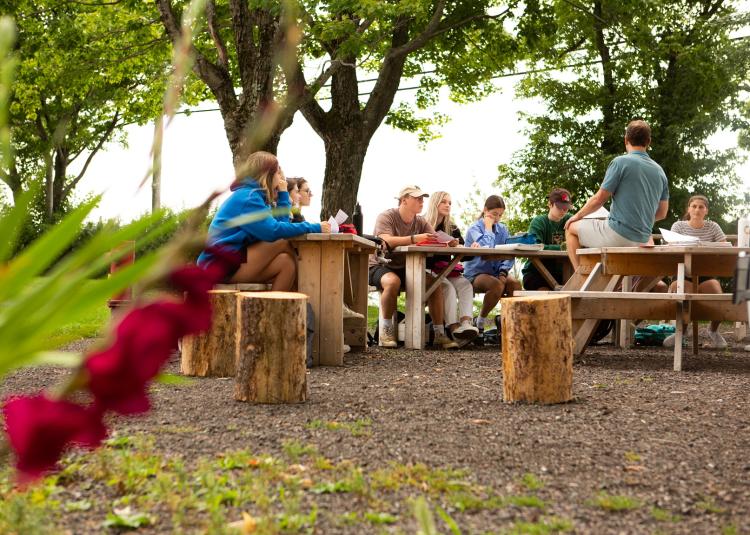
Place for outdoor pedagogy
For more than a year, the Cégep teaching team has been supporting teachers in experimentation and preparing the ground to welcome an outdoor class on each campus. Research, exchanges of expertise and the production of podcasts have paved the way before the material realization, because "an outdoor classroom is more than a place, it's a state of mind", assures Danka Cormier, assistant director of studies at the Cégep de la Gaspésie et des Îles.
Choices specific to each campus
All different, but meeting the same objective, these four classes aim to vary teaching methods to stimulate learning. "An outdoor class is a tool that opens up participation and discussions more naturally. Outdoor pedagogy, more often associated with primary schools, can easily adapt to college education. We want to provide an active learning experience in authentic situations. At the Cégep de la Gaspésie et des Iles, we fully agree with our slogan "life-size studies", explains Danka Cormier.
Unique classes on each campus
The classes have been designed according to specific locations, so each campus has its own color. In Gaspé, the class has been ecologically and economically thought out. With a view of the sea, it is at the back of the campus and near the new food forest and community gardens. Rocks from quarries in the region are placed on a floor made of recycled glass. In Carleton-sur-Mer, seated or standing stations surrounded by trees face the campus near Chaleur Bay. At ÉPAQ, classes are held under a shaded terrace mostly made of wood and facing the sea. Finally, in the Îles-de-la-Madeleine, hanging canvases, hammocks, a swing and edible landscaping complete the Cégep's range of outdoor classrooms.

Inspire other places of education
Both teaching and learning outdoors bring many benefits including reducing stress, increasing academic motivation, and significantly building the bond between colleagues, students, and teachers. Therefore, any place can thus become an external class, whether informal or not. The outdoor classes of the Cégep, like living laboratories, will be able to evolve according to needs and tests and thus inspire other places of education.