


As cold weather sets in, viruses such as influenza, RSV, and COVID-19 are resurfacing. Quickly identifying symptomatic individuals is an essential part of any strategy to fight their spread. Yet, traditional thermal cameras, which measure facial temperature on the forehead or cheeks, are easily skewed by airflow, sweat, or face coverings - leading to unreliable readings.
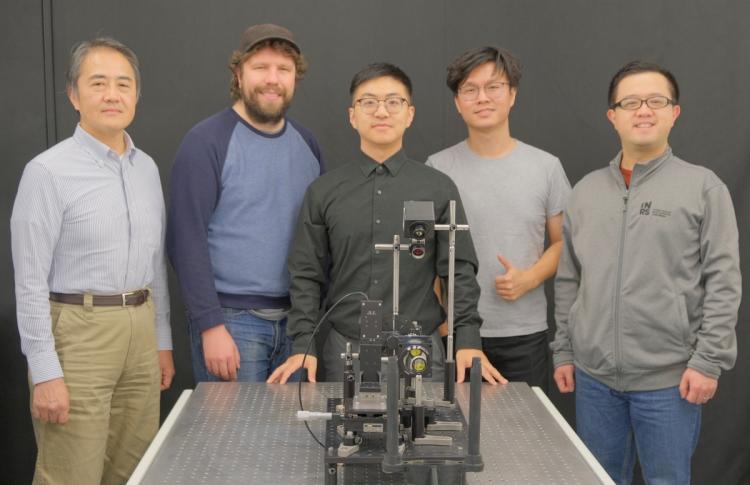
From left to right: Tsuneyuki Ozaki (Professor at INRS), Patrick Kilcullen (Postdoctoral Fellow in the laboratories of Professors Liang and Ozaki), Cheng Jiang (Postdoctoral Fellow in Professor Liang's laboratory), Yingming Lai (Postdoctoral Fellow in Professor Liang's laboratory) and Jinyang Liang (Professor at INRS). Photo credit: Cheng Jiang, INRS
To address this, a team at the Institut national de la recherche scientifique (INRS) led by Professor Jinyang Liang, an expert in computational imaging, has developed SPIRIT (Single-pixel infrared imaging thermometry), a technology that could change how we screen for fever in public spaces.
"SPIRIT is a next-generation technology that is simple, accurate, and easy to use. It has the potential to reshape fever monitoring in everyday settings."
Jinyang Liang, study's lead investigator and Scientific Head of the Laboratory of Applied Computational Imaging
Professor Liang, the Canada research chair in ultrafast computational imaging, worked in collaboration with Cheng Jiang, Patrick Kilcullen, Yingming Lai, and Professor Tsuneyuki Ozaki, all based at the INRS Énergie Matériaux Télécommunications Research Centre, a recognized leader in X-ray sources for biomedical applications. The team's findings were published in Nature Communications.
A single pixel, a smarter scan
SPIRIT focuses on the most reliable spot on the face: the inner corners of the eyes, near the nose. These tiny areas are less affected by external conditions and better reflect core body temperature. The challenge? They're small and far apart, so conventional cameras barely capture them - less than 0.5% of their pixels are dedicated to these zones.
SPIRIT solves this by using just one infrared pixel, combined with a clever light encoding system and computational reconstruction. This design concentrates 100% of detection on the most accurate zones, without expensive cooling systems or bulky sensors.
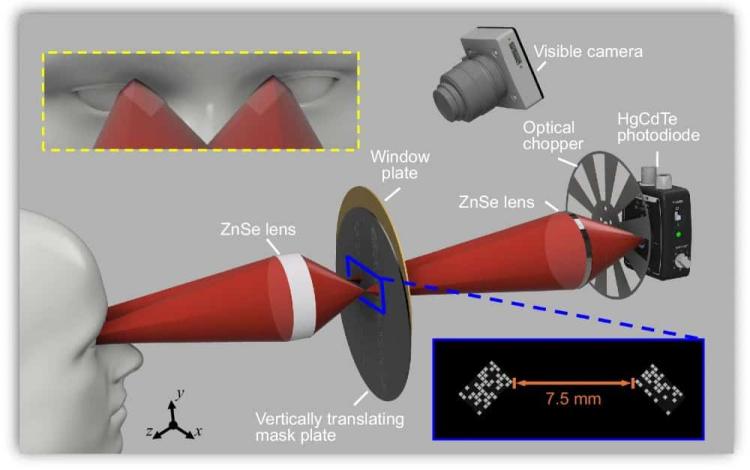
Schematic of single-pixel infrared imaging thermometry (SPIRIT) (Credit: Tsuneyuki Ozaki, Patrick Kilcullen, Cheng Jiang, Yingming Lai, Jinyang Liang (INRS) Source: https://doi.org/10.1038/s41467-025-64125-3 . Creative Commons licence)
In tests with 39 volunteers, SPIRIT detected a fever case, tracked normal temperature changes throughout the day, and even picked up subtle differences linked to wearing glasses, all with compact, affordable hardware.
"What's exciting is that we can map temperature with a single pixel and smart computation."
Cheng Jiang, lead author and a postdoctoral fellow in Liang's laboratory.
Jiang is currently working with QV Studio to explore SPIRIT's potential beyond research and toward real-world applications. The team's ultimate goal is commercialization, but several steps remain - starting with improving performance and preparing a pilot study in collaboration with healthcare institutions.
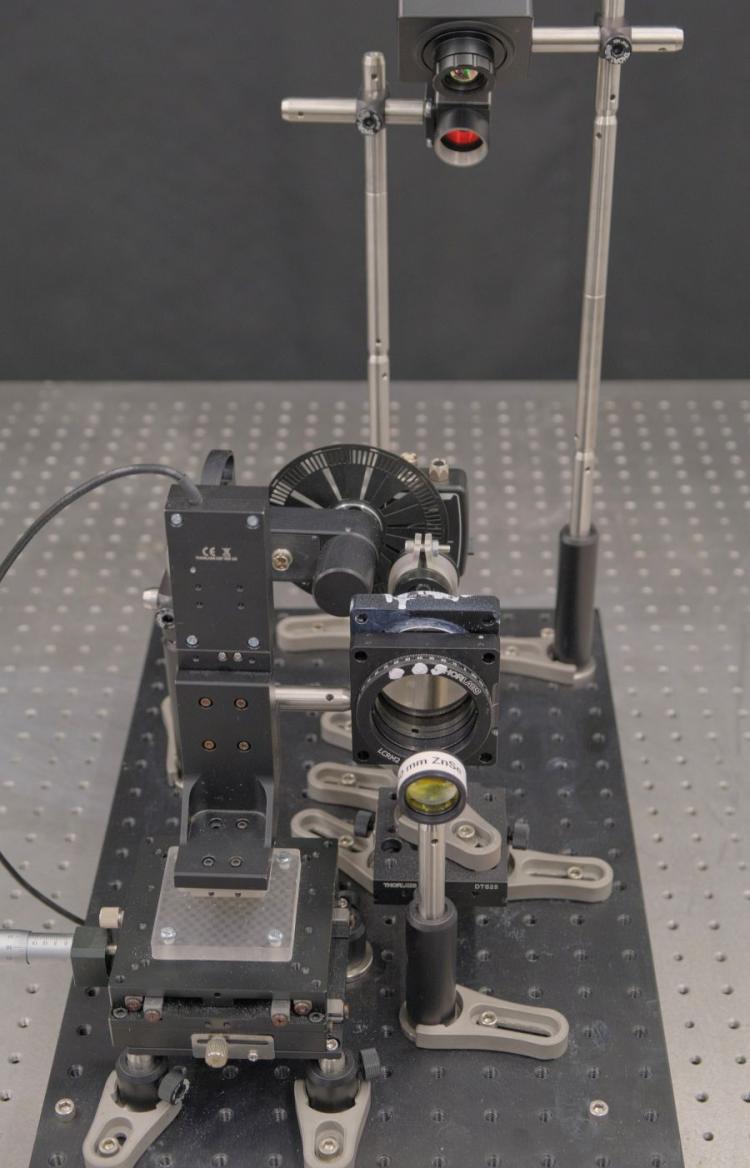
The SPIRIT system uses lenses, moving masks, and a photodiode to encode and collect thermal radiation to precisely map the temperature of the human inner canthi.
A tool for smarter public health
SPIRIT isn't just precise - it's practical. With real-time processing and subdegree accuracy (0.3 °C), it can be deployed in schools, clinics, transit hubs, and workplaces. By reducing false alarms, it lowers stress and avoids unnecessary testing costs.
SPIRIT is the first single-pixel infrared thermometry system that meets international standards. It measures human temperature in the clinically relevant range of 31.7-39.8 °C, making it a reliable tool for health screening.
These findings could help refine fever screening criteria and provide new tools to better prepare Québec and Canada for future epidemic waves.
About the study
Jiang, C., Kilcullen, P., Lai, Y. et al. Single-pixel infrared imaging thermometry maps human inner canthi temperature. Nat Commun 16, 8885 (2025). https://doi.org/10.1038/s41467-025-64125-3
This work was supported in part by the Natural Sciences and Engineering Research Council of Canada (RGPIN-2024-05551, ALLRP 592389-23), the Canada Research Chairs Program (CRC-2022-00119), the INRS Chair in Nanobiophotonics, and the Fonds de Recherche du Québec - Nature et Technologies (203345-Centre d'Optique, Photonique, et Lasers).
For more information

490, rue de la Couronne
Québec Québec
Canada G1K 9A9
www.inrs.ca/