


Hotchkiss Brain Institute (HBI) researchers investigating the complex role of primary cilia in the central nervous system (CNS) and their role in disease prevention and repair have won the 2025 $1-million Hopewell M.I.N.D. Prize.
Drs. Jiami Guo and Lizheng Wang, both PhDs, have been studying primary cilia tiny, antenna-like signalling sensors inside brain immune cells and how they help protect against diseases that affect the nervous system. They will use the prize to advance insights into this relatively under-researched topic so they can gather insights for future therapies for CNS diseases such as stroke and Alzheimer's disease.
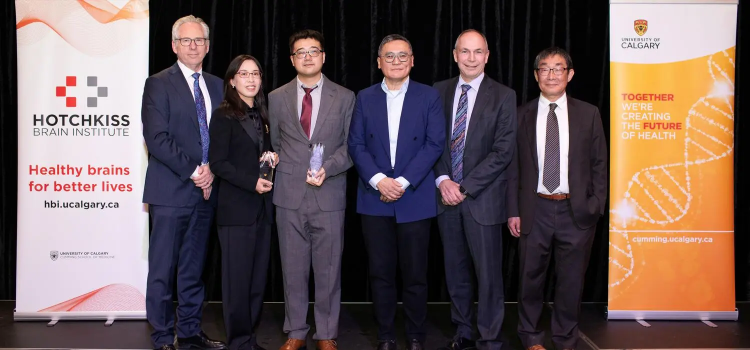
From left: UCalgary President Ed McCauley, Drs. Jiami Guo and Lizheng Wang, prize founder Sanders Lee, Dean Todd Anderson, HBI director David Park. Photo Courtesy Paul McGrath
"We are so happy to have the opportunity, thanks to Sanders Lee and the Hopewell M.I.N.D. Prize, to leverage our accumulated knowledge and make a direct impact on brain and mental health, " says Guo. "As basic scientists we are used to making fundamental discoveries that help translational and clinical work in the future, but thanks to the Hopewell M.I.N.D. Prize we will now be able to achieve more immediate and tangible results."
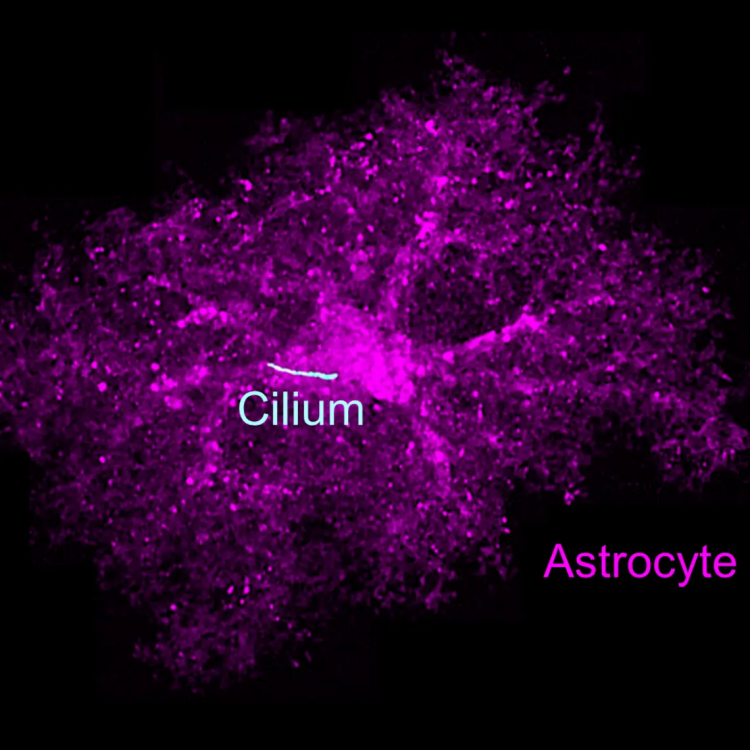
Astrocyte and cilium. Photo Courtesty Guo Lab
Four years of philanthropy-powered innovation
Standing for Maximizing Innovation in Neuroscience Discovery, the Hopewell M.I.N.D. Prize has been sparking innovation in brain health since 2021. The prize was created through the visionary $10-million commitment of Sanders Lee, a Calgary business leader and philanthropist who founded the Hopewell Group of Companies.
"Entrepreneurial thinking whether in research or business means taking bold risks for big impact," says Lee. "The M.I.N.D. Prize brings game-changing ideas to Calgary, unlocking brain and mental health breakthroughs that can save lives and I'm proud to help make that happen."
This year's finalists are advancing ideas that have the power to reshape how we diagnose, treat, and understand brain and mental health, says Dr. David Park, PhD, director of Hotchkiss Brain Institute at the Cumming School of Medicine.
"The Hopewell M.I.N.D. Prize continues to catalyze bold, high-impact research and we are excited to see where these teams will take us next," Park says.
Pushing boundaries to drive solutions
Adds Dr. Todd Anderson, BSc'82, MD'85, dean of the Cumming School of Medicine: "The Hopewell M.I.N.D. Prize continues to reflect the University of Calgary and the Cumming School of Medicine's unwavering commitment to bold, discovery-driven innovation.
"By championing visionary ideas and the people behind them, we empower our researchers and trainees to push boundaries, pursue transformative solutions, and deepen our partnerships with community leaders who believe in investing in breakthroughs that will shape the future of brain and mental health."
Two other strong pairs of researchers also edged out other competitors to become finalists for the prize.
Drs. Wilten Nicola and Jafar Shamsi Chamyousefali, both PhDs, proposed a research program known as NeuroMorpheus, a personalized assistant that uses artificial intelligence (AI) to help seniors live more safely and independently in their own homes for longer.
Dr. Aravind Ganesh, MD'12, PGME'20, and Dr. Jianhai Zhang, PhD, proposed program called PENTOS-AI, which would use AI to better predict, diagnose and treat ischemic stroke.
The next Hopewell M.I.N.D. Prize competition, open to applicants consisting of a postdoctoral fellow and a full HBI member, is currently open. To learn more about this year's other finalists, past prize recipients and full eligibility details, please visit the Hopewell M.I.N.D. Prize website.
Dr Jiami Guo, PhD, is an associate professor in the department of Cell Biology & Anatomy at the Cumming School of Medicine. Dr. Lizheng Wang, PhD, is a postdoctoral fellow in the Guo lab.