A team of students in Creative Technologies and Design (CTCH & DES) at the University of Regina are using digital storytelling and emerging technologies to bring the Saskatchewan Indigenous Veterans Monument in Victoria Park to audiences around the world through an interactive website called Living Honour.
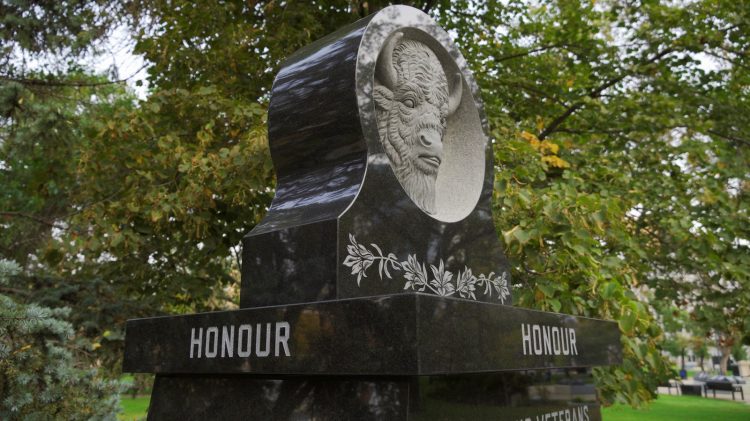
The Saskatchewan Indigenous Veterans Monument in Regina's Victoria Park honours the service and sacrifice of Indigenous veterans. Photo courtesy of Creative Technologies & Design
The website features a 360-degree recreation of the monument alongside historical content, video interviews, and educational resources that honour Indigenous veterans. By sharing these stories in a dynamic and accessible format, the project helps connect new audiences, including youth and people in remote communities, with the significant contributions Indigenous veterans have made to Canada's military history.
The project was developed by the Royal United Services Institute (RUSI) Regina in partnership with the U of R's Faculty of Media, Art, and Performance (MAP) and sponsored by the Saskatchewan Indigenous Veterans Monument Committee (SIVMC).
Through projects like this, we are helping ensure those stories are not lost, and that families, friends, and communities have a way to connect with them. Sydney Coleman, a fifth-year Creative Technologies student.
Hands-on learning with real-world impact
As part of a fourth-year placement course, Living Honour brought together CTCH & DES students Samantha Liamzon, Carmen Jerry, Sydney Coleman, and Kadence Meredith, along with Film student Bee Bird. Under the mentorship of Dr. Charity Marsh, Department Head of CTCH & DES, and Dr. Evie Johnny Ruddy, Assistant Professor, the project gave students the opportunity to put their skills into practice, helping amplify stories that deserve greater recognition.
"Being able to contribute to preserving and sharing Indigenous veterans' stories is so pivotal, and I am beyond honoured to have been asked to assist with such an important and equally delicate task," says Sydney Coleman, a fifth-year Creative Technologies student.
Through the project, Coleman gained a new perspective on the little recognition Indigenous veterans have received for their military service and the experiences they faced after returning home.
"It is shocking that only now Indigenous Veterans are finally getting recognized for their service, and that their stories of the experience after the war are coming to light," she says. "That's what made being a part of this so important; it was not an assignment. It was part of our duty to do this and I am honoured to have been a part of it."
That sense of responsibility shaped how the team approached its work. Students collaborated closely with RUSI Regina and SIVMC, taking care to represent the people and stories behind the monument respectfully.
"Everything about this project was done in a way that emphasized care. It was important that we made sure the voices and people involved were not mis-represented," Coleman says.
Working alongside community partners also allowed students to see how their academic skills could contribute to something meaningful beyond the university classroom.
Learning by Doing
Students took part in every stage of development, turning their ideas into a fully realized digital experience. This included researching historical content, developing concepts, filming interviews, creating digital artwork and animation, building the website, conducting user testing, presenting their work to project partners, and so much more.
"This project has been a successful year-long, fully immersed experiential learning opportunity. It has been a privilege to mentor, support, and collaborate with these students throughout the entire process," says Marsh.
For Coleman, whose primary focus is animation, the project also provided an opportunity to expand her expertise in audio design.
"A lot of my work on Living Honour centred around audio," she says. "I worked on mixing and mastering interviews, creating soundscapes, and composing music. It was exciting to step away from animation for a while and explore another side of my skill set."
Even the smallest details required thoughtful research. While developing the website's audio experience, Coleman researched Saskatchewan bird species to ensure the background soundscapes reflected the province's natural environment. She also incorporated a heartbeat-inspired drum rhythm throughout the audio, creating a subtle connection between the digital experience and the human stories at its centre.
Beyond technical skills, Coleman says the collaboration deepened her understanding of Indigenous veterans' experiences and introduced her to aspects of Canadian history she had not previously encountered.
A digital legacy
Today, Living Honour offers users new ways to experience the Saskatchewan Indigenous Veterans Monument, wherever they are in the world. These new opportunities for connection are what Coleman believes is the website's greatest contribution.
"Projects like Living Honour open up conversations and uplift voices that often go unheard. They provide an accessible way to engage with the monument for audiences who cannot easily make it to Regina while ensuring these stories are not forgotten," she says.
Now the public can explore the monument through changing seasons, learn about Saskatchewan Indigenous veterans in English and French, watch interviews with Indigenous veterans and soldiers, and discover how the concept of honour is expressed in seven Indigenous languages spoken in Saskatchewan.
Coleman hopes users will take the time to learn from Indigenous veterans' experiences and consider perspectives that have not always received widespread attention.
"These are not just stories that are being told and remembered, these are people's lives. They are somebody's grandparents, parents, siblings, friends they all matter to someone, and they all deserve to be remembered and have their stories shared," she adds.
Interested in combining creative and technical skills to make a real-world impact? Explore opportunities in the University of Regina's Creative Technologies and Design program.
Through Living Honour, U of R students have demonstrated how experiential learning can extend beyond professional development to create lasting community impact. By combining digital innovation, creative collaboration, and community-engaged storytelling, they have helped ensure Indigenous veterans' stories remain accessible to future generations.
"There is a saying that a person dies twice: once when they take their final breath, and again when their name is spoken for the last time," says Coleman. "Through projects like this, we are helping ensure those stories are not lost and that families, friends, and communities have a way to connect with them."