The University of British Columbia is renaming its Faculty of Forestry to the Faculty of Forestry & Environmental Stewardship, marking a significant step in the evolution of one of Canada's leading centres for environmental research, education and innovation.
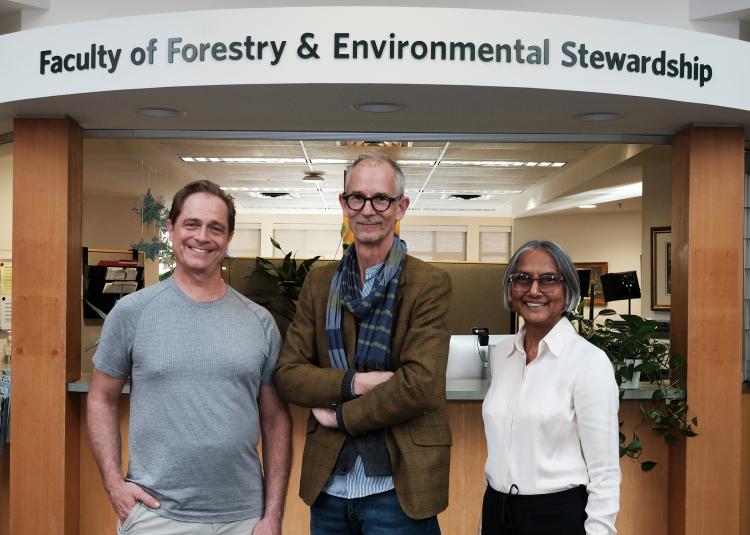
Associate Dean of Students and Professor Scott Hinch, Dean Rob Kozak and Associate Professor Janette Bulkan. (Credit: UBC Forestry & Environmental Stewardship.)
The change recognizes a shift underway across Canada and around the world: managing forests alone is no longer enough to solve today's environmental challenges. Climate change, intensifying wildfires and floods, clean water scarcity, food insecurity, and accelerating biodiversity loss all threaten ecosystems and livelihoods alike. Responding to these crises requires ethical, responsible and sustainable management systems grounded in conservation, respect and education - this is environmental stewardship.
Leading innovation in climate and biodiversity action
Environmental stewardship reflects the faculty's expanded role in climate adaptation, wildfire resilience, flood prevention, water and watershed protection, urban greening, food security, biodiversity conservation and management, greenspace management, environmental equity and the fast-growing low-carbon bioeconomy.
"Over the past 30 years, student numbers have doubled and so have our faculty members," says Dean Rob Kozak. "Many of whom are world leaders in solution-based research and education - from conservation science and landscape ecology to genetics, fire sciences, forestry, fisheries, bio-products, mass-timber construction and Indigenous resource governance."
This shift mirrors a broader trend across Canada's postsecondary sector, where universities are rethinking how they train environmental leaders. Graduates now enter a rapidly evolving workforce that requires transdisciplinary skills across conservation, ecology, chemistry, genetics, sociology, engineering, economics, and technology.
"There was a time when traditional university programs in forestry produced professionals who were skilled in managing our forests and wild spaces, but today's solutions demand additional kinds of expertise and new kinds of environmental programs," says Associate Dean of Students and Professor Scott Hinch. "The faculty has been rapidly transforming its teaching programs to train the specialists and leaders society needs to meet the environmental challenges of our time."
Older programs have been re-envisioned, while new programs have been launched to deliver cutting-edge, experiential and transdisciplinary education. The new BSc degree in Natural Resources integrates science, engineering, technology and business with students majoring in conservation, bioeconomy, wood products, forest sciences or forestry. The programs train students to deal with real-world complexities where every environmental challenge is now a social and economic one.
Indigenous-led stewardship
The transition underscores the faculty's commitment to Indigenous environmental governance. Through its newest program, the Bachelor of Indigenous Land Stewardship and its research initiatives, the faculty embraces Indigenous knowledge systems with modern stewardship practices.
"Indigenous Peoples have stewarded these lands since time immemorial," says Dean Kozak. "Climate action and environmental stewardship in Canada must involve Indigenous governance, resource co-management, and land -and water-use planning. The faculty's new name acknowledges those responsibilities."
A strategic step for Canada's environmental future
The faculty's evolution signals its commitment to advancing solutions that strengthen climate resilience, support Indigenous sovereignty, grow the low-carbon economy and conserve and manage ecosystems that sustain communities - the faculty's work directly supports the environmental goals emerging across B.C. and Canada.
"This change reflects what we have already become," said Dean Kozak. "Our work is rooted in forestry, but it extends across the entire environmental spectrum. Our Faculty has been a global leader in conservation science, environmental education, research and action and the new name reflects that commitment."