

Six UNBC researchers are heading to Victoria to participate in Science Meets Parliament BC, an initiative designed to strengthen connections between scientists and policymakers with a goal of fostering evidence-informed decision-making at senior government levels or in public policy.
The program brings researchers together with Members of the B.C. Legislative Assembly and senior policy leaders to promote dialogue between the scientific and political communities. Through meetings, briefings and discussions, participants gain insight into how public policy is developed while sharing research expertise that can help inform government decisions.
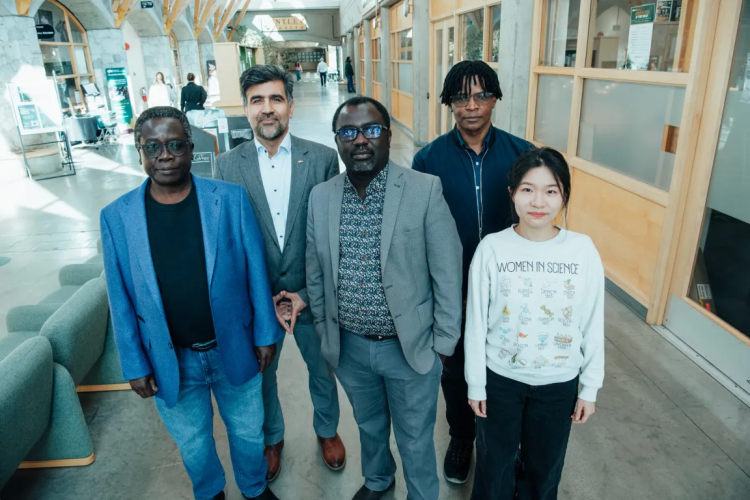
From left, Dr. Ben Daniel, Dr. Hossein Kazemian, Dr. Oliver Iorhemen, Dr. Taru Manyanga and Dr. Sonia Kong are all part of UNBC's delegation to Science Meets Parliament BC. Missing from the photo is Dr. Aki Gormezano.
For UNBC researchers, the experience represents an opportunity to ensure northern perspectives are part of provincial conversations.
"The program highlights the importance of building relationships between researchers and government," says UNBC Provost and Vice-President Academic Dr. Michel Beaulieu. "Researchers at UNBC generate knowledge that directly builds capacity for the advancement of healthy, productive and thriving communities. Initiatives like Science Meets Parliament helps to ensure that the insights generated through research can contribute to public policy."
Engineering Assistant Professor Dr. Oliver Iorhemen is looking forward to discussing the role of research in sustainable water management.
"Researchers need opportunities to engage directly with government so evidence, innovation and community realities can meaningfully inform public policy," Iorhemen says. "I hope to help strengthen collaboration between science and government to support resilient and equitable water systems across British Columbia."
Northern Analytical Lab Services Director, Dr. Hossein Kazemian sees the program as a chance to highlight UNBC's impact as a northern research institution.
"This is an opportunity to demonstrate how regional research infrastructure and talent development support emerging sectors such as clean technology and bio-based industries while strengthening the communities we serve," Kazemian says.
For UNBC Assistant Professor with the UBC Master of Physical Therapy - North program Dr. Taru Manyanga, the experience is an opportunity to better understand how research can serve the public interest through policy development.
"I'm eager to learn how to communicate my research findings in ways that are most helpful to decision-makers working on health priorities," Manyanga says. "Science-to-policy translation is essential if research is going to make a real-world difference."
Psychology Assistant Professor Dr. Sonia Kong hopes to contribute insights from her research in developmental psychology and children's social and emotional well-being.
"Science Meets Parliament creates meaningful dialogue between researchers and policymakers," Kong says. "I hope to help translate research evidence into insights that can inform policies related to children's well-being, education and mental health, particularly in multicultural and underserved northern communities."
Centre for Teaching, Learning and Technology Director Dr. Ben Daniel examines the intersection of artificial intelligence and sustainability in higher education, which he describes as "green AI in education."
"I am excited to share early insights and explore how this work can inform policy and practice as AI becomes more embedded in society. I also see strong alignment with the important sustainability work already underway at UNBC, which has positioned the university as one of Canada's leading green institutions," Daniel says. "I am particularly excited about the opportunity to engage at the parliamentary level and bring those insights back to UNBC. I believe such an experience will help inform how we, in the Centre for Teaching, Learning and Technology can develop a faculty development program that support why, and how faculty can share their research more broadly with Canadians."
Post-doctoral researcher Dr. Aki Gormezano says Science Meets Parliament offers a valuable opportunity to connect community-informed research with real-world policy decisions.
"My work focuses on health-care access, prevention, and health equity," Gormezano says. "I'm looking forward to strengthening how those insights can be translated into clear, practical information that supports more equitable and effective public policy."
For more information

3333 University Way
Prince George British Columbia
Canada V2N 4Z9
www.unbc.ca