What begins as a patchwork of blankets laid out to represent Sto:lo territory slowly shrinks, fragments, and disappears. In a year marked by a landmark B.C. Supreme Court ruling on unsurrendered Indigenous land, the lessons of Beyond Blankets: A Sto:lo Lands Estxercise are resonating more deeply than ever.

When Hi:olemtel (Grand Chief Clarence "Kat" Pennier) first envisioned Beyond Blankets, he saw it as a way to advance truth and reconciliation and inform those who wish to be allies an experiential learning exercise that highlights the impacts of settler colonialism, fostering understanding of Sto:lo culture and history, and celebrating Stó:lō resilience.
Developed by Kat and Dr. Keith Carlson, director of UFV's Peace and Reconciliation Centre, supported by Sto:lo Knowledge Keepers, the exercise has proven transformational for hundreds of participants since its debut in 2025.
Its message has taken on renewed urgency over the past year.
In Cowichan Tribes v. Canada, the B.C. Supreme Court ruled that the Cowichan did not surrender 1,846 acres of land on which part of Richmond now sits and that the federal government unlawfully sold the land to private owners without consent. The decision, now under appeal, has sparked public discussion about what the ruling could mean.
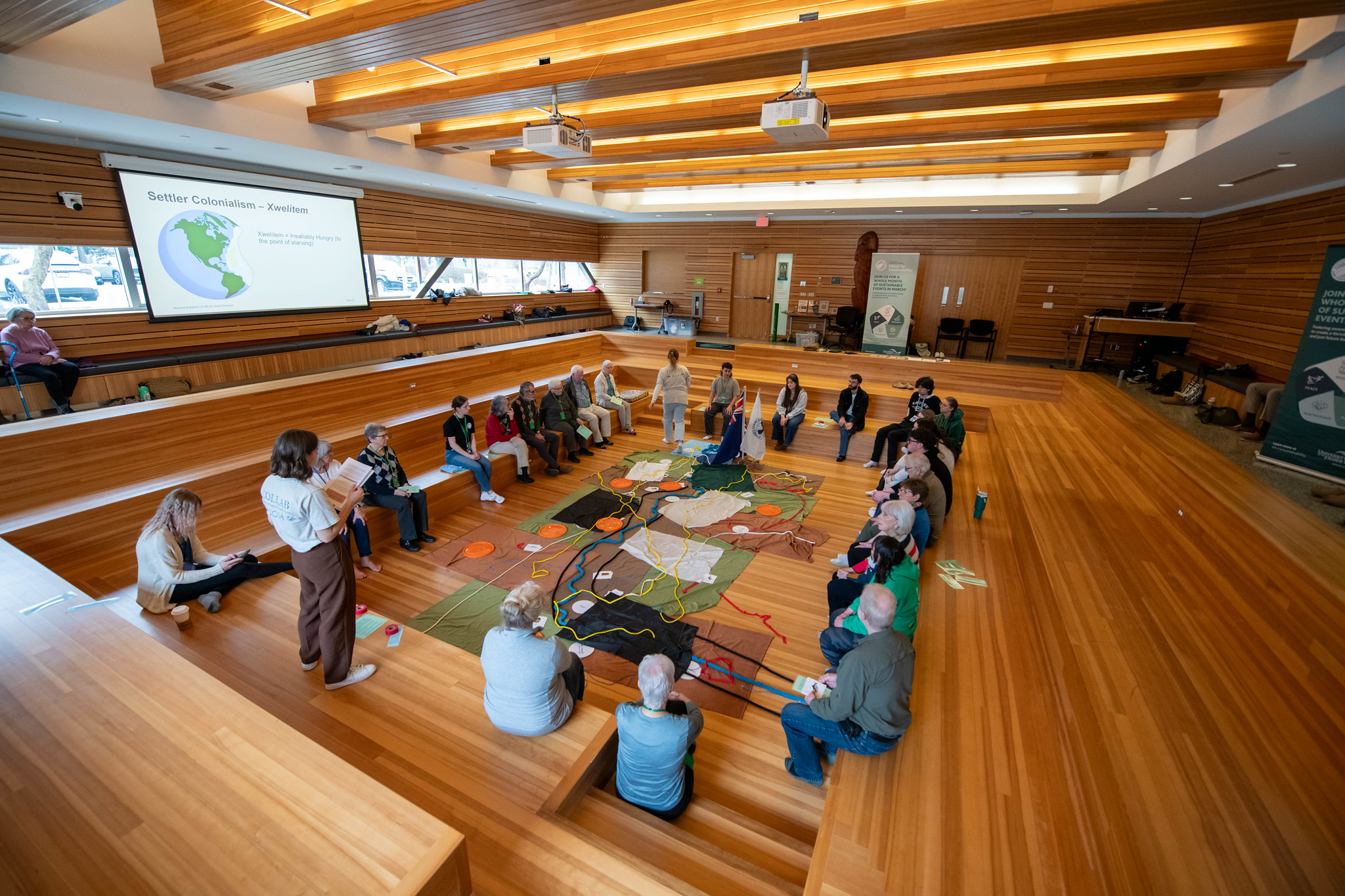
A blanket exercise takes place in the Gathering Place on the UFV Chilliwack campus.
Kat says such fears reflect widespread misunderstanding. While there have been many court decisions affirming Aboriginal rights and title over the decades, Indigenous Peoples are not interested in disrupting private land ownership, he says. They want to be consulted and accommodated.
As debate intensifies, so too does misinformation.
That is why education matters, Kat says, and why Beyond Blankets is part of the solution.
"We're going to continue living in this territory, and we still need to have good relationships with the other people who are here," he says. "Together, we need to find better ways to look after the land and resources, and that's what it's really about."
Kat first encountered the blanket exercise through KAIROS, a national organization that shares the story of the Beothuk in Newfoundland an Indigenous people driven to extinction by colonialism. He approached Carlson with the idea of creating a Sto:lo-specific version, and Carlson and a group of students began developing it.
The result is an interactive journey through history. What begins as pristine territory, represented by blankets, becomes increasingly fragmented. Ropes mark the arrival of railways, highways pipelines, hydro lines, and reserves shrink, and Sumas Lake disappears.
"It shows all the activities that have cut up the land in the name of so-called progress two railroads, two highways, BC Hydro transmission lines, the loss of Sumas Lake, developments on the mountains and things like that," Kat says.
As the exercise unfolds, participants hear and read quotations drawn from Carlson's research, including work published in A Sto:lo-Coast Salish Historical Atlas.
"I've enjoyed being a fly on the wall," Kat says, with reference to observing the exercise as it was piloted in early 2025. "It's interesting to watch people as they begin to understand what happened to the people who lived here for thousands of years. It makes them think more about how they can help restore relationships and leave something for future generations."
Carlson says Beyond Blankets is designed to help lay a foundation for meaningful contributions to Sto:lo cultural and political resurgence and to genuine Sto:lo-settler reconciliation.

Part of the blanket exercise involves simulating trade, with participants visiting other regions to swap their surplus goods for items they need.
Meghan Underwood participated in Beyond Blankets in the most recent allyship course hosted by PARC.
"For me, the most powerful aspect of the workshop was the way it conveyed the history of colonization from the Sto:lo people's experience, in their own words and through their lens," Meghan says. "This gave me a richer and more comprehensive understanding of the land, its people, and the long-lasting effects of colonization.
"This shift in perspective has not only increased my awareness but also deepened my sense of responsibility in supporting reconciliation efforts. I walked away with a greater appreciation for the resilience of the Sto:lo people and an even stronger commitment to learning and advocating for Indigenous rights."
Carilynn Siemens, who experienced Beyond Blankets at the same time, agreed.
"I think what I appreciated most was the visual representation of the river and its tributaries, and the action of standing on the land as it was physically scarred, just as its people were emotionally scarred, and their way of living was dismantled and disrespected by newcomers seeking personal benefit," Carilynn says. "The physical land is still telling this story. This exercise helped me to hear it."
Keith shares that he is encouraged by this response and hopes more people will sign up to experience Beyond Blankets.
"Working on this project with Kat and the other Knowledge Keepers gave me an opportunity to transform my research into something practical that reaches a wide audience," Keith says. "This is designed to be a powerful history lesson that helps us all to work together towards a better future."
Beyond Blankets is available to community groups, who can get more information and book a session by clicking here.
For more information

33844 King Road
Abbotsford British Columbia
Canada V2S 7M8
www.ufv.ca/