

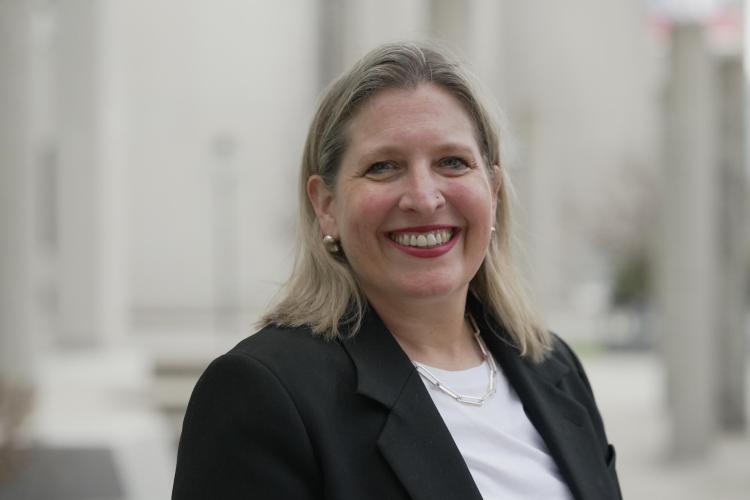
Julie Cafley began her quest to become vice-president, Francophonie and External and Community Relations at the University of Ottawa by taking an approach she is very familiar with: listening.
To get a sense of the position, she invited many people out for coffee to gain a better understanding of the reality on the ground, to gather their opinions and to assess what she could bring to the job.
This approach is almost surprising, given that she is a leader who has advised some of the most influential CEOs in Canada on inclusion and leadership. However, it does correspond to the way in which she imagines the Francophonie: a space for building relationships, conversations and partnerships. She says she is genuinely honoured and eager to fulfill her mandate.
As a former chief of staff for the Office of the President, this uOttawa alumna is back on campus after a 14-year absence, returning to the place that shaped her personal and professional life. She is also returning to a university that has undergone profound transformations and where she sees immense potential for the Francophonie.
A typically Francophone path
Faithful to her origins, Julie Cafley chose a traditional Francophone path.
After honing her bilingualism at uOttawa, she now lives her life in French, informed by both Franco-Ontarian and Quebec perspectives, and describes the Francophonie as deeply rooted in her personal and professional life. Her partner is Franco-Ontarian, her children grew up in Quebec, and French has been part of her daily life at home for years.
She sees understanding the Francophonie as about much more than language: it is first built through relationships, partnerships and a sense of belonging.
Gathering around a common vision
Julie Cafley is a well-known motivator who speaks of listening and collaboration because over the course of her career, she has convinced groups who wouldn't normally speak to one another to find common ground.
At the Public Policy Forum, the Digital Research Alliance of Canada and at Catalyst Canada, she worked on projects that brought together stakeholders from governments, the private sector, community groups, academia and Indigenous communities to contribute to national ideas on inclusion, public policy and institutional transformation.
Her inclusive leadership style can be summarized as the ability to facilitate discussions that find commonality between very different ideas, interests and perspectives.
With this in mind, she sees the new vice-presidency as a platform for building bridges, fostering collaborations and sparking initiatives between uOttawa, as the national university for Francophones, and governments, Francophone communities and civil society.
"Julie Cafley possesses a rare ability to bring together different communities around promising initiatives. Her background in inclusion, public policy and partnership development fully corresponds to our vision of a university that is deeply rooted in the community and engaged in the future of the Francophonie," said uOttawa President and Vice-Chancellor Marie-Eve Sylvestre.
Equity and Francophonie
According to Julie Cafley, equity must be integrated into every current consideration. Equity is not additional to reflections on the Francophonie: it is a necessary starting point to clearly define needs, seize opportunities, identify challenges and better understand its blind spots.
She feels that the University of Ottawa has become home to thousands of Francophone students from Ontario and across Canada, as well as a necessary partner for governments, community organizations and local residents, because it sits at the crossroads of equity and the Francophonie.
As executive director at Catalyst Canada, where she advised business leaders on inclusive leadership and organizational transformation, she garnered valuable expertise on the reality of bilingual environments and how institutions can create a genuine feeling of belonging, an expertise that she also brought to the international scene, notably to the United Nations Commission on the Status of Women.
These experiences will enrich her vision of the Francophonie at the University of Ottawa. She is taking on her new role by paying close attention to the communities that participate and feel represented in these conversations, to Indigenous communities, and to those voices that are too often on the margins of decision-making.
Given a world in which artificial intelligence is already transforming the way we work and communicate, she sees culture and a sense of belonging as guideposts that are more important than ever. She believes that such guideposts will need to continue to stand out in a world that sometimes tends to erase differences.
Leaping into the job
If you ask her where she sees herself in a year, or in the next few years, Julie Cafley will immediately respond by describing the current consultations on the Francophonie at uOttawa as a "welcome gift".
For someone who is returning to uOttawa after more than a decade away, the consultations are a comprehensive snapshot that presents a rare opportunity to better understand how the Francophonie has evolved, and how students, staff members, professors and partners experience the Francophonie on campus today.
Her enthusiasm also reflects her genuine thirst to learn about uOttawa's strategies, identify existing relationships, and meet with the various Francophone communities that revolve around the University.
As such, she says that the Sommet de la francophonie, a summit planned for 2028, is already a major opportunity for the University to strengthen its role within Canada's Francophone communities and to advance collaborations in teaching, research and civic engagement.
For Julie Cafley, her return to uOttawa is much more than simply a new job. In a world that she describes as "topsy turvy" at best, she sees universities, more than ever, as places that are key to nurturing reflection, dialogue and human transformation, places in which to hone critical thinking skills fueled by curiosity, openness and mutual understanding.