When thrifters describe the "thrill of the find," it isn't about finding the item it's about letting the item find you. And when it happens, you feel it: The shift as you recognize you came across something special.
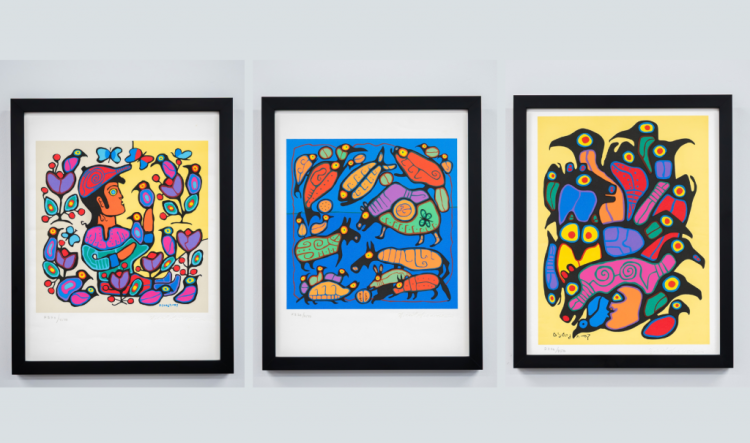
That's how Megan Somers, equity, diversity and inclusion coordinator in McMaster's Department of Pediatrics, describes coming across three prints by acclaimed Indigenous artist Norval Morrisseau at a local Hamilton thrift shop.
"I felt quite drawn to them," Somers explains, "I had not seen anything quite like them."
And while Somers felt an instant connection with the prints, entitled "In Spirit We Are One," they knew the art wasn't theirs to keep.
"They came home, but I never really felt like they were going to stay with me," says Somers. "I felt a responsibility to do something good with these, and also do something meaningful."
The Picasso of the North
Anishinaabe (Ojibwe) artist Norval Morrisseau, or Copper Thunderbird (Miskwaabik Animiiki), is regarded as the "Mishomis, or grandfather, of contemporary Indigenous art in Canada."
Morrisseau's art is a form of visual storytelling, simultaneously focusing on the legends of the Ojibwe people and the spiritual, cultural and political tensions between Indigenous and European traditions.
A residential school survivor, Morrisseau combined Anishinaabe spiritual teachings and Christian themes in his artwork to explore the colonial systems of oppression and violence he both witnessed and experienced.
Morrisseau's steadfast development of his own style and artistic vocabulary inspired and strengthened an Indigenous art movement across Canada, becoming a voice for emerging artists.
The creator of the Woodlands School of Art, Morrisseau was also a member of the Indian Group of Seven.
Throughout his life, Morrisseau received many awards in recognition of his achievements, including the Canadian Centennial Medal in 1968, and being made a member of the Royal Canadian Academy of Art in 1973. In 1978, Morrisseau was appointed a Member of the Order of Canada.
One year before his passing, the National Gallery of Canada held an exhibition of Morrisseau's work it was the first retrospective for an Indigenous artist ever held at the gallery, and the first time many Canadians had ever seen his paintings, as much of his work was held in private and public collections.
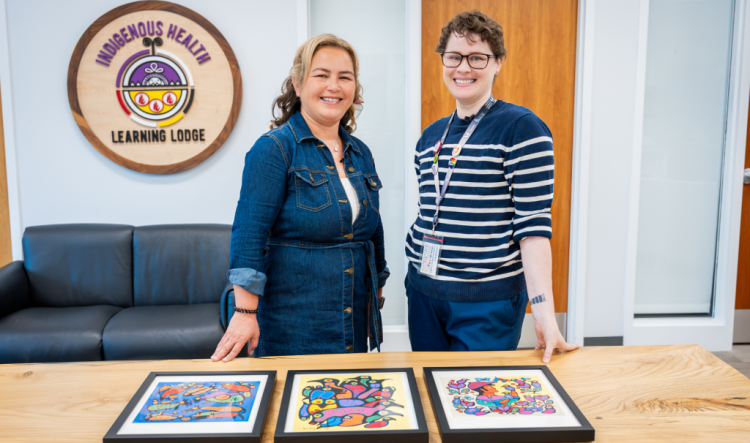
Patricia Farrugia, associate dean of Indigenous Health for the Faculty of Health Sciences, left, and Megan Somers, with the Norval Morrisseau prints.
A gift of thanks
Captivated by the prints, Somers began learning about Morrisseau and his artwork. And the more they learnt, the more strongly they felt they wouldn't keep the prints.
"They don't belong in my home, where I'm the only one seeing them regularly," explains Somers. "That doesn't feel right for their story. It doesn't feel right for how I've come to know them, and Morrisseau."
Given the long history of Morrisseau forgeries, Somers felt they could not donate them without having first authenticated the prints.
"I can't in good faith offer donation of something from an artist who is this important to Indigenous art and has such a strong legacy and such a strong voice, without making sure that somebody's looked at them," explains Somers.
To do this, Somers brought the prints to Francis Germain, a fine art appraiser and McMaster PhD student in art history. Once Germain confirmed the authenticity of the prints, the next step for Somers was deciding where to donate them.
Reflecting on the decision, the answer became obvious.
At the beginning of 2026, Somers participated in the inaugural cohort of the Indigenous Health Learning Lodge's Culture of Safety Online, which they describe as "one of the most impactful learning opportunities I've engaged with to date."
"It helped me further develop my tools, language and resources to properly honour these prints," says Somers. "I feel like these prints found me at a time when I was able to do that."
Guiding connection through art
The prints will have one last stop before moving to their home in the Indigenous Health Learning Lodge, as Somers will incorporate them into a Department of Pediatrics event to mark the National Day for Truth and Reconciliation.
Using the artwork as a guide, Somers plans to take department members through conversations about residential schools, reconciliation and anti-Indigenous bias in medicine.
"If you look at Morrisseau's whole portfolio, especially his earlier works, they talk a lot about his experiences as an Indigenous person, as an Indigenous artist navigating colonial systems of violence and the intergenerational trauma that those systems continue to cause," says Somers.
"That's part of his story as a whole person. And what are we missing if we are not including his own view of himself, his own experiences there? What are we missing in our perceptions of him as an artist, as a person?"
Knowing how critics and media tried to shoehorn Morrisseau into stereotypes, Somers will use his prints as an entry point to create parallels that are relevant in a patient setting.
"We see these things manifest in health-care settings," explains Somers. "What are we missing with Indigenous patients if we are not thinking about the systemic impacts of colonialism if we are not thinking about how these systems are influencing their health outcomes or how that has made it harder for them to even be here in clinic today? What do we miss, as health-care providers, when we aren't seeing and treating the whole person?"
Somers says their ability to support this event is thanks to the Learning Lodge's Culture of Safety Online, which helped them recognize how the impacts of systemic anti-Indigenous racism are reflected in patient experiences.
"I'm just really grateful," says Somers. "And it felt like a way also to express my gratitude, to offer the prints to a place that created the opportunity for me to grow in this way. The Learning Lodge is so important to the Indigenous communities at McMaster, and this way the prints can be enjoyed for years to come and spark more conversations."
"Many times people tell me that I've cured them of something, whatever's ailing them. But I didn't do anything. It was the colour of the painting that did it. But now it's even much stronger. The healing is more colourful than it ever was. What I finally find is this: we could live with turmoil and the anguish in everything and still we could feel contented and happy and compassionate." Norval Morrisseau, Travels to the House of Invention