The funding includes a $24-million New Frontiers in Research Fund (NFRF) grant and $9.8 million for 10 new and renewed Canada Research Chairs (CRCs).

Eleven McMaster researchers have been awarded funding from the federal government. Left: Randall Jackson. Top row, from left: Katherine Bujold, Jillian Halladay, Zoe Li, Guillaume Paré and Laurel Trainor. Bottom row, from left: Gita Wahi, Olufemi Ayeni, Alexander Klein, Mehdi Narimani and Jennifer Walker.
McMaster was also awarded over $17.5 million in Research Support Fund (RSF) grants. The RSF assists Canadian postsecondary institutions with the costs associated with managing their research enterprise.
The funding was announced Oct. 23 at McMaster, with Karim Bardeesy, Parliamentary Secretary to the Minister of Industry, announcing $813 million in funding going to 450 researchers across Canada, on behalf of Mélanie Joly, Minister of Industry and Minister responsible for Canada Economic Development for Quebec Regions.
"Researchers across disciplines are helping solve some of today's biggest challenges and seize tomorrow's greatest opportunities," said Bardeesy. "This funding will allow researchers to pursue bold ideas and make breakthrough discoveries in key areas such as artificial intelligence, precision medicine and public policy."
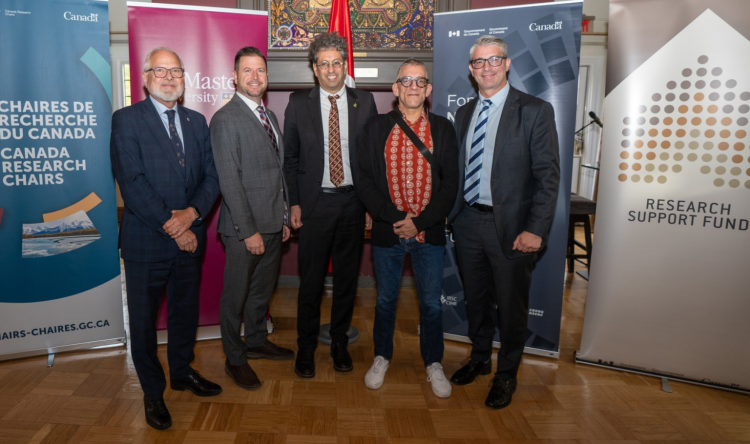
From left, Interim President of the Social Sciences and Humanities Research Council of Canada Normand Labrie; MP John-Paul Danko; Parliamentary Secretary Karim Bardeesy; NFRF recipient Randall Jackson; and vice-president, research Gianni Parise.
McMaster's vice-president (Research), Gianni Parise, congratulated the award recipients and said the investment reflects both the strength of Canada's research ecosystem and the federal government's trust in the people driving discovery and innovation.
"Today's (Oct 23) announcement recognizes the extraordinary researchers, students, trainees and partners whose ideas and dedication are helping to solve real-world challenges" Parise said. "On behalf of McMaster, I congratulate all of our award recipients and thank the Government of Canada for its continued investment in research and its confidence in the talent, creativity and impact of Canada's research community."
Randall Jackson awarded $24 million to advance community-led approaches to STBBI care
Randall Jackson, an associate professor of Social Work, has been awarded $24 million through the New Frontiers in Research Fund - Transformation program.
In collaboration with researchers and Indigenous communities across Canada, Jackson's project aims to transform how sexually transmitted and blood-borne infections (STBBIs) are researched and addressed in Indigenous communities by centering Indigenous knowledge, cultural practices and community-led approaches to care.
The project will support the development and evaluation of land-based interventions rooted in local languages, ceremony and community-defined approaches to wellness. The research will also establish a national framework and toolkit to help guide culturally safe STBBI research and care, with Indigenous communities leading decisions about how research is conducted, evaluated and shared.
Ten new and renewed Canada Research Chairs
Six McMaster researchers are newly named CRCs and four have had their chairs renewed or advanced.
There are two tiers of CRCs, which recognize accomplished and emerging research leaders: Tier 1 chairs are held for seven years with an investment of $200,000 a year; Tier 2 chairs are held for five years, with an investment of $100,000 annually, with an additional $20,000 annual stipend for first-term chairs. Each tier of chairs can be renewed once.
These are the new CRCs:
Katherine Bujold | Canada Research Chair in Nucleic Acid Nanostructures (Tier 2)
Katherine Bujold is an assistant professor in the Department of Chemistry & Chemical Biology.
Bujold's research program focuses on developing next-generation nucleic acid delivery systems to improve the targeting and effectiveness of therapies, including gene therapies and vaccines. Her research investigates how chemical modifications and nanoscale engineering can enhance cellular uptake and enable more precise delivery of nucleic acids to specific tissues and cell types.
Jillian Halladay | Canada Research Chair in Youth Substance Use and Mental Health (Tier 2)
Jillian Halladay is an assistant professor in the School of Nursing and a clinical researcher at St. Joseph's Healthcare Hamilton.
Halladay's research focuses on preventing and treating co-occurring substance use and mental health problems among youth aged 12-25. Her work examines developmental trends, risk and protective factors, while developing and evaluating tailored prevention strategies, early interventions and treatments to improve youth mental health outcomes.
Zoe Li | Canada Research Chair in Resilient Water and Environmental Systems (Tier 1)
Zoe Li is an associate professor in the Department of Civil Engineering.
Li's research program focuses on developing advanced modelling tools to improve the resilience of water and environmental systems, including flood control, drinking water and wastewater infrastructure. It examines how climate change and shifting environmental conditions affect these systems, using predictive modelling to support better planning and management of water resources and infrastructure.
Guillaume Paré | Canada Research Chair in Precision and Molecular Medicine (Tier 1)
Guillaume Paré is a professor in the Department of Pathology & Molecular Medicine.
Paré's research investigates how genes, environmental factors and lifestyle influence the risk of heart disease and other related diseases, with the goal of predicting disease risk before symptoms appear. His work uses genetic analysis, artificial intelligence and molecular data to identify harmful genetic changes, understand how individuals respond differently to foods and medications, and develop personalized approaches to disease prevention and treatment.
Laurel Trainor | Canada Research Chair in the Perceptual, Developmental, and Social Neuroscience of Music (Tier 1)
Laurel Trainor is a professor in the Department of Psychology, Neuroscience & Behaviour.
Trainor's research investigates how musical rhythm promotes social connections, optimal development and well-being in infants and adults. Using wearable technologies to measure brain activity, movement and physiology during real-world musical interactions, her work examines how music coordinates behaviours between caregivers and infants, strengthens connections between musicians and audiences, and can be harnessed to enhance well-being and cooperative communities.
Gita Wahi | Canada Research Chair in Child Health Equity (Tier 2)
Gita Wahi is an associate professor in the Department of Pediatrics.
Dr. Wahi's research seeks to improve how we understand and tackle the social and environmental factors that contribute to obesity and chronic diseases in children, particularly those from marginalized communities. In partnership with immigrant and newcomer families, Wahi aims to develop culturally appropriate health promotion strategies focused on nutrition, physical activity and access to community supports.
One researcher had their CRC advanced from Tier 2 to Tier 1:
Jennifer Walker | Canada Research Chair in Indigenous Health Data and Aging (Tier 1) | Faculty of Health Sciences
These are the renewed CRCs:
- Olufemi Ayeni | Canada Research Chair in Joint Preservation Surgery (Tier 2) | Faculty of Health Sciences
- Alexander Klein | Canada Research Chair on Bertrand Russell and History of Scientific Philosophy (Tier 1) | Faculty of Humanities
- Mehdi Narimani | Canada Research Chair in High Power Conversion Systems (Tier 2) | Faculty of Engineering