


Students from Niagara College's School of Environment and Horticulture are applying cutting-edge technology to global pollinator conservation through a unique partnership with U.K.-based AgriSound.
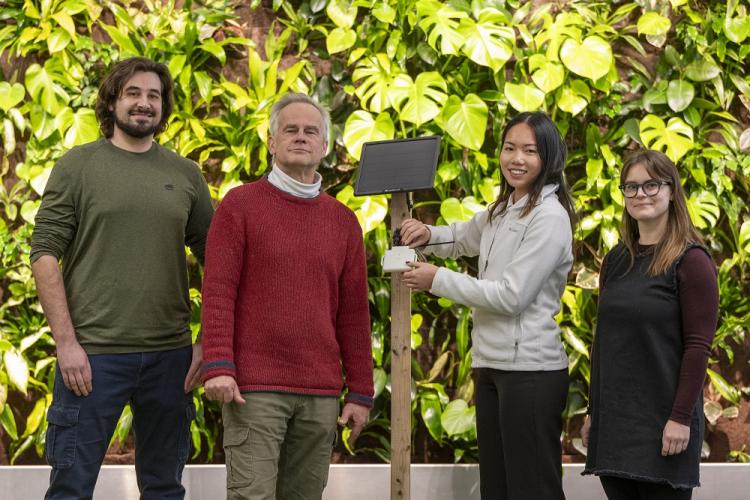
Professor Martin Smith (second from left) and Ecosystem Restoration students Sam Ghiran, Carolinh Do and Emily Clunas, stand with an AgriSound Polly bioacoustic monitoring technology unit, which analyzes pollinator activity in real-time.
Ecosystem Restoration students are utilizing AgriSound's Polly bioacoustic monitoring technology to analyze pollinator activity in real-time. The solar-powered units record acoustic data to track bumblebee activity across diverse habitats. The research provides insights into seasonal trends and behaviour patterns, which will be used to inform and improve future restoration methods.
By using these non-invasive units, students can monitor vital species without disrupting the ecosystem - protecting local populations, improving crop yields, and enhancing biodiversity.
School of Environment and Horticulture Professor Martin Smith noted that NC is among the first institutions in Canada to deploy this technology. Unlike traditional methods that require capturing specimens, the AI-powered monitors identify pollinators - specifically bumblebees - by the frequency of their wingbeats. Data is transmitted via cellular networks to a cloud-based AI, allowing students to monitor bee activity, temperature, humidity, and light intensity remotely via their smartphones.
"Listening for pollinators, and not killing them during sampling, will become one of the major techniques for evaluating pollinators going forward," said Smith. "This is certainly a first for us and most postsecondary institutions across the country."
"This project - like many others in the Ecosystem Restoration program - demonstrates how technology, experiential learning and strong partnerships can develop students into industry leaders while supporting community conservation efforts," said Evan DiValentino, Dean, Business and Environment. "Professor Martin Smith is a champion of hands-on learning that prepares our graduates to tackle real-world environmental challenges."
"This collaboration represents a powerful fusion of technology and education," said Calum Pheby, Product Manager at AgriSound. "By combining our real-time monitoring capabilities with Niagara College's living laboratory' approach, we're empowering the next generation of environmental scientists to make data-driven decisions for biodiversity conservation that can be used to support crop decisions worldwide."
Pollinator health is a critical global issue. According to data from the World Health Organization (2025) and World Economic Forum (2019), an estimated 35% of pollinator species are currently at risk of extinction. This is a significant economic concern, as pollinators support roughly $500 billion of the world's agricultural economy and are essential for 75% of global food crops.
Smith emphasized that students are gaining comprehensive real-world experience, ranging from mastering new technology and research skills to navigating grant-seeking and procurement processes.
"Niagara College's Ecosystem Restoration program is particularly good at encouraging students to develop new applied research skills, adopt emerging technologies, think outside the box' and apply all their creative skills to solve age-old ecological challenges," said Smith. "Familiarity with emerging ecological technologies, data management and interpretation makes this cohort more competitive when it comes to finding ecosystem restoration-specific employment."
The roots of the project date back to last year when a group of Ecosystem Restoration students identified a need to monitor pollinators but lacked the necessary equipment. Their independent research led them to AgriSound. Recognizing the initiative's value, Professor Smith secured the equipment, which arrived in time for Fall 2025.
"The 2024-2025 Ecosystem Restoration cohort searched the world market and only this company offered this sound-based approach for insects," said Smith.
Current students Carolinh Do, Emily Clunas, and Sam Ghiran launched a pilot project as part of their Wildlife Species Management course last fall. During a field trip to Norfolk County, they installed nine devices across three distinct environments: a tall-grass prairie, a meadow, and a sandy plantation.
"With the installation of a wooden post, solar panel, and sensor, the devices were live and recording bee activity that I could access from my phone," said Do. "I think it's incredible that students are able to lead this project through the various phases of coordination, implementation, and eventually presenting our research poster at the Long Point Biosphere Region Conference."
Ghiran enjoyed the fieldwork. "The experience of scouting and finding a site location and going through the physical effort of installing and setting up the monitors was rewarding," said Ghiran. "I do think that this experience provided me with skills that are applicable in pursuing my career ambitions."
While the units were removed in early November once bumblebee activity ceased, the students are now entering the second phase: identifying new installation sites. Once temperatures rise above six degrees Celsius, the units will be redeployed to capture emerging bumblebees this spring on or near the Daniel J. Patterson Campus in Niagara-on-the-Lake.
The pilot project is scheduled to run until October 2026. Following a comprehensive data review, AgriSound will provide site-specific recommendations for habitat enhancement to support the College's broader biodiversity framework.
"I am particularly excited about the AgriSound bumblebee monitoring project because it is studying insect pollinators," said Clunas. "There are over 800 species of native bees in Canada ... I look forward to contributing to the limited bee research published."
Ecosystem Restoration is a one-year graduate certificate program centred on "hands- boots-on" learning opportunities via community-based, year-long ecological restoration projects. Students study at NC's Daniel J. Patterson Campus in Niagara-on-the-Lake, home to restored wetlands, the Wetland Ridge Trail, and part of the Niagara Escarpment.
For more information

300 Woodlawn Road, P.O.Box 1005
Welland Ontario
Canada L3C 7L3
www.niagaracollege.ca