




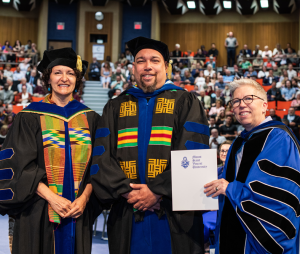
Three-time Mount Saint Vincent University (MSVU) graduate Dr. Martin Morrison made history this year as the first Indigenous African Nova Scotian to earn a PhD at MSVU and the first Indigenous African Nova Scotian man to graduate from the Inter-University Doctoral Program, a collaborative initiative between MSVU, Acadia University and St. Francis Xavier University.
Understanding Indigenous African Nova Scotian Identity
The term Indigenous African Nova Scotian refers to people of African ancestry whose families have been in Nova Scotia since the early colonial period - defining their resistance and resilience to systemic racism and their unique multigenerational experiences in the province.
"People of African descent have common racialized experiences, but the impact of living here multi-generationally has a different trajectory," Martin says. This cultural identity recognition has been championed by many scholars in Nova Scotia.
A Transformative Educational Path
With this achievement, Martin reaches the summit of a remarkable educational journey spanning more than two decades.
His connection to MSVU began in 2002, when he chose the university based on its small class sizes and hands-on teaching experience for his Bachelor of Education studies. It evolved into a transformative relationship that has shaped both his career and identity as an educator and advocate.
Martin's second degree - a Master of Education in Graduate Studies in Lifelong Learning- proved to be life-changing. The groundbreaking program, offered in partnership with the Africentric Learning Institute of Nova Scotia under the guidance of faculty member Dr. Susie Brigham, brought together 20 African Nova Scotian scholars from across Nova Scotia through full scholarships.
"It provided an opportunity for people of African ancestry to unapologetically place their lived experiences at the centre of their educational experience," Martin says. "This was an opportunity to be in a classroom with 20 other scholars where you didn't have to work to first build understanding of your lived experience - you could just communicate and have it be validated and affirmed."
From Student to Educator
Martin's educational journey was motivated by real-world challenges he witnessed in public education. As a classroom teacher who began his career at Graham Creighton Junior High School before moving to Digby to serve the Black community closer to home, he recognizes the systemic inequities affecting African Nova Scotian and Mi'kmaq learners.
"When ability meets opportunity, you can succeed," Martin says. "You just need the appropriate environment for learners to feel accepted, welcomed, understood and supported."
His doctoral work in Educational Studies focused on Africentricity and critical race theory, emerging from his commitment to creating more responsive educational systems. Martin successfully defended his dissertation in November 2024 and graduated at MSVU's spring 2025 convocation.
Interwoven with his studies, Martin's 20-plus years of work experience includes roles as a public educator and administrator, as well as positions focusing on race relations, cross cultural understanding, human rights and African Nova Scotian education.
Following the completion of his master's degree, Martin worked as the Race Relations, Cross Cultural Understanding and Human Rights Coordinator, Regional Coordinator of African Nova Scotian Education, and principal at Digby Regional High School for Tri County Regional Education Centre, and at the Department of Education and Early Childhood Development as an African Nova Scotian Corporate Strategist for the African Canadian Services Branch and as the African Nova Scotian Regional Education Officer for the province.
More recently, Martin served as an Assistant Professor at MSVU for two years - enjoying a full circle moment after completing his degrees at the university. He is now an Associate Professor at the Acadia University School of Education, where he is most proud to participate in supporting the development and implementation
A Legacy of Community Advocacy
Martin emphasizes that his achievements reflect collective community effort rather than individual success. Growing up in Danvers and Southville, Nova Scotia, where his mother completed grade 12 and his father grade 9, Martin credits community advocacy for creating opportunities that weren't available to previous generations.
"There's a deep sense of responsibility I feel toward community," he says. "Community advocacy demanded and created space for more people to get opportunities. I see myself in that continuum it is not only about getting myself through the door, but helping move more people in."


