




The artist Skawennati, BFA 92, GrDip 96, has spent decades envisioning Indigenous futures through fashion collections, quilts, beadwork and films created entirely in virtual environments using game-like software as both camera and set.
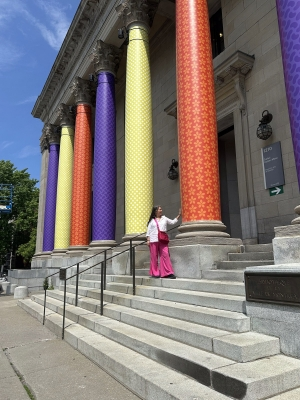
That vision now appears on the façade of the Maison du CAM (also known as the Gaston-Miron Building) across from Montreal's La Fontaine Park, where an augmented reality installation brings the building's nine columns into a layered visual experience shaped by Indigenous worldviews.
Created to mark the 70th anniversary of the Conseil des arts de Montréal, Skawennati's work centres on the Three Sisters corn, beans and squash whom Skawennati has reimagined as superheroes, complete with costumes she designed and patterned with corn niblets, bean shapes and squash seeds.
Point a phone at the building and the Sisters come alive, singing a hip-hop song written by Skawennati and performed in Kanien'kéha, French and English by three Mohawk speakers she first collaborated with in 2023.
"I don't see enough Indigenous symbolism in Montreal," says the Faculty of Fine Arts and John Molson School of Business graduate. "I'm so interested in showing what a city can feel like if it has bigger and bolder Indigenous imagery in it."
The installation chosen as the winner of the Conseil des arts de Montréal's first-ever temporary public art competition is also political. Skawennati, whose works have been exhibited at the National Gallery of Canada and the Musée d'art contemporain de Montréal, is clear-eyed about that intent.
"By inserting Indigenous iconography into the public eye, you affect change," she says. "Not just raising awareness of the existence of Indigenous people, but of our values and our vitality."
Her end goal, she says, is a level playing field where race, gender and background are not barriers to self-actualization. The Three Sisters, ancient symbols of sustainability and interdependence, are her vehicle for saying so.
That instinct to use new tools to carry old values traces directly to Concordia, where Skawennati arrived intending to become a designer. Her first materials list included rapidograph pens and an eraser shield.
After the Faculty of Fine Arts opened a new Apple IIe computer lab and introduced a class on HyperCard, early Apple multimedia software, something shifted.
A professor, Don Ritter, brought her class to a separate lab housing Amiga computers machines with video and graphics cards that Apple hadn't yet caught up to. The Amiga lab wasn't officially hers to use, but she kept coming back anyway.
"I just got seduced by new media by the computer as a design tool and as an art tool," Skawennati recalls.
It was also at Concordia where she found community. Through the campus group Assembly of First Nations-Concordia, she met the people who would become co-founders of Nation2Nation, an Indigenous artist collective that propelled her into the urban Indigenous art world she has inhabited ever since.
Skawennati's roots still remain at Concordia as a research associate and co-director of Aboriginal Territories in Cyberspace, the research-creation studio she co-founded with Jason Lewis, Tier 1 Research Chair in Computational Media and the Indigenous Future Imaginary.
Thirty years after she first sat down at that Apple IIe, her work is finding one of its biggest public canvases yet in the heart of Montreal/Tiohtià:ke.


