




Family, friends, Elders, Knowledge Keepers, local Indigenous leaders and members of the University of Victoria (UVic) community gathered at the Esquimalt Nation Longhouse last week guided by the protocols of the host Nation to honour Qwul'sih'yah'maht, Dr. Robina Thomas in a traditional Coast Salish Honouring Ceremony.
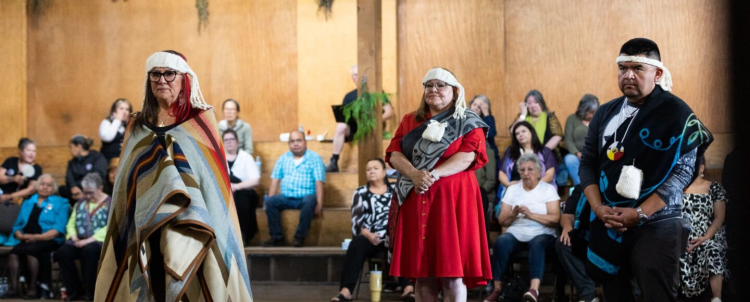
Qwul'sih'yah'maht, Dr. Robina Thomas stands beside Lalita Kines and Ian Sam during the Honouring Ceremony.
As Thomas retires after 27 years at UVic a career that culminated in the role of acting president and vice-chancellor the gathering celebrated a lifetime of leadership grounded in Indigenous ways of knowing, guided by relationships and rooted in community. Walking confidently in two worlds throughout her career, she carried her teachings, values and cultural responsibilities into every role she held, helping create space for Indigenous ways of knowing to guide the university while creating new pathways for those who would follow.
Rather than marking an ending, the gathering recognized that leadership evolves over time. It was a reminder that the work of caring for community and creating opportunities for others continues long after a formal role comes to a close.
The ceremony celebrated more than a distinguished career; it honoured those who have walked alongside her to help create lasting change within the institution and the shared responsibility to continue that work for future generations.
Songs from the Quw'utsun Tzinquaw Dance Group filled the longhouse as family, friends and colleagues stood together to sing, dance and celebrate. Stories gave way to laughter, heartfelt memories and moments of deep gratitude that celebrated not only what Thomas had accomplished, but how she made people feel seen, supported and valued throughout her life's work.
Among the gifts presented during the ceremony was one from the University of Victoria, offered by Kundoqk, Dr. Jacquie Green, executive director of the Office of Indigenous Academic and Community Engagement (IACE), and a long time friend and colleague of Thomas. Together with the blanketing and the words shared by witnesses, Indigenous leaders and community members, these gestures reflected the university's gratitude for Thomas' years of integrity, strength and leadership.
Grounded in relationships
Thomas began her career at UVic in the School of Social Work. It was here that she helped establish the Indigenous Specialization in Social Work, working alongside Indigenous colleagues, students and community partners to reimagine what Indigenous education could look like. Grounded in Indigenous knowledge, relationships and community, the program reflected a belief that would continue to shape every chapter of her career: Indigenous students should never have to leave their identities, cultures or ways of knowing in order to succeed.
Working alongside Indigenous communities, students, faculty, staff, university leaders and allies, she helped foster a university where Indigenous ways of knowing became increasingly woven into the fabric of the institution not as additions to existing structures, but as guiding laws and philosophies to strengthen UVic as a whole.
Her leadership advanced Indigenous student success, strengthened relationships with Nations and communities, expanded opportunities for Indigenous faculty and staff, and supported transformative initiatives such as the Indigenous Plan. Throughout each chapter, Thomas reminded those around her that meaningful change is never the work of one individual, but of people coming together with a shared purpose and commitment to walking alongside one another.
Guided by the Sacred Cycle
For Thomas, leadership has always been rooted in love, humility and reciprocity. Throughout her career, she has worked to create the conditions for others to thrive, understanding that lasting change begins with relationships, grows through trust and continues when others are empowered to lead.
That philosophy reflects the Sacred Cycle, one of the foundational teachings woven throughout UVic's Indigenous Plan, which reminds us that we are connected across generations honouring those who came before us, caring for those around us today and preparing a path for those yet to come. Thomas has embodied that teaching by helping create opportunities for Indigenous students, faculty and staff to flourish while inspiring others to carry the work forward.
She has often challenged those around her to dream beyond what seemed possible, believing that meaningful institutional change begins with the courage to imagine something better. While the ceremony celebrated her leadership, it also reflected a shared commitment to continue dreaming together, building together and creating new possibilities for the generations who will follow.
Preparing the path for future generations
It is a vision perhaps best reflected in the hope that she has shared throughout her career: that one day her grandchildren could attend the University of Victoria without having to leave their identities, culture or values at the door that they would know they belong exactly as they are. That aspiration has become more than a personal dream. It has become a shared commitment embraced by many across the university.
As family, friends, Elders, Knowledge Keepers and colleagues raised their hands one final time, Qwul'sih'yah'maht, Dr. Robina Thomas was sent forward in a good way surrounded by community, culture, laughter, song and love and with the confidence that the work will continue in the hands and hearts of those who walk beside her.
I've had the privilege of walking alongside Robina for more than three decades, beginning as an undergraduate student in social work, then as faculty colleagues in Social Work and continuing throughout our leadership journeys at UVic. She has always led with a good heart and good mind, integrity, humility and deep respect for people and these territories this university sits on. No matter what role she held, she remained a social worker at heart someone who listened first, built relationships, and believed in creating opportunities for others. From her role in Social Work, she guided this school to recognize and implement Indigenous ways of knowing and being' to her role as VPI where this university learned and adapted these important cultural teachings. Robina has inspired so many of us to lead in the same way, and I know the work she helped nurture will continue because of the people she has encouraged and believed in along the way."
Kundoqk, Dr. Jacquie Green, IACE, executive director


