




The University of Waterloo's Pearl Sullivan Engineering IDEAs Clinic has built an impressive reputation over the past 10 years as the leading provider of student-focused, hands-on learning experiences aligned with industrial and societal needs.
Launched in 2015, this unique facility in the Faculty of Engineering has hosted more than 60,000 students from across campus and challenged them to work in teams and apply their classroom theory to solve real-world problems.
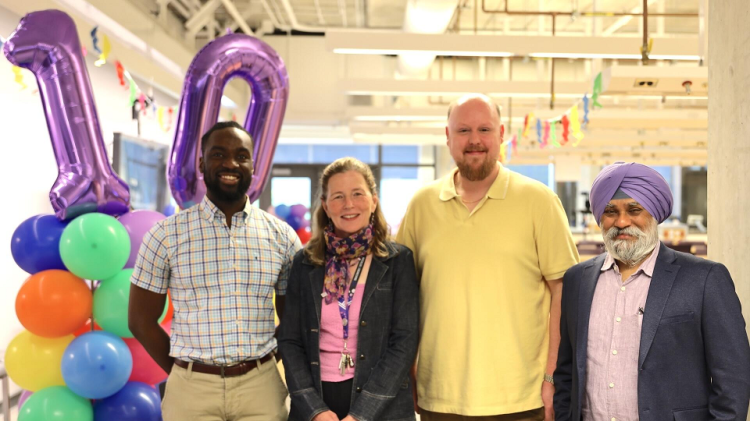
(left to right): Silas Ifeanyi, engineering educational developer, IDEAs Clinic; Dr. Mary Wells, dean of Waterloo Engineering; Dr. Chris Rennick engineering education developer, IDEAs Clinic; Dr. Simarjeet Saini, director, IDEAs Clinic. Photo credit: University of Waterloo Faculty of Engineering
Named for former Waterloo Engineering dean, the late Dr. Pearl Sullivan, the idea for the IDEAs Clinic was born in 2011 when first-year students from the Department of Mechanical and Mechatronics Engineering were tasked with taking apart single-cylinder engines. The workshop was a hit. When Sullivan, who was chair of the department at the time, became dean in 2012, integrating practical engineering experiences into the curriculum evolved into a Faculty-funded and interdisciplinary initiative spearheaded by Dr. Sanjeev Bedi, a mechanical and mechatronics engineering professor.
"From the start, it was about giving students the chance to make and test things, to connect theory with practice, to be innovative and have fun tinkering," Bedi, the IDEAs Clinic's founding director, says. "We wanted to show how chemistry connects to materials, how circuits tie into programming, how challenges are solved through teamwork. Real engineering problems are not solo fixes and don't fit neatly into textbook course descriptions."
Growing pains and growing up
In those early days, the workshops took place in makerspaces and labs borrowed from the University's Sedra Student Design Centre (SSDC) and the Douglas Wright Engineering (DWE) building, among others. There were a lot of big learning curves, including one particularly memorable coffeemaker dissection workshop in DWE with first-year chemical engineering students. They all plugged in and turned on their coffeemakers at the same time, knocking the power out and plunging most of the building into darkness.
By 2015, the initiative's enthusiasm and impact had attracted industry interest from Ansys, Quanser, D2L, Xinyi Glass, Skyjack and Rockwell. These foundational partners, combined with Faculty's financial backing and the establishment of a NSERC Chair in Design Engineering awarded to Bedi, provided the funding and structure to formally launch the IDEAs Clinic. When the *Engineering 7 (E7) building opened in 2018, the clinic got its own purpose-built space with the scale and flexibility to create a true maker environment.
Dr. Chris Rennick, the engineering educational developer at the IDEAs Clinic and one of its longest-serving team members, highlights the facility's physical and technical properties.
"It's large enough for over 200 students," Rennick says. "But modular enough to transform from a fabrication lab to a team competition space in minutes. It's equipped with mobile tables and overhead power outlets to fit different setup requirements and accommodates activities from quantum mechanics to urban design to automative manufacturing we're the envy of other Canadian universities."
The space is designed to emphasize teamwork with tables arranged in groups of four so students face one another and work side by side to solve problems together. As one large, open room, it encourages conversation students can easily connect with each other and engage with instructors in a way that is more natural and fluid than that of a traditional lecture hall. The layout quite literally flattens the usual hierarchy of a large classroom, creating a more collaborative and approachable environment for learning.
The importance and impact of partnerships
The IDEAs Clinic has grown into a multifaceted ecosystem that supports both curricular and co-curricular learning. For example, Design Days integrate project-based learning directly into courses across engineering departments, while Innovation Challenges invite students from multiple faculties to tackle complex, real-world problems in partnership with industry.
The Toyota Motor Manufacturing Canada (TMMC) has been a partner since 2022, exposing students to the real challenges shaping modern automotive manufacturing. At its annual Innovation Challenge, TMMC engineers take a problem they themselves are actively working on and task participants to design and prototype solutions. This year's hackathon challenged students to devise ways to control robots operating in the same space as people and improve automated manufacturing lines.
We're proud to collaborate with the University of Waterloo's IDEAs Clinic on the Toyota Innovation Challenge," Erin Buchanan, TMMC General Manager and a Waterloo Engineering alum, says. "Together, we're turning real-world engineering challenges into hands-on learning opportunities that help students develop the skills and confidence to succeed in the workplace."
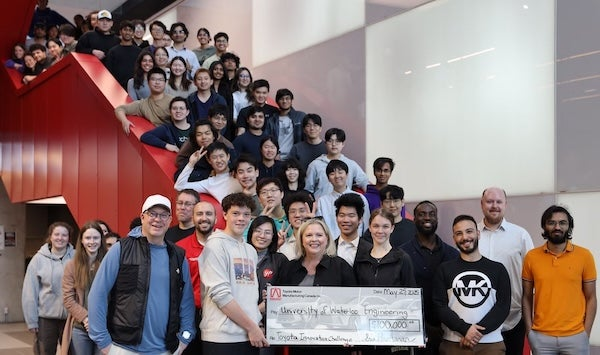
Toyota Motor Manufacturing Canada (TMMC) renews their partnership with the IDEAs Clinic in 2025.
While rooted in the Faculty of Engineering, the IDEAs Clinic is building new collaborations that connect engineering students with their peers in science, health and environment to tackle interdisciplinary challenges in areas such as quantum mechanics, health tech and urban design.
The Yuen Family Foundation has partnered with the Clinic to support the Health Hub which hosts an annual Health Tech Innovation Challenge for engineering and health students. Designed to get students interested in tackling the complex and evolving world of health-related challenges, this year's hackathon tasked participants to develop technological solutions for hospital-induced delirium in elderly patients.
Sharing the foundation's motivation behind the partnership, Waterloo Engineering alum Ivan Yuen (BASc '00) says "We hope to attract engineering talent to tackle some of the biggest challenges and opportunities in our society. Healthy aging and eldercare are among the most pressing needs as our country ages rapidly.
"The Health Hub presents a terrific opportunity because it brings together multidisciplinary teams with diverse experiences and backgrounds. This is how real-world change happens, especially for issues that potentially affect everybody."
The IDEAs Clinic aims to scale industry-relevant experiential learning with two Innovation Challenges each term in 2026. Efforts are also underway to better coordinate fourth-year Capstone design projects across programs by leveraging Clinic space, co-op talent and shared technical resources. The Clinic's long-term objective is a coherent, first-to-fourth-year pathway that embeds real-world engagement and hands-on design learning throughout a student's degree.
"We're building a structure that supports continuous, applied learning from a student's first day through to graduation," Rennick says. "Everything we've achieved so far, and hope to achieve going forward, is thanks to our dedicated faculty members, students and partners who believe that a good engineering education is practical, collaborative and fun."
*With gratitude to the Gloria Baylis Foundation, the Faculty of Engineering has renamed E7 the Pearl Sullivan Engineering building. Read the full story: Honouring the legacy of Dr. Pearl Sullivan and the future of education
Get in touch with Dr. Chris Rennick at the Pearl Sullivan Engineering IDEAs Clinic at the University of Waterloo, to find out how you can support and participate in upcoming interdisciplinary workshops and innovation challenges designed to improve educational outcomes.


