




A new plastic recycling project at UNBC is diverting plastic waste from the landfill while creating hands-on learning opportunities for students and community members.
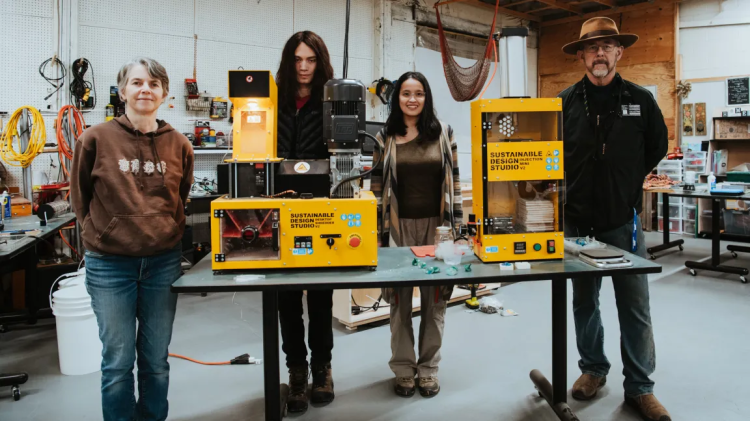
The Northern BC MakerCollective space in downtown Prince George is home to the plastic recycling project in partnership with UNBC. Pictured from left are Belinda Larisch, Joe Helle, Ann Duong and Ian Simpson.
In partnership with the Northern BC MakerCollective, a new plastics recycling station is open at the maker space in downtown Prince George. Collected waste plastics are now being processed and reshaped into new products. The project is supported by $168,000 in funding from the provincial CleanBC Plastic Action Fund.
For UNBC Sustainability Manager Ann Duong, the project represents a crucial step toward improving campus waste management while building practical skills.
"From my lab experience, I've seen perfectly good plastics end up in landfills," she says. "This project aims to shift UNBC toward a circular economy, closing the loop rather than following a linear waste model."
Plastics are collected at the Prince George campus and then transported downtown where they are shredded before they are molded into new products.
The initiative aligns closely with UNBC's 10-year Sustainability Strategic Plan. In particular, its focus areas on Campus as a Living Lab, Waste and Asset Management as well as In Service of Community and the Next Generation. It also supports the University's target of 70 per cent total waste diversion by 2035.
"Students engage directly with recycling processes, gaining applied learning experience," Duong says, adding that the hands-on approach gives learners a better understanding of what recycling truly entails and fosters greater appreciation for material systems.
Beyond environmental benefits, the project responds to broader economic gaps in traditional sustainability measures.
"There's also a business case," Duong says. "Traditional measures of wealth like GDP don't account for waste and pollution as costs. By applying lifecycle analysis and promoting recycling, UNBC can demonstrate the economic and environmental benefits of sustainable practices."
The partnership with the Northern BC MakerCollective grew through shared interests in sustainable design and community-based making. Founder Belinda Larisch says the Collective had been working toward reopening a local makerspace after the previous MakerLab at Two Rivers Gallery closed.
"When we were introduced to UNBC Sustainability, we found that we had much in common," she says. "We were intrigued by the idea of plastic recycling, as repurposing materials is something of a core principle to many makers."
As planning progressed and funding was confirmed, the partnership shifted from concept to action. The Maker Collective accelerated efforts to acquire a working space, opening the Maker Station to house the project's recycling equipment.
"The ability to take waste plastic and re-shape it into new and useful products opens up a seemingly infinite amount of potential projects," Larisch says. "The addition of plastic recycling opens up opportunities for greater creativity whether for personal use, prototyping for future business ventures, or small entrepreneurial projects."
While much of the equipment will be dedicated to plastics processing, Larisch notes that some tools, including a Computer Numerical Control machine used for mold-making, can also be applied to other creative projects involving wood or aluminum.
UNBC faculty and students have already played a key role in shaping the project. During the Spring 2025 semester, students in a third-year Engineering course focused on sustainability principles, conducted term projects examining plastics available on campus, collection methods, processing pathways and potential end products.
"They looked at what types of plastics are available on campus, how to collect the plastic, product ideas, and how to process the plastic from collected plastic to final product," says Engineering Associate Professor Dr. Steve Helle.
In future semesters, Helle plans to deepen this collaboration with more advanced assessments of the Makerspace's real-world operations.
"My plan is for the students to complete detailed lifecycle analyses for the actual equipment and processes running at the MakerCollective," he says.
Helle believes working on active projects gives students skills that extend beyond the classroom.
"Hands-on, real-world projects have higher learning potential," he says. "They are messier and require the ability to work with uncertainty and they are highly motivating because it is not a make-work project, but one with real meaning."
While the plastic recycling project is not intended to operate on a commercial scale, organizers hope it will inspire similar initiatives across northern and remote communities. Outreach plans include working with schools and promoting open-source methods so communities can adapt and replicate the model.
"We are committed to expanding outreach," Duong says, "demonstrating how simple and accessible recycling can be."
For more information

3333 University Way
Prince George British Columbia
Canada V2N 4Z9
www.unbc.ca


