


Brock University is taking steps to ensure its busiest residents are feeling at home on campus.
Now officially recognized as a Bee Campus, Brock is committed to supporting the humble pollinators and their vital role in the environment.
For Brock bee expert Miriam Richards, the University's new designation and the education and environmental activities associated with it make Pollinator Week from June 22 to 28 particularly sweet.
"Pollinator Week is a good time to stop and think about the myriad tiny creatures that we usually don't even notice but which have an enormous, positive impact on people and the landscapes that they live in," says the Professor of Biological Sciences and principal investigator of the Brock Bee Lab. "Also, it's nice to have projects linking the University to the UNESCO biosphere in which we're located and to interface more with nature right on campus."
Bees carry pollen grains from one flower to the next, which starts the process of producing seeds, fruits and the next crop of plants.
Bee Campuses cultivate native flowers, shrubs and other plants that attract bees and other pollinators, supporting their natural habitat.
To that end, Brock faculty, staff and students from across campus came together this past September to plant a pollinator garden near the Glenridge entrance of the Roy and Lois Cairns Health and Bioscience Research Complex.
The combination of native plants coneflower, milkweed, bee balm, yarrow and raspberry were chosen with great care, says Rebecca Anderson, Facilities Management Sustainability Co-ordinator.
"We have a responsibility as stewards of this land," she says. "Being here, we have a responsibility to respect the land by increasing biodiversity and managing the planting of native species."
Bee Campuses also work to raise awareness about bees and how to protect them from human activity.
Richards and her students provide knowledge and insights about bees through their many research projects. These include male eastern carpenter bee behaviour, how hormones influence egg maturation in adult female eastern carpenter bees, rare bumble bees on campus, how to increase bee populations in Niagara, and threats to bees' survival.
Richards and her team conduct much of their research in the nearby Glenridge Quarry Naturalization site. Between campus and the site, they have found 160 species of bees "way more than the number of bird species," she says.
Most bees live in burrows they dig in the ground or in hollow sticks, with mason bees building little nests out of mud and resins, Richards says.
Bees arrive in two "waves" in the spring and early summer. Before overwintering in their burrows, they reproduce, with the babies emerging the following spring.
Brock's Bee Campus Pollinator Team developed a Pollinator Habitat Action Plan that supports the initiative by installing signage across campus giving information about native bees and habitats, offering guided tours around campus, bringing students to campus to learn about bees and other pollinators and setting up "bee hotels" where bees can build their nests.
Plans are underway to create two pollinator planter gardens at the Marilyn I. Walker School of Fine and Performing Arts in downtown St. Catharines.
Brock's Bee Campus Pollinator Team includes Richards; Anna Lathrop, Special Advisor, Office of the Provost, and Professor of Kinesiology; John Dick, Manager of Grounds Services; Lyllian Corbin, PhD student; James Mesich (MSc '24), Master of Science graduate; and Tomas Flecker, Executive Director, Strategic Projects in the Office of the Provost.
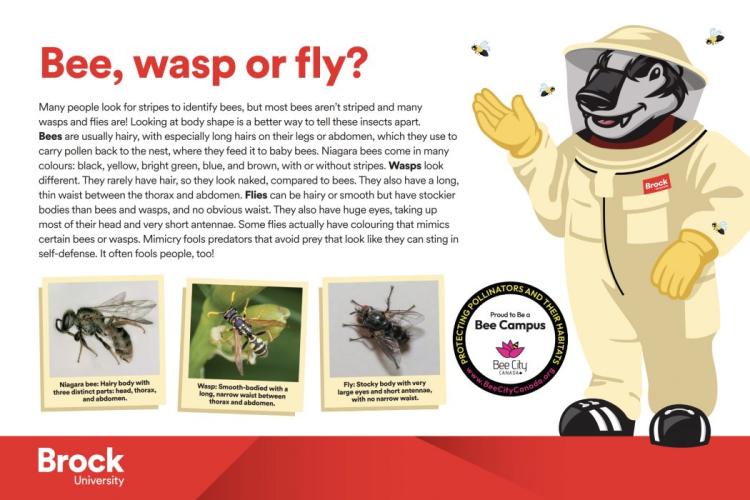
Signs have been installed on campus sharing helpful information on bees.


