




Driven by the stark reality that two out of every five Canadians are expected to be diagnosed with cancer in their lifetime, Travis Dudding has made it his mission to improve early detection through advanced imaging technologies.
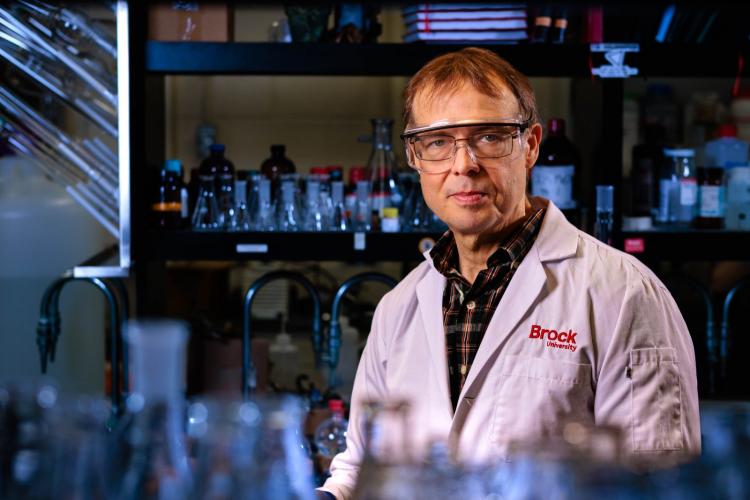
Professor of Chemistry Travis Dudding's research on new molecular imaging agents is among three Brock University projects awarded Alliance International Catalyst Quantum grants offered by the Natural Sciences and Engineering Research Council of Canada.
The Brock University Professor of Chemistry, working with collaborators at Johns Hopkins University, is developing new molecular imaging agents that circulate through the body and illuminate biological processes. This will allow clinicians using positron emission tomography (PET) scans to visualize tissues and disease sites with greater accuracy.
PET scans are powerful diagnostic tools that reveal the body's molecular and cellular activity. By capturing these processes in real time, they play a critical role in diagnosing and managing complex diseases such as cancer, says Dudding.
Dudding's work is being supported by funding announced April 16 under the Natural Sciences and Engineering Research Council of Canada's group of Alliance Grants.
Brock Associate Professor of Chemistry Jianbo Gao also received two Alliance International Catalyst Quantum grants. The three grants total $75,000.
"These prestigious awards recognize the world-class quality of Dr. Dudding's and Dr. Gao's work in quantum computing, materials and communications," says Brock University Vice-President, Research Tim Kenyon. "Through partnerships across sectors and borders, our researchers are applying their innovations to meet emerging global and national challenges that have wide-ranging impacts in health care, industry and many other sectors."
Dudding's collaboration focuses on PET's imaging agent, which enables the body's internal structures to be seen more clearly. Bioimaging is enabled by incorporating fluorine-18 into biomolecules such as carbohydrates, lipids, proteins and nucleic acids. However, these fluorine-18-labelled biomolecules are often unstable, leading to reduced image clarity and, in many cases, fuzzy results.
Dudding, Johns Hopkins Assistant Professor of Radiology and Radiological Science Laurence Carroll and their graduate students are using artificial intelligence and quantum computing methods to create a new molecule that will carry fluorine-18.
"The end result is that we can diagnose cancers more effectively and faster, which is going to save human lives in Canada and throughout the globe," says Dudding. "I'm excited to use my knowledge and interest in chemistry to make diagnostic tools that doctors use to treat patients."
Meanwhile, Gao's research focuses on advancing next-generation quantum sensing and quantum computing technologies.
In these technologies, particles made from light, electric currents, magnetism brought about by electrons spinning, and temperature-related atomic vibrations interact with each other at "ultra-fast" speeds in quantum devices.
In one project, Gao is collaborating with Clément Livache at École Polytechnique in France to develop qubits the basic unit of information in quantum computing that can operate at room temperature. Currently, qubits are formed and operate in very cold temperatures.
"Qubits functioning at room temperature is a key step toward practical quantum computing," says Gao. "This allows for dramatically increased computing power and much faster data processing."
In another project, Gao is working with Sohee Jeong at Sungkyunkwan University in South Korea to develop advanced sensors based on nanocrystals. These materials enable the detection of extremely weak or invisible light, opening new possibilities for imaging, communication and security technologies.
"These quantum technologies have the potential to enable scalable, low-cost and energy-efficient devices," says Gao. "They will play a key role in strengthening Canada's leadership in quantum innovation, supporting industry growth and training the next generation of highly skilled researchers."
NSERC's Alliance International Catalyst Quantum grants seek to support partnerships between Canadian researchers and international collaborators.
Chris Bittle, Member of Parliament for St. Catharines, says Brock University's quantum researchers are among scientists across the country who are positioning Canada to be "a leader in quantum research."
"Quantum technologies, developed through the study of systems at the atomic and subatomic level, support the growth and transformation of key sectors and advance the range of benefits for society," he says.


