




Today's high school bullies are likely to become tomorrow's office tyrants, says Tony Volk.
That's the stark reality the Brock University Professor of Child and Youth Studies has uncovered through a long-running study that follows up on teens who expressed aggressive behaviours at school more than a decade ago.
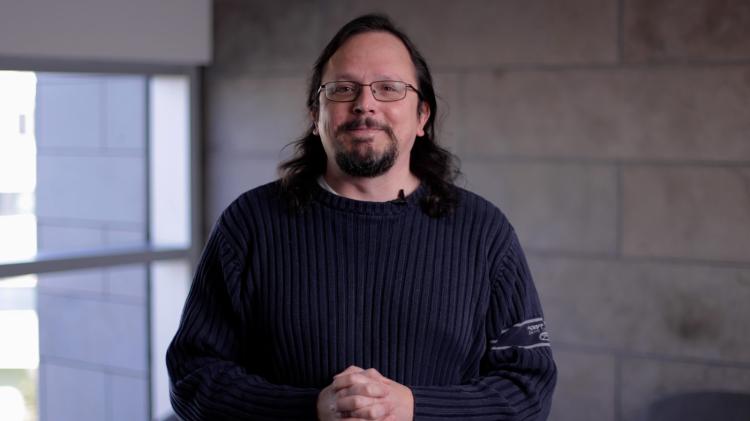
Professor of Child and Youth Studies Tony Volk has been awarded Brock's 2026 Distinguished Research and Creative Activity Award for his work on child and adolescent bullying.
"We're finally able to answer the question, Do those teenagers behave the same way when they're in the workplace?'" Volk says. "And for many, the answer is yes."
His team is now looking to extend its bullying research from high school into the workplace to see how this developmental trend impacts the next phase of life.
Volk is doing so with the support of Brock University's 2026 Distinguished Research and Creative Activity Award (DRCA).
Vice-President, Research Tim Kenyon says Volk has an extensive, innovative research and publishing history that has made him a leading bullying expert in the field of child and adolescent psychology.
"Dr. Volk's record reflects his commitment not only to research excellence but also to the accessibility of scholarship to the public and to professionals who can use it to inform their understanding and their practices," says Kenyon.
Volk is a founding member of the Brock Research on Aggression and Victimization Experiences (BRAVE) group. Made up of Brock researchers, professors and graduate and undergraduate students who study aggression, BRAVE is one of Canada's largest teams of child and adolescent bullying experts.
Currently, Volk and his team are collecting a range of data from who likes who to the social goals that teens have from 1,000 elementary and high school students in the Niagara Catholic District School Board for a study on adolescent relationships.
This study, which builds on previous research examining relationships before and after the pandemic, aims "to understand how to motivate adolescents to use social power in constructive and beneficial, rather than selfish, ways," he says.
A large part of Volk's work sees bullying as behaviour rooted in evolution, designed to enable the bully to get access to resources they need to achieve their goals.
For example, in a 2018 study, he found teen bullies have a higher number of sexual partners than their non-bullying peers while his 2025 study revealed aggressive teens tend to have more children when they become adults.
Other "benefits" bullies derive from their anti-social behaviour include obtaining social dominance, popularity, money, academic rankings and scholarships.
But these advantages gained from aggressive behaviours don't stop at high school and aren't just an adolescent "rite of passage," says Volk.
"If you have a business model that incentivizes competition and individual gain, you're going to be incentivizing bullying," he says. "Workplaces are behind most schools because many businesses still encourage this kind of open competitiveness for positions, promotions and other rewards."
While a small degree of competition can be healthy, the "survival of the fittest" mentality in many workplaces leads to toxic environments endangering employees' mental and physical health, leading to suicide in some tragic cases, says Volk.
"The similarities between schools and the workplace are so strong that we plan to transfer much of what we know about bullying in schools to better understanding bullying in the workplace," he says.
Volk also plans to expand the national and international ties and collaborations of the BRAVE group, including inviting and training students and postdoctoral researchers from international, world-class labs.
He says receiving the DRCA recognition points to the importance of addressing aggressive behaviours in high school and the workplace.
"When we look south of the border, at North Korea and especially Russia, there are all kinds of examples of how bullying is being applied at a global scale," says Volk. "But messages about working together to stand up to bullying are resonating across domains, across Canada and around the world.
"This is something that gives us a lot of encouragement about the value of our work and how we can apply our adolescent bullying research to adult settings."
Brock University's $10,000 DRCA award recognizes outstanding research achievements, contributions to the training of future researchers and strong scholarly or creative performance.


