




Dementia can be brewing in the background for years before the telltale signs of memory lapses and difficulties with wayfinding creep into people's daily lives or are caught through memory tests, but endless crossword puzzles or sudoku are unlikely enough to make a meaningful difference.
Decades of research as the scientific lead of York University's Sensorimotor Neuroscience Laboratory have taught Professor Lauren Sergio that brain games are not enough to stave off dementia or recover from a concussion, at any age. The missing piece is combining thinking with movement, she says. "Cognitive brain training on its own hasn't been shown to work in terms of maintaining functional independence as it doesn't incorporate movement."
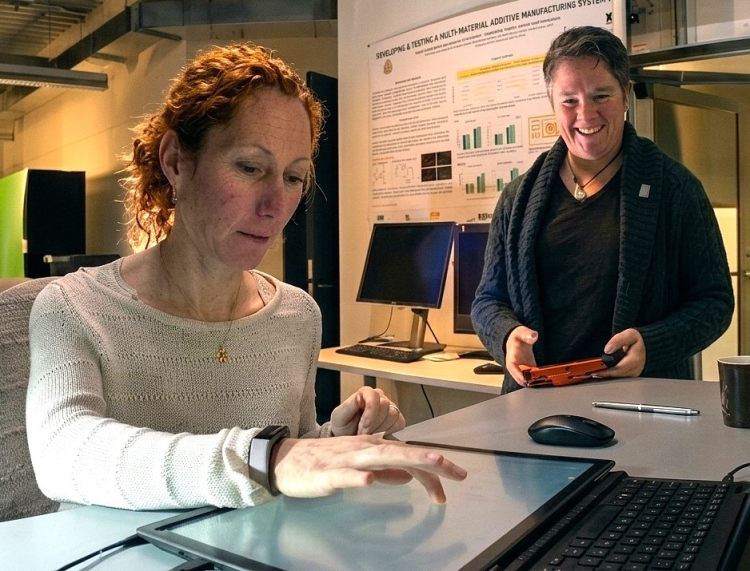
York University Professor Lauren Sergio (R) in her lab with a participant in one of her research projects
Brain changes with mild cognitive impairment or early dementia often show up first as cognitive motor integration changes, such as through movement, coordination and slower reactions when having to think and move at the same time, rather than with memory issues, she adds. For those with concussions, whether elite athletes, children or older adults, they recover faster when given tasks that force their brains to make new connections through movement.
Her biomedical research is now being used as the basis for a new brain performance platform, by NERON AI, bringing cutting-edge neuroscience from the lab into the real word. "This is a toolbox that can not only be used by people concerned with their brain health, but it can help clinicians, such as gerontologists, as well as other health-care providers, to understand and potentially track brain changes for people concerned about dementia as they age or those suffering from an acquired or mild brain injury, such as a concussion. The concepts of brain health from my research could be incorporated into their work," Sergio, York Research Chair in Brain Health and Gender in Action.
The NERON platform provides a cognitive baseline and track changes and improvements over time as users do a series of interactive brain and movement training challenges designed to develop new and stronger neural pathways. The goal is to help improve functional ability to do everyday tasks, catch early brain changes and provide tasks to build brain resilience based on Sergio's research.
"Through dozens of studies, we found using a cognitive motor integration approach allows us to look at movement as a window into how well the brain regions are talking to each other," says Sergio, who worked with Innovation York to get her research out to a broader audience. "This is research that for me is really important for it to be accessible to the public in a way that can benefit them starting with a simple way to test how well their brain is functioning."
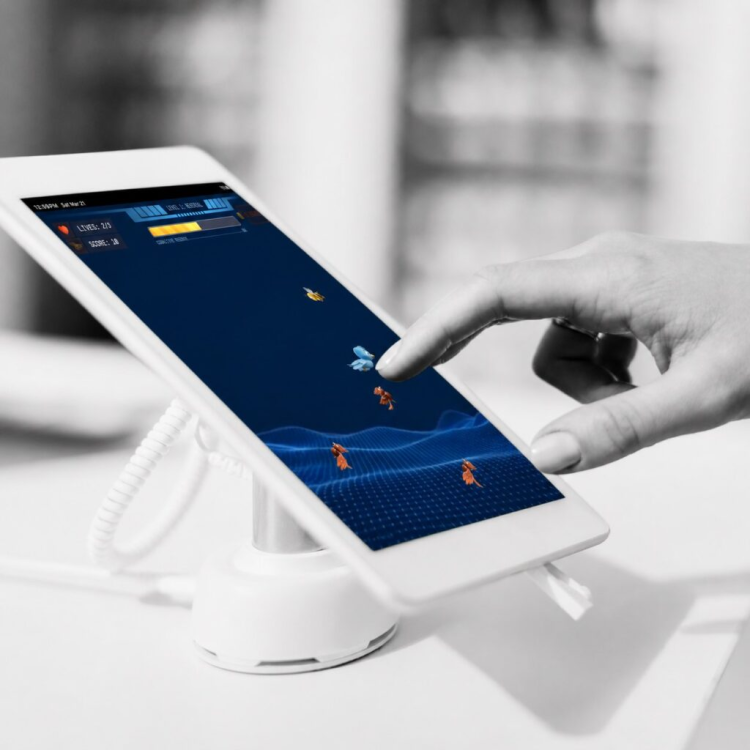
One of the NERON kiosks
Continuing to challenge the brain with the kinds of tasks available on the platform can help build cognitive reserve, which not only helps the brain recover faster from a concussion but also provides a buffer against cognitive decline.
"Everyone is concerned about their brain health but measuring how it performs under real load has mostly stayed inside research labs," says Reed Hanoun, CEO, NERON. "We built a way to do it in under 10 minutes, anywhere, so brain performance can finally be tracked as routinely as any other vital sign using any mobile device."
The tasks are designed to continually challenge the brain. Although they may seem simple - like moving a computer mouse to the right to complete an onscreen task when the cursor moves unexpectedly to the left - it requires the brain to abandon automatic mode and really think about completing the task.
"It turns out if you are having a problem with that kind of task, it could be an early warning sign, either of a past history of a brain injury or future dementia," says Sergio, who has received multiple grants for her research through the Canadian Institutes of Health Research and the Natural Sciences and Engineering Research Council of Canada.
Through her research with young athletes who have played a sport competitively for more than seven years, she has found they recover function and performance skills faster after a concussion than house league children and youth who have only played a sport for a couple of years. Those athletes who play a particular sport for years develop a particular visual motor skill that helps protects their brain. Sergio is now also looking at older elite athletes to see if they retain that brain resilience as they age.
Sports are not the only way to develop these brain protecting connections. Operating a drone or a backhoe or reversing a vehicle with an RV camper attached into a parking spot are everyday examples how the brain is engaged while doing movement. "Believe it or not, that guy operating a backhoe, he's using way more of his brain when he's working than if he takes a shovel and digs something out manually, which is far less complicated," says Sergio.
"All your brain regions have to talk to each other if you're just using a little joystick to do something, like fly a drone. Those sorts of skills, it turns out it requires a lot of brain communication."
The key is to force your brain out of its comfort zone so it will build new neural connections. "Take up a new instrument, learn a new language, start doing something with your left hand that you would normally do with your right, like brushing your teeth, try pickleball with your left hand or parallel parking your car on the opposite side of the road, as you would if driving in the United Kingdom," says Sergio of York's School of Kinesiology & Health Science in the Faculty of Health. "Practicing any of these kinds of skills where you're challenging your brain to think while it's doing a new activity could actually help counteract decline."
Gaming is another one. Sergio points to the brains of gamers as having well-connected neuron pathways not necessarily evident in non-gamers. "You want the surgeon who was a gamer as a teenager doing your laparoscopic surgery," she says. Although half joking, she points out their brain networks are usually really strong for doing the types of decoupling tasks, where they are often using a monitor to guide their instruments, demanded of today's surgeons. "That's also who you want to back up your RV camper."
Her research with athletes, gamers and musicians, which has included imaging their brains while they do complicated tasks, has found they have built up some cognitive protection through brain connections in a way that doing a simpler task, like reading an email, doesn't. The brain's networks just don't light up in the same way.
The bottom line is we need to move our bodies while thinking. "Neuroplasticity doesn't go away. You can always learn new things," says Sergio.
About York University
York University is a modern, multi-campus, urban university located in Toronto, Ontario. Backed by a diverse group of students, faculty, staff, alumni and partners, we bring a uniquely global perspective to help solve societal challenges, drive positive change, and prepare our students for meaningful life and career paths. York's Glendon Campus is home to Southern Ontario's Centre of Excellence for French Language and Bilingual Postsecondary Education. York's campus in Costa Rica offers students exceptional transnational learning opportunities and innovative programs, while at the Markham Campus, innovation, technology, entrepreneurship and industry collaboration are built into every program. York's new School of Medicine, the first Canadian medical school to focus on community-based primary health-care education, will welcome its first cohort in September 2028 (subject to accreditation). York was recently named one of Canada's Greenest Employers for the 14th consecutive year. Together, we can make things right for our communities, our planet, and our future.
About NERON AI
NERON AI is a neurotech company making brain performance measurable and trainable for everyone, anytime, anywhere. In under ten minutes, NERON turns how well the brain and body coordinate into an objective Brain Performance Score; a window into the brain's Cognitive Reserve people can track over time, grounded in 20+ years of neuroscience.


