At 6:30 PM Mountain Time on March 14, Aurora College's AuroraSat nanosatellite was launched from Cape Canaveral, Florida, to the International Space Station (ISS) via a SpaceX-27 Falcon 9 rocket and Cargo Dragon spacecraft. Upon arrival at the ISS, astronauts will launch AuroraSat into an orbit around the earth.
Although it won't pass over Inuvik, staff there will still be able to communicate with the satellite for four five-minute blocks per day. The satellite is expected to remain in orbit for approximately one year.
High school students from the Inuvik Robotics Club helped Aurora Research Institute (ARI) staff to design and build the satellite. Nine students were involved during the live of the project, including a computer science student on a six-month internship.
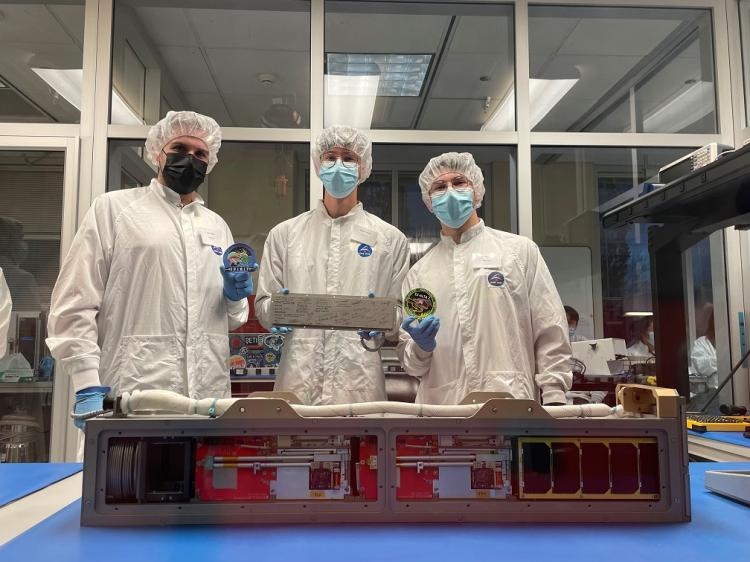
Patrick Gall, Engineering and Technology Projects Technician, Aurora Research Institute, with fellow Group D members Thomas Ganley and Josh Lazaruk with their CubeSats - AuroraSat, YukonSat and NEODOSE (McMaster University) - which have been integrated into the deployer. (Photo Courtesy of Patrick Gall)
Since 2018, Aurora College has participated in the Canadian CubeSat Project (CCP) by constructing AuroraSat in collaboration with Yukon University and the University of Alberta. This partnership unites the three institutions and their individual CubeSats under the name Northern SPIRIT (Space Program with Interesting Research and Integrated Training). https://en.wikipedia.org/wiki/SpaceX_CRS-27
As part of the CCP, 15 student teams from post-secondary institutions in each province and territory designed and built their own CubeSats, with guidance from Canadian Space Agency experts and representatives from the Canadian space industry. A CubeSat is a miniaturized satellite that is a 10 cm x 10 cm cube, weighing less than two kilograms and typically using off-the-shelf electronic components. AuroraSat is a two-unit (2U - 10 cm x 10 cm x 22.70 cm) CubeSat.
Final preparations, including testing to ensure the CubeSats could withstand the temperatures in space, transmit data to the surface, and meet international safety protocols, were completed in late November 2022 to qualify the CubeSats to be launched into space and deployed from the ISS.
Aurora College has developed three outreach missions for AuroraSat called Northern Images, Northern Voices, and Northern Games, which aim to provide STEM outreach opportunities to youth and interested participants in the NWT at the elementary and high school levels. Alongside these outreach missions, AuroraSat will also fly a shared scientific mission, which will be conducted on the satellites built by Yukon University and the University of Alberta. Running the same experiment on all three satellites enables the gathering of spatially distributed data. More information about the shared scientific mission is available on the AlbertaSat website.
Northern Images Mission:
- The Northern Images Mission will display artwork submitted by NWT youth in front of a camera mounted on the CubeSat and photographed with the earth's horizon in the background. NWT artists can continue to submit their artwork, as images can be uploaded and downloaded while AuroraSat orbits the Earth. For more information or to submit artwork, visit https://northernimagesmission.ca or contact cubesat@nwtresearch.com .
Northern Voices Mission:
- The Northern Voices Mission will feature recordings of northern stories about space and sky and transmit them to amateur radios across the country in various languages on a rotating schedule. The Aurora College team is currently working on the details of how to contribute recordings and the requirements needed to receive them from the satellite.
Northern Games Mission:
- The Northern Games Mission invites participants to create an interactive game for amateur radio operators around the world. Specific data packets will be transmitted in certain geographic zones, requiring global cooperation to decode the complete message. The game's content will revolve around northern Indigenous histories and languages. The details regarding the specific frequencies and data structures that will be used in the Northern Games Mission are still under development.
Quotes:
"After many years of Northern students being involved in the design and construction of AuroraSat, through the space mission partnership (Northern SPIRIT), it is very exciting to have the payload launched from the International Space Station this month. The exposure to science, technology, engineering and mathematics (STEM) for all Northerners during the satellite build and flying virtually as part of the AuroraSat mission, will spark the next generation of Northern space explorers."
- Joel McAlister, Vice President Research, Aurora College
"The Northern SPIRIT consortium has provided a unique opportunity to show that technical work, such as the construction of a satellite payload, can be done in the North. As we continue to transform into a polytechnic university, we hope that our participation in programs such as this provides the opportunities and awareness for the benefits of a technical post-secondary education and employment opportunities that are possible inside the NWT. "
- Patrick Gall, Engineering & Technology Projects Technician, Aurora College
For more information

PO Box 1290, 50 Conibear Crescent
Fort Smith Northwest Territories
Canada X0E 0P0
www.auroracollege.nt.ca