How three Camosun students turned a classroom idea into a promising augmented reality prototype that has attracted industry interest and is moving toward a provisional patent.
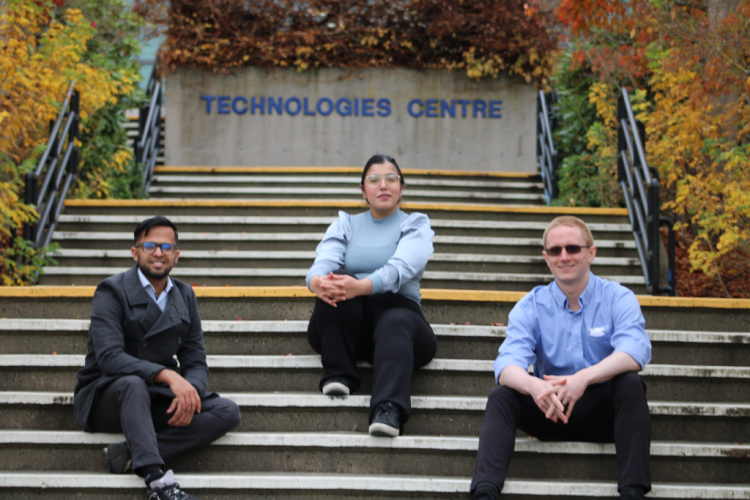
Camosun College Electronics and Computer Engineering graduates Ada Hmoud, Masud Zaman and Maximillian (Max) Schaerer took their time finding the right capstone project. What began as an idea during early discussions in 2025 grew into a fully developed augmented reality (AR) system: clip-on AR lenses paired with custom-created Spectrum software, capable of embedding hidden layers of text, audio and video within images. Only authorized users wearing the team's Spectracle device can securely extract this information, preserving privacy.
The team developed their concept through many iterations and presented it to their classmates and industry at Camosun's electronics capstone symposium at the end of 2025. Their innovation was developed with support from a local company, and the team is now pursuing a patent while exploring future commercialization.
Ada and Masud were already friends who had collaborated on past projects. Ada, who is now in the bridge program to an electrical engineering degree at the University of Victoria, led the software and programming components. Masud originally from Bangladesh and now working as a production technologist in rail manufacturing took charge of the hardware development. Max focused on the machine-learning algorithm that supported the system's intelligent features.
Their roles were distinct, but their approach was deeply collaborative. "If someone was struggling with something, we picked up that burden from them," Ada says. "Then, it all just came together."
The idea for the project originated with Ada. After exploring several alternatives, the team kept returning to her concept.
"We figured out that the ideas Ada shared are really cool and could be a future prospect if we could take the time to develop them," Masud reflects.
They spent the summer preparing and returned for the Fall 2025 semester ready to move forward. The process demanded long nights, constant problem-solving and the challenge of keeping up with other classes. The final week before the symposium, they admit, was uncertain.
"It was very much a question mark up until then," says Ada. "But we all helped each other out, and it fell into place on the big day."
For Masud, the project reinforced the value of adaptability. "When we're working as a team, there's no promise that things will go according to plan. We had to find a different way or a workaround to achieve our goal. I learned to never, never give up."
Looking back, both students agree that they achieved far more than they initially believed possible. Their project represents not only technological innovation, but also the personal growth that comes when a team learns to rely on each other, overcome setbacks and pursue an ambitious idea with curiosity and commitment.
"We proved to ourselves that we are capable of so much," Ada says. "And we learned we can put it to good use."