While studying at Red Deer Polytechnic (RDP), Meghan Heistad conducted applied research on urban coyotes to help inform city residents about how to safely coexist with them. Although coyotes have been sighted in many cities, there has been little research on urban coyotes and their dens in midsize communities such as Red Deer.
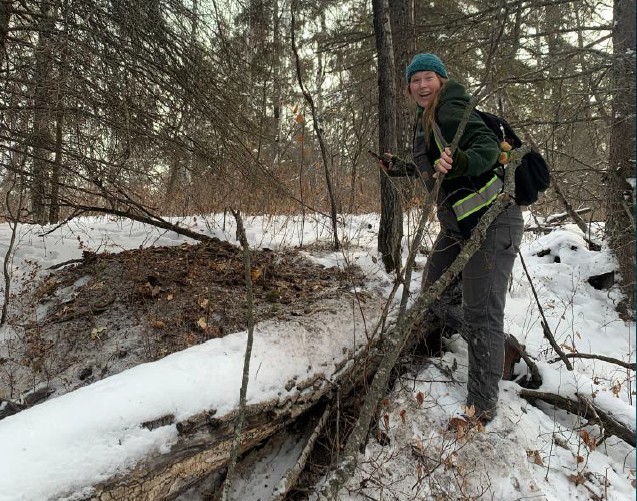
Photo : courtesy of Meghan Heistad
To help address this gap, Heistad's applied research project titled "Exploring Urban Coyote Ecology in Red Deer, Alberta" is helping The City of Red Deer better understand where coyotes raise their pups, how they navigate urban environments and how community members can live alongside them responsibly.
Heistad's research, performed in collaboration with Sandra MacDougall, RDP Biology instructor and Principal Investigator, began by analyzing wildlife camera data collected from some of Red Deer's green spaces. Heistad noticed that two locations showed high coyote activity during the spring and summer months. While coyotes generally try to avoid humans, urban coyotes tend to be braver and more willing to explore.
"I found two locations that had a higher number of observations," explains Heistad, who recently completed her Bachelor of Science in Biological Sciences Degree. "That suggested to me that coyote dens may be in that area, as they use their dens during gestation and pup-rearing seasons."
Using this information, along with data provided by The City of Red Deer, Heistad set out to locate dens in person. Once she found them, she recorded detailed characteristics such as entrance dimensions and slope, the number of openings, surrounding vegetation and soil conditions. Heistad then created a full Geographic Information Systems (GIS) map of den locations and analyzed their proximity to buildings, roads, pathways and water.
Her findings reveal patterns in how coyotes choose den sites. They tend to avoid buildings and busy roads and select areas close to water. Heistad also noticed differences in the direction dens open in Red Deer compared to those in Edmonton. While Edmonton dens often face east, Red Deer dens in her sample tended to face northwest or northeast. She speculates wind patterns may play a role.
"The prevailing winds were coming from the southwest," she says. "It appears that the coyotes didn't prefer to have their dens face that way to prevent the wind from blowing in."
One of the most surprising discoveries surfaced from a wildlife camera placed near an active den. Although past research suggests dens are used from March through August, Heistad's footage showed activity as early as January 9. Tracks and freshly excavated soil indicated that coyotes may have used the site even earlier.
Her research brings immediate value to the community. The map of den locations will be shared with The City of Red Deer, which currently has limited data on where dens are located.
This information can help The City implement more proactive strategies, such as signage, public education and promoting safe coexistence practices. Heistad is passionate about helping residents understand how to live safely alongside coyotes.
"I really think that cohabitation with this intelligent species in the city is possible," she explains.
Heistad identifies the value of using hazing techniques, which include making noise, appearing large or throwing objects near coyotes to discourage them from approaching people. She also emphasizes simple preventative measures such as securing garbage and keeping pets leashed.
The project will continue into fall, when Heistad plans to search for additional dens, conduct vegetation surveys, collect soil samples and check whether dens were reused this season. She will also mentor new students who join the project.
"There's definitely opportunities for future RDP students to get involved and grow the project," she says. Heistad credits the small class sizes in the Polytechnic's Bachelor of Science in Biological Sciences program and supportive instructors for giving her the chance to pursue meaningful research.
"All of the instructors I've had at RDP are great," expresses Heistad. "I've had a lot of opportunities to conduct research projects that I might not have had at larger institutions."
After graduating in June 2026, Heistad hopes to continue working in wildlife biology. Her work is already contributing to a deeper understanding of how coyotes live in urban environments and how communities like Red Deer can coexist with them safely.
For more information about research and innovation at RDP, visit: rdpolytech.ca/innovation.