New research published in Nature Communications shows that lakes sweat off heat to fight the effects of climate warming but this is not necessarily good news.
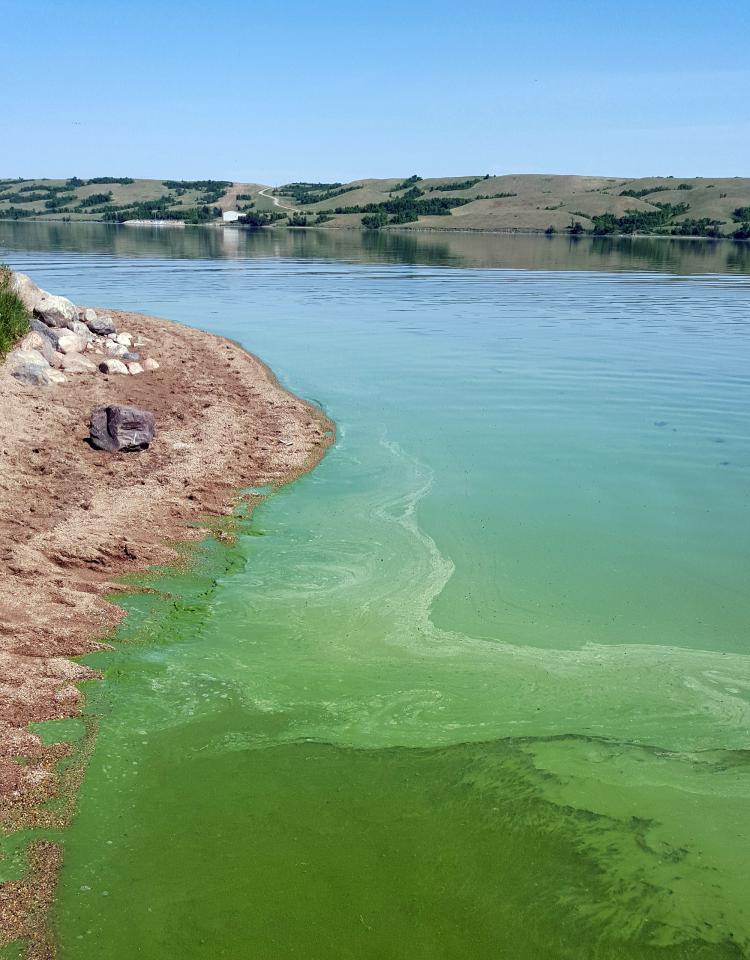
Buffalo Pound Lake in the Qu'Appelle River Watershed in southern Saskatchewan. Buffalo Pound is the drinking water reservoir of the cities of Regina and Moose Jaw.
Photo: Deirdre Bateson
As the atmosphere warms up, so do most freshwater lakes. However, some lakes seem to be more resistant to warming. As temperatures, increase lakes start to lose water by evaporation and this acts to cool them off. Much like people sweat to cool off, lakes sweat' by evaporating water to get rid of excess heat.
Dr. Peter Leavitt is a Canada Research Chair in Environmental Change and Society and the co-director of the University of Regina's Institute of Environmental Change and Society. He is a co-author on the study.
"But this isn't actually great news. While lakes can cool themselves for a period of time by sweating - which protects biodiversity in lakes, recreational fishing, and some aspects of water quality - it's a short-term measure because those same lakes are losing water and will eventually dry out and disappear."
The researchers also discovered that remote, deep lakes, especially those at high elevation and far from human activity, are actually more sensitive to climate change.
"Our study shows that greener, more polluted lakes don't respond to global warming as much as clear lakes, because they are already damaged by human activities in the surrounding landscape." says Leavitt. "Too many nutrients from land results in green surface waters that act as a shade, keeping the deep waters cool.
"Clear lakes aren't already damaged by human activities, so they more readily respond to human-caused atmospheric warming," said Dr. Jian Zhou, lead author on the study and a research scientist in the Nanjing Institute of Geography and Limnology at the Chinese Academy of Sciences. "Once lakes become green, they are less affected by warming, but are already damaged by nutrient pollution - basically, they can't win."
The research team's work clearly shows that one-size-fits-all responses to global warming and land-use change won't work.
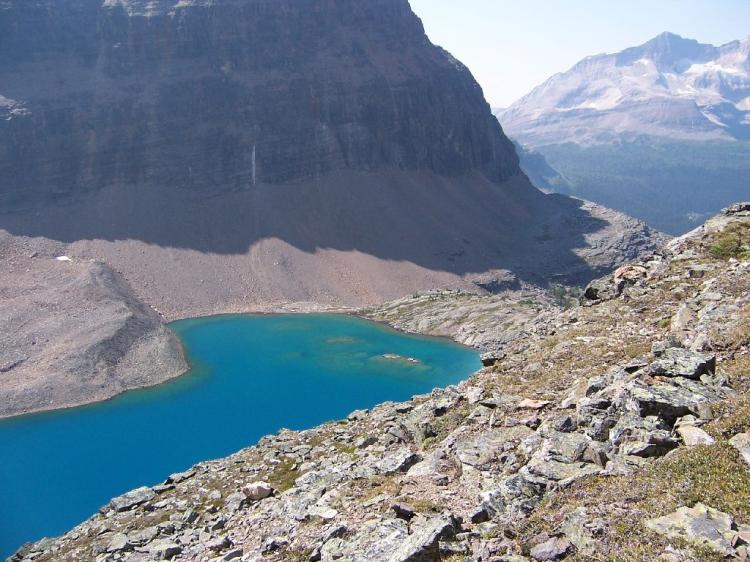
Clear, freshwater lake in Yoho National Park in the Canadian Rocky Mountains.
Photo: Dr. Everett Fee
"Our lake management practices need to consider where lakes are, what they are surrounded by, and how sensitive they might be to unique and interactive effects of climate change and human activities," said Zhou.
Researchers sampled 345 lakes distributed across twelve countries, primarily in the United States and Europe, for the Controls of thermal response of temperate lakes to atmospheric warming study. Eighteen Canadian lakes were sampled, including six of Saskatchewan's Qu'Appelle Lakes, which were sampled by the U of R's Institute of Environmental Change and Society (IECS) as part of a 30-year long Qu'Appelle Long-Term Ecological Research program.